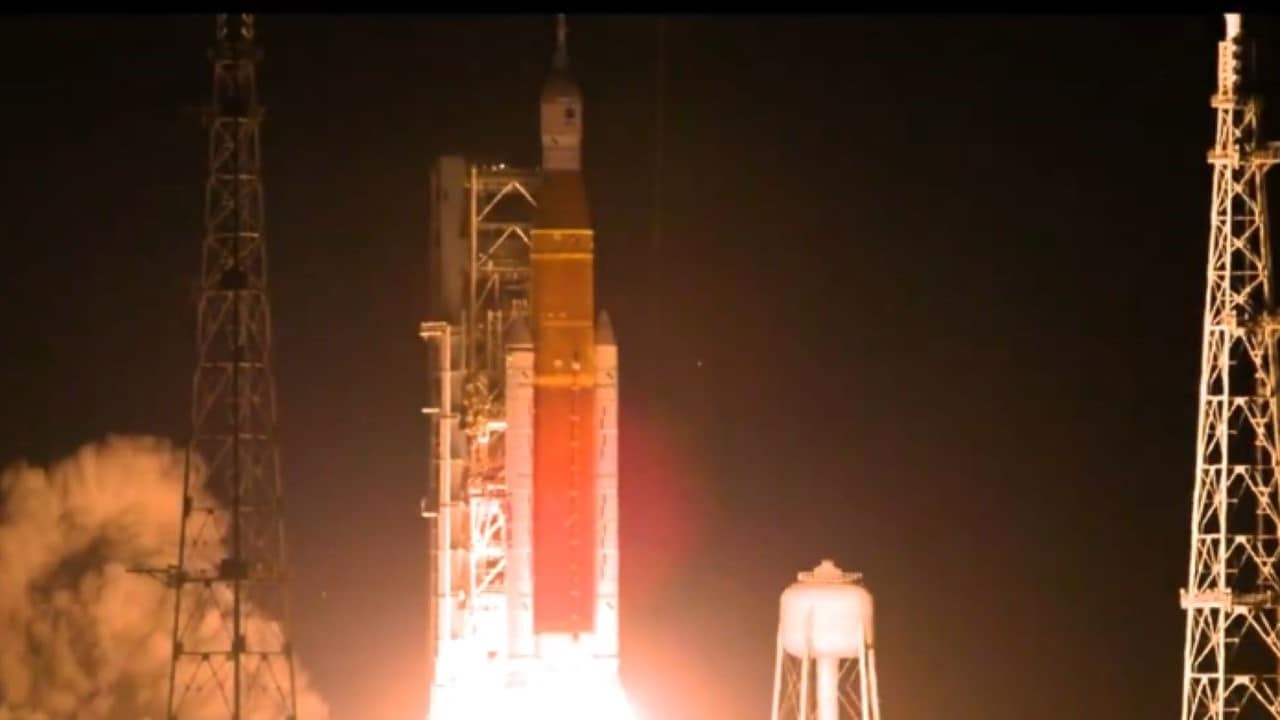
The roar wasn't just loud. It was historical. When the Space Launch System (SLS) engines ignited at Kennedy Space Center, it felt like the entire Florida coast took a collective breath. Artemis II is finally in the air. This isn't just another satellite deployment or a cargo run to the International Space Station. We just watched four humans leave Earth's immediate orbit for the first time in over fifty years. If you think this is just a repeat of the Apollo era, you're missing the point entirely.
Artemis II is the bridge. It's the stress test for the hardware that will eventually put boots on Mars. Most people focus on the fire and the smoke of the launch, but the real story is what happens now that they're up there. Reid Wiseman, Victor Glover, Christina Koch, and Jeremy Hansen aren't just passengers. They're test pilots in a high-stakes environment where "good enough" doesn't exist.
Why Artemis II is the most critical mission of our decade
The SLS rocket is a beast. It's the only vehicle on the planet currently capable of sending the Orion spacecraft, its crew, and supplies to the Moon in a single launch. We've seen private companies make massive strides in low Earth orbit, but deep space is a different animal. The radiation is harsher. The distances are unforgiving. There's no quick "abort and come home in three hours" option once you commit to a lunar trajectory.
This mission is a 10-day flight test. It's designed to prove that Orion's life-support systems can keep humans alive and healthy while navigating around the far side of the Moon. Think about the complexity. You're balancing oxygen levels, scrubbing carbon dioxide, and managing internal temperatures while moving at thousands of miles per hour through a vacuum. If a single pump fails or a software bug crops up, these four people are the ones who have to fix it in real-time.
NASA didn't just build a rocket; they built a survival pod. The Orion capsule has more habitable volume than the old Apollo modules, which is a relief because being cramped for ten days is a recipe for psychological friction. But the tech under the hood is what actually matters. We’re talking about advanced heat shields that have to survive $5,000^{\circ}F$ upon reentry.
The crews perspective on the lunar flyby
You have to look at who is sitting in those seats. Victor Glover is the first person of color on a lunar mission. Christina Koch is the first woman. Jeremy Hansen is the first non-American. This isn't just about diversity checklists. It’s about the fact that the best of the best from across the globe are finally working on a singular goal again.
During the initial phase of the mission, the crew will stay in a high Earth orbit. They'll use this time to test the spacecraft's handling. It's basically a checkout period. They want to make sure the proximity operations—moving the ship around and testing manual controls—work exactly as the simulations predicted. Only after every green light is lit will they perform the Trans-Lunar Injection. That’s the "big push" that sends them toward the Moon.
Once they leave Earth's orbit, they're on a free-return trajectory. This is a brilliant piece of orbital mechanics. They aren't orbiting the Moon; they’re swinging around it. The Moon’s gravity will naturally pull them back toward Earth. It’s a safety-first approach. If the engines fail after the initial burn, the laws of physics will literally pull them home.
The tech that makes this different from Apollo
People love to ask why it took us so long to go back. The answer is usually money or politics, but the technical answer is that we aren't going back the same way. Apollo was a sprint. Artemis is about staying.
- Navigation systems: Apollo astronauts used star charts and rudimentary computers. Orion uses high-tech optical navigation that can determine its position by looking at the Earth and Moon autonomously.
- Communication: We aren't relying on grainy black-and-white signals. The Deep Space Network is handling massive data loads, allowing for high-definition video and constant telemetry updates.
- Safety backups: The SLS has an abort system that can pull the capsule away from the rocket at any point during the climb. It’s significantly more sophisticated than anything flown in the 1960s.
The heat shield is also a major talking point. During the Artemis I uncrewed mission, NASA noticed some unexpected "charring" patterns. They spent months analyzing that data to ensure the Artemis II shield was perfect. This is how science works. You fly, you find the flaws, and you fix them before you put people on top of the fuel tank.
Dealing with deep space radiation
This is the bogeyman of space travel. Once you leave the protection of Earth's Van Allen belts, you're exposed to solar flares and cosmic rays. For a ten-day mission, the risk is manageable, but it’s still a massive concern. The Orion capsule is built with shielding, and the crew has specific protocols for "sheltering in place" inside the most protected part of the ship if a solar event occurs.
Monitoring their health during this trip provides the data needed for the Artemis III landing and the eventual construction of the Gateway—a mini-space station that will orbit the Moon. We need to know exactly how the human body reacts to this environment before we start asking people to live there for months at a time.
What happens when they get back
The mission doesn't end when they round the Moon. The reentry is arguably the most dangerous part. They’ll hit the atmosphere at roughly 25,000 miles per hour. That’s fast. Faster than anything coming back from the International Space Station. The friction turns the air around the capsule into plasma.
When those parachutes deploy over the Pacific Ocean, it marks the start of a new era. Recovery teams from the U.S. Navy are already stationed and waiting. The goal is a "front-porch" recovery where the crew is whisked away almost immediately. This isn't just about getting them out; it's about studying their physical condition the second they feel gravity again.
The missed details in the mainstream hype
Most news outlets are talking about the "spectacle." I want to talk about the logistics. This launch used Pad 39B, the same historic site used for Apollo and the Space Shuttle. But the infrastructure is all new. The mobile launcher alone is a marvel of engineering, standing over 300 feet tall and designed to withstand the acoustic energy of the SLS liftoff.
There's also the fuel. We're using super-cooled liquid hydrogen and liquid oxygen. It's notoriously difficult to work with. We saw "scrubs" during the Artemis I attempts because of tiny leaks. The fact that Artemis II got off the ground shows that the ground teams have finally mastered the temperamental nature of this rocket. It’s a victory for the engineers as much as the astronauts.
Moving toward a permanent lunar presence
If you're wondering what you should do now that the mission is underway, start looking at the maps of the lunar South Pole. That’s where we’re heading next. Artemis II is the proof of concept for the orbital path. Artemis III will be the one that actually touches down near the craters that hold water ice.
Keep an eye on the mission updates regarding the "Optical Communications" experiment. They’re testing laser-based communication that could revolutionize how we get data back from deep space. Instead of slow radio waves, we’re looking at gigabit-level speeds from the Moon.
Don't just watch the highlights on the evening news. Follow the live telemetry feeds if you can. Seeing the distance from Earth increase in real-time gives you a sense of scale that no photo can replicate. We're witnessing the moment humanity stops being a single-planet species. It's happening right now.
Get familiar with the names of the crew. In twenty years, they’ll be in the history books alongside Armstrong and Aldrin. The mission is far from over, but the hardest part—leaving the ground—is behind them. Now, we watch them dance with the Moon.