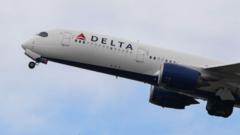
The recent hospitalization of three flight attendants following a Delta Air Lines flight from Los Angeles to Sydney underscores a critical vulnerability in modern aviation: the intersection of high-velocity atmospheric shifts and the physiological limits of unrestrained cabin occupants during the terminal descent phase. While the incident is often characterized by the media as a freak weather event, a structural analysis reveals it as a predictable consequence of specific meteorological variables interacting with standardized airline operational protocols.
Effective risk management in commercial aviation requires moving beyond the "turbulence" label to identify the specific mechanical forces at play. This incident highlights the failure of existing mitigation strategies when faced with rapid-onset convective activity or clear-air turbulence (CAT) during the transition from cruise altitude to the landing configuration.
The Physics of Vertical Acceleration and Cabin Trauma
The injury of crew members during descent is rarely a product of horizontal buffeting. It is almost exclusively a result of vertical acceleration ($a_z$) exceeding the gravitational constant ($g$). When an aircraft encounters a powerful downdraft or a sudden loss of lift, the airframe drops faster than the occupants who are not mechanically coupled to the seat.
The Coupling Variable
The primary determinant of injury severity is the "coupling status" of the individual. Passengers are generally required to be seated with belts fastened during descent, creating a singular mass with the aircraft. Flight attendants, conversely, are often in the "service stowage" or "cabin readiness" phase. This creates a decoupled state. When the aircraft undergoes a negative G-load, the decoupled occupant remains at their previous inertial vector, effectively "falling" into the ceiling of the cabin before being struck by the floor as the aircraft recovers its flight path.
The Delta 41 Velocity Profile
On the Los Angeles to Sydney route, aircraft transition from the high-altitude jet stream into the complex maritime boundary layer of the Tasman Sea. The descent into Sydney (SYD) often involves navigating the "Southerly Buster," a powerful cold front that creates intense vertical shear. When an Airbus A350 or Boeing 777-300ER—the typical workhorses for this ultra-long-haul route—descends through these shear layers, the wing's angle of attack can change instantaneously.
- The Lift Equation Shift: As the vertical component of wind velocity changes, the effective airspeed over the wing fluctuates.
- Induced Load Factor: A sudden increase in upward wind velocity increases the load factor. If the autopilot or pilot corrects aggressively, or if the gust disappears as quickly as it arrived, the resulting "snap" back to equilibrium produces the high-magnitude vertical displacements responsible for slamming crew members against the overhead bins.
The Three Pillars of In-Flight Risk Exposure
To quantify the risk of these events, we must look at the three-part framework that dictates the safety margin of any given flight.
1. The Predictive Accuracy Gap
Current cockpit technology relies on Pulse-Doppler weather radar. While excellent at detecting precipitation (hydrometeors), it is largely blind to Clear-Air Turbulence (CAT). CAT occurs in "dry" air where there are no water droplets to reflect radar waves. This leaves pilots relying on:
- PIREPs (Pilot Reports): Subjective data from aircraft ahead on the same track.
- SIGMETs (Significant Meteorological Information): Broad geographic warnings that often lack the temporal resolution to predict a specific 30-second window of instability.
The Delta incident likely occurred in a "blind spot" where the atmospheric energy was not yet converted into detectable moisture-based signatures.
2. The Occupational Vulnerability Window
There is a fundamental tension between safety and the service-delivery model. In the final 30 to 45 minutes of a 15-hour flight, the cabin crew is at their highest level of physical activity. They are securing the cabin, collecting remaining service items, and ensuring passenger compliance.
The "Cost of Compliance" in this scenario is high. If a captain calls for "Flight attendants, take your seats" too early, service standards drop and cabin readiness is delayed. If they call it too late, the crew is caught in the aisles during the most turbulent layers of the atmosphere (typically between 10,000 and 20,000 feet where thermal mixing is most violent).
3. Structural Rigidity vs. Human Fragility
Modern composite aircraft, like the A350 used in many trans-Pacific routes, are designed to flex. This aeroelasticity is a safety feature for the airframe, absorbing energy that would otherwise cause structural failure. However, this flex does not mitigate the "jolt" felt by the occupants. In fact, the dampening characteristics of composite wings can sometimes mask the early harmonic vibrations that would otherwise serve as a tactile warning to crew members to grab a fixed handle.
The Causality Chain of the Sydney Incident
Reconstructing the logic of the Sydney descent suggests a convergence of three specific failures:
- Thermal Gradients: The transition from the warm, stable Pacific air to the volatile coastal air near New South Wales creates a density altitude shift.
- Inertial Lag: Flight 41, being an ultra-long-haul, arrives at its destination at a significantly lower weight than at takeoff. A "light" aircraft is more susceptible to vertical accelerations from gusts than a "heavy" one, as the same force ($F$) acting on a smaller mass ($m$) results in higher acceleration ($a$), following $F = ma$.
- The Descent Gradient: To meet noise abatement or air traffic control (ATC) requirements, aircraft often utilize a "Continuous Descent Approach." This keeps engines at low thrust, reducing the pilot's immediate "thrust-to-climb" authority to stabilize the aircraft if a sudden sink rate is encountered.
Operational Limitations of Current Safety Protocols
The aviation industry currently operates on a reactive safety model regarding turbulence. This model has three primary limitations that the Delta incident exposes.
The Subjectivity of "Severe"
Turbulence is categorized as Light, Moderate, Severe, or Extreme. These definitions are based on the aircraft's reaction, not the atmospheric force.
- Moderate: Occupants feel definite strains against seatbelts; unsecured objects are tossed about.
- Severe: Aircraft may be momentarily out of control; occupants are thrown violently against belts.
The Delta incident was classified as severe because the crew was hospitalized. However, the same atmospheric force might be classified as "moderate" if all crew had been seated. This circular definition prevents accurate data modeling because the "severity" is linked to the outcome rather than the meteorological input.
The Communication Bottleneck
When a pilot sees an upcoming cell on the radar, the communication chain is:Radar -> Pilot Brain -> Intercom -> Crew Ear -> Physical Movement to Seat.
In a descent scenario, where airspeeds are high (often near 250-300 knots), the aircraft can cover the distance of a radar-identified cell in seconds. The lag in this human-in-the-loop system is often greater than the time to impact.
The Economic and Strategic Imperative of Turbulence Mitigation
The Delta incident is not merely a medical or safety issue; it is an operational cost center. The diversion of resources, potential hull inspections, crew medical leave, and the "brand tax" of negative headlines create a measurable drain on the carrier's bottom line.
The Cost Function of Cabin Injuries
The total cost ($C_t$) of a turbulence-related injury event can be modeled as:
$$C_t = M + L + R + D$$
Where:
- $M$ = Immediate medical and emergency response costs.
- $L$ = Long-term liability and disability payouts.
- $R$ = Regulatory investigation and reporting overhead.
- $D$ = Operational disruption (flight delays, crew rescheduling).
Airlines that fail to invest in predictive LiDAR (Light Detection and Ranging) systems, which can detect CAT by measuring the backscatter of aerosol particles using lasers, are effectively self-insuring against an unpredictable and rising cost.
Climate Change and the "New Normal"
Recent atmospheric research indicates that the vertical wind shear in the jet stream is increasing due to the widening temperature gap between the troposphere and the stratosphere. This suggests that the frequency of "severe" encounters on trans-Pacific routes will increase by 40% to 170% by 2050. Carriers like Delta, Qantas, and United must decide whether to accept these hospitalizations as "acts of God" or re-engineer the descent phase.
Strategic Reconfiguration of the Descent Phase
To move beyond the current plateau of cabin safety, the following structural changes are required:
Automation of the "Fasten Seatbelt" Trigger
Relying on pilot intuition for the seatbelt sign is an antiquated 20th-century protocol. Integration of real-time vertical accelerometer data from aircraft currently in the terminal maneuver area (TMA) should automatically trigger seatbelt alerts across the fleet via a centralized "atmospheric map." If one aircraft hits a 0.5G vertical shift, every trailing aircraft's seatbelt sign should be force-activated by the flight management system (FMS) before the pilot even perceives the threat.
Redefining the "Clean Cabin" Deadline
Airlines must mathematically determine the "Point of No Return" for cabin service. On the LAX-SYD route, the descent typically begins 120-150 miles out. Data suggests the most violent mixing occurs below 24,000 feet. A mandated "All Crew Seated" policy at 25,000 feet, regardless of the perceived smoothness of the air, would eliminate the decoupling risk during the high-energy descent phase.
Implementation of LiDAR and Improved Avionics
While expensive, the installation of forward-looking LiDAR provides a 60-to-90-second warning for CAT. In the context of the Delta incident, a 60-second lead time would have been the difference between flight attendants being in the aisle and being strapped into their jumpseats.
The Sydney incident serves as a data point in a broader trend of atmospheric volatility. The aviation industry's current reliance on "reaction to sensation" is no longer a viable strategy for long-haul carriers. Precision in predicting vertical acceleration, combined with a rigid, data-driven "seated" policy, is the only path to reducing the injury rate in the terminal descent phase.
Airlines must now prioritize the deployment of algorithmic turbulence forecasting integrated directly into the Electronic Flight Bag (EFB), providing pilots with a "heat map" of vertical shear rather than a vague verbal report from a pilot ten minutes ahead of them. This shift from qualitative to quantitative safety management is the necessary evolution for trans-oceanic operations.