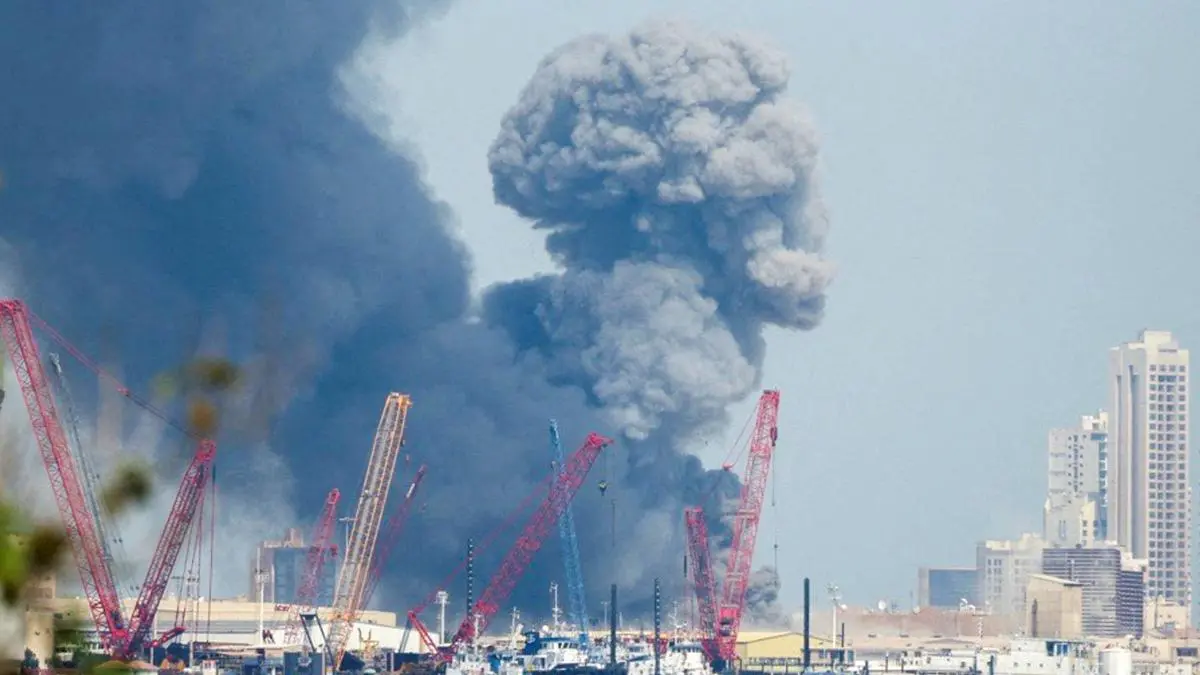
The plume of smoke rising from the outskirts of Manama was not supposed to happen. For years, the narrative surrounding the security of the Persian Gulf has rested on a specific, expensive promise: a multi-layered shield of American-made interceptors capable of scrubbing the sky clean of threats. But when a massive blast rocked a Bahraini industrial site, the immediate silence from official channels spoke louder than the explosion itself. Evidence now points to a catastrophic malfunction of a Patriot missile system, likely under the direct operational control of United States forces stationed at the sprawling Naval Support Activity Bahrain.
This was not a successful intercept. It was a failure of the very hardware meant to prevent such optics.
When a MIM-104 Patriot missile exits its canister, it does so with a violent expenditure of kinetic energy. If the solid-fuel rocket motor fails or the guidance system suffers a "logic flip" shortly after launch, the result is a massive, unguided firebrand falling back to earth. Investigative analysis of debris patterns and thermal signatures from the Bahrain incident suggests this exact scenario. While the Pentagon remains tight-lipped, the presence of specific component serial numbers and the lack of a declared "incoming" target from regional adversaries like the Houthis or Iranian-backed militias point to a grim reality. This was a technical mishap during a period of heightened readiness, and the fallout reveals a crumbling facade of regional invulnerability.
The Ghost in the Integrated Air Defense System
Air defense is a game of probabilities, not certainties. The public is often led to believe that systems like the Patriot or the newer THAAD batteries provide a 100% "no-fly" guarantee. This is a myth. In the high-stress environment of the Gulf, where heat, humidity, and constant electronic warfare interference degrade sensitive hardware, the failure rate of interceptors is a closely guarded secret.
The Bahrain incident highlights the "How" of such a failure. To understand why a missile would strike its own host territory, one must look at the engagement logic of the Patriot’s AN/MPQ-65 radar set. These systems are increasingly automated. When a radar "ghost"—a false positive caused by atmospheric conditions or interference—is interpreted as a threat, the system can initiate a launch sequence. If the missile's seeker fails to acquire a target once it’s in the air, a self-destruct command is supposed to trigger. When that fails, the missile becomes a several-thousand-pound ballistic lawn dart.
The U.S. operates these batteries in Bahrain to protect the 5th Fleet. Unlike local forces, American crews operate under a distinct chain of command and often utilize more advanced, restricted software versions of the Patriot Advanced Capability-3 (PAC-3) interceptors. If a US-operated battery failed, it suggests that even the most well-maintained and "current" iterations of this technology are vulnerable to the harsh realities of the desert environment and the complexity of modern sensors.
The Cost of the Invisible War
We are currently witnessing an unprecedented arms race in the Middle East, but it isn't just about who has the most planes. It’s about the electronic spectrum. The blast in Bahrain occurred amidst a backdrop of intense GPS jamming and "spoofing" across the region. While mainstream reports focus on physical missiles, the real war is happening in the frequencies used by guidance systems to tell up from down.
Bahrain sits at the heart of this electronic crossfire. It is entirely plausible that the "mishap" was triggered by a defensive system reacting to a phantom threat created by electronic warfare. If an interceptor is launched against a non-existent target, the probability of a "controlled" failure drops significantly. This raises a terrifying prospect for the residents of the Gulf. If the systems meant to protect them can be tricked into firing at nothing, the protector becomes a threat as dangerous as the aggressor.
The financial stakes are equally staggering. A single PAC-3 interceptor costs roughly $4 million. When one of these units fails and destroys local infrastructure, the bill isn't just the price of the missile; it’s the erosion of trust in the American security umbrella. Neighbors like Saudi Arabia and the UAE are watching. They have spent billions on these same systems. If the U.S. can't keep its own hardware from falling out of the sky over a friendly port, the sales pitch for "integrated defense" starts to look like a liability.
Accountability in the Age of Plausible Deniability
The standard operating procedure for the Department of Defense in these instances is "strategic ambiguity." By neither confirming nor denying the origin of the missile, the U.S. avoids legal liability for damages and prevents a public relations nightmare regarding the reliability of its premier export. However, the lack of a clear explanation creates a vacuum filled by conspiracy and legitimate fear.
Wait for the official report, and you will wait forever. The military classifies "accidental discharges" involving sensitive technology to protect "sources and methods." But in a dense urban and industrial environment like Bahrain, you cannot hide a falling skyscraper-sized rocket. Local witnesses reported a specific whistling sound—the unmistakable acoustic signature of a high-velocity projectile—followed by a secondary explosion that suggests the warhead remained intact until impact.
The technical reality is that the Patriot system is aging. Despite numerous "Block" upgrades, the core architecture dates back to the Cold War. It was designed to hit Soviet bombers and Scuds in the empty plains of Europe, not to navigate the cluttered, electronically dense environment of a modern 21st-century flashpoint.
The Hardware Trap
The obsession with "hard" defense solutions has led to a technological trap. We have built systems so sensitive that they are prone to overreacting. In Bahrain, the proximity of civilian air traffic to military zones creates a nightmare for radar operators. The "clutter" on a screen in Manama is a hundred times more complex than a test range in White Sands, New Mexico.
Consider the physical mechanics of the PAC-3. It uses "hit-to-kill" technology. It does not have a large explosive proximity fuse; it is designed to ram into its target at Mach 4. When such a weapon misses—or when there is no target to hit—it retains its massive kinetic energy until it finds a stopping point. On that day in Bahrain, the stopping point was the ground.
Beyond the Blast Radius
This incident should serve as a wake-up call for the diplomatic corps. Security cannot be outsourced entirely to automated machines. The reliance on "black box" technology, where even the host nation doesn't fully understand the logic of the weapons on its soil, creates a dangerous sovereignty gap. Bahrain hosts the U.S. Navy, but it seems it also hosts the risk of U.S. technical malfunctions with zero recourse.
The blast was a physical manifestation of a systemic glitch. It wasn't just a missile failing; it was the failure of the idea that technology can provide a perfect shield without a cost. As long as the U.S. maintains its posture of silence, it signals to its allies that they are expected to absorb the "collateral damage" of American technical errors.
The debris has been cleared, and the charred earth has likely been paved over by now. But the questions remain. If a Patriot missile can fall on an industrial zone during a time of relative "peace," what happens when the sensors are truly overwhelmed during a multi-front conflict? The answer lies in the blackened remains of the Bahraini site.
Investigate the shipping manifests and the radar logs from that afternoon. You will find a gap in the data that matches the timing of the explosion. That gap is where the truth lives.
Check the tail fin markings of the next "unexplained" wreckage in the region.