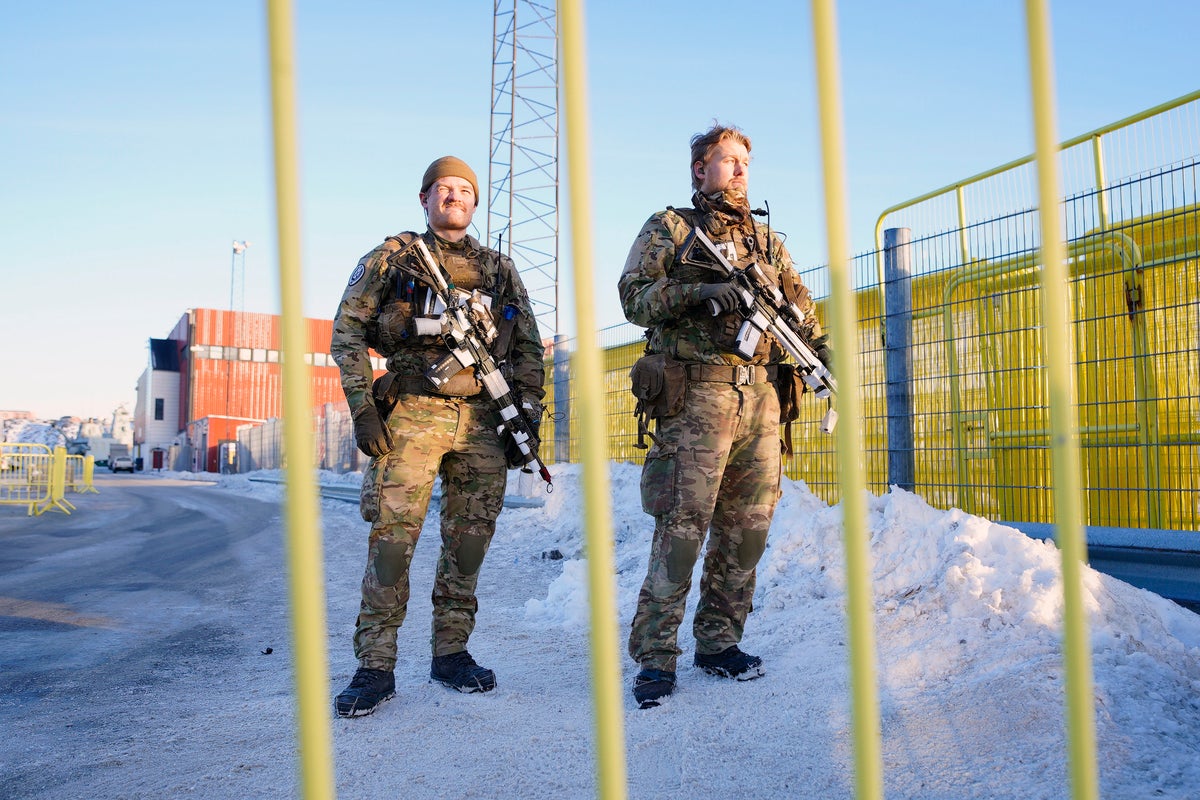
The wind in Kangerlussuaq doesn't just blow. It carves. It is a physical weight that strips the heat from your bones before you even realize you’ve stepped out of the pressurized safety of a transport plane. For decades, this vast, white expanse was a place of scientific curiosity and quiet sovereignty. But lately, the air smells different. It smells of diesel, ozone, and a specific kind of clinical readiness that belongs in a trauma ward, not a tundra.
Denmark is quietly moving. Not with the loud, chest-thumping bravado of a superpower, but with the frantic, precise movements of a homeowner who just noticed the deadbolt on the front door has been tampered with.
The crates arriving on the darkened tarmacs aren't filled with research equipment or arctic trekking gear. They are packed with explosives. They are stacked with vacuum-sealed blood bags. When a military begins stockpiling the means to take life and the means to desperately preserve it in the same shipment, the conversation about "regional stability" has officially ended. A new, grimmer chapter has begun.
The Ghost in the Permafrost
To understand why a peaceful Nordic nation is suddenly obsessed with surgical sterility and high-grade munitions in the middle of a wasteland, you have to look at the map through the eyes of a strategist in Washington or Moscow. For a long time, Greenland was a frozen shield. It was too difficult to traverse, too expensive to occupy, and too remote to matter beyond a few radar pings.
Climate change changed the math. As the ice retreats, the treasures beneath—rare earth minerals, gold, and untapped oil—are becoming reachable. More importantly, the sea lanes are opening. What used to be a dead-end street is becoming a global highway.
The Danish government is staring at a terrifying paradox. They are the official guardians of this land, yet they are dwarfed by the sheer scale of the interests now circling it. There is a lingering, unspoken fear that has haunted the halls of Copenhagen for years: the American shadow. It isn’t an "invasion" in the cinematic sense—no paratroopers dropping onto the ice cap—but a slow, gravitational pull of "security interests" that could eventually make Danish sovereignty an inconvenient footnote.
The Anatomy of a Blood Bag
Imagine a young Danish conscript named Erik. He is twenty-one, from a quiet suburb in Aarhus, and he has just been deployed to a remote station where the sun doesn't rise for months. He isn't there to fight a war he understands. He is there to maintain a presence.
When Erik sees those crates of blood bags being moved into refrigerated storage, the reality of his situation shifts. A blood bag is a countdown. It has a shelf life. It is a biological promise that someone expects a body to be torn open. You don't ship thousands of units of O-negative to a frozen desert unless you have run the simulations and seen the casualties.
The explosives tell the other half of the story. They aren't for mining. They are for denial. In military terms, "area denial" is the polite way of saying: If we can't have this, no one will. They are there to blow the runways, to collapse the tunnels, and to ensure that any infrastructure remains useless to an advancing force.
The presence of these supplies reveals a deep-seated anxiety about the reliability of old alliances. For seventy years, the logic was simple: the U.S. protects Greenland because it’s in their backyard. But what happens when the neighbor decides they don't just want to guard the fence, but own the yard?
The Weight of the Invisible Stake
There is a specific kind of silence in Greenland that is louder than any city noise. It’s the sound of a world that doesn't care if you live or die. When you add the tension of a geopolitical tug-of-war to that silence, it becomes suffocating.
The Danish military isn't just importing hardware; they are importing a psychological deterrent. They are signaling to the world—and specifically to the two giants looming over the North Pole—that Greenland is not a vacuum. It is occupied. It is defended. And it is ready to bleed.
The tragedy of the situation lies in the local perspective. For the Inuit population, these geopolitical maneuvers are often just more flashes of light in a sky they’ve navigated for millennia. They watch the crates arrive. They see the soldiers with their cold-weather gear and their grim expressions. To them, the "invasion" isn't a future threat; it’s a century-long process of being caught between the gears of larger machines.
The Calculus of Fear
Why now? Why this sudden urgency to fortify a land that has been "safe" since the Cold War?
Consider the fragility of the modern supply chain. In a high-intensity conflict, you cannot wait for a shipment from Copenhagen. The Atlantic is wide, and in a crisis, it will be hunted. If a skirmish breaks out over a newly revealed lithium deposit or a strategic deep-water port, the forces on the ground have what they have, and nothing more.
The blood bags represent the realization that help is not coming.
Denmark is operating on the grim assumption that they may have to hold the line alone, at least for the first critical hours or days. It is a David and Goliath scenario, except David is shivering in a parka and Goliath has a fleet of nuclear icebreakers and a trillion-dollar appetite.
The technology being deployed isn't just about guns. It’s about the infrastructure of survival. Sophisticated sensors are being threaded through the ice like a nervous system. They are designed to hear the heartbeat of a submarine or the vibration of a distant tread. All of this data feeds back to a central command that is increasingly aware of how vulnerable they truly are.
A Sovereignty Written in Red
We often think of borders as lines on a map, fixed and certain. In reality, a border is only as real as the power used to enforce it. By moving these supplies, Denmark is trying to make their border "thick." They are trying to give it weight and consequence.
There is a subtle, biting irony here. The very nation that Denmark relies on for its broader security—the United States—is the same entity that triggers this defensive reflex. It is a marriage where one partner is starting to sleep with a knife under the pillow, not because they hate their spouse, but because they’ve realized their spouse is much, much stronger than them.
The stakes are invisible until they aren't. They are invisible until a sonar tech picks up a signature that shouldn't be there. They are invisible until a diplomat makes a "suggestion" about base access that sounds remarkably like a command.
Then, suddenly, the blood bags make sense.
The Cost of the Cold
Maintaining a military presence in the Arctic is a logistical nightmare that eats money and breaks machines. Metal becomes brittle. Electronics fail. Humans crack. The cost of just being there is astronomical. Yet, the Danish government has decided that the cost of leaving is higher.
If they pull back, they concede. If they stay, they risk being caught in the crossfire of a conflict that isn't theirs. It is a trapped move.
Every time a transport plane touches down in the Arctic twilight, the message is sent again. We are here. We are prepared for the worst. We have the explosives to break the ground and the blood to stain it. It is a haunting, lonely stance to take on the edge of the world.
As the ice continues to groan and crack, sliding into the warming sea, it reveals a landscape that was never meant to be a battlefield. But the crates are already in the warehouse. The sensors are already humming in the dark. The preparation for a war that no one wants, but everyone expects, is complete.
The ice doesn't care about sovereignty. It doesn't care about blood bags or explosives. It only knows how to melt, and in its wake, it is leaving a world that has forgotten how to be cold without being cruel.


