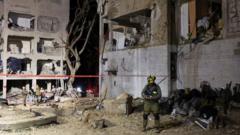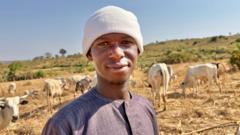
The sun does not rise in Plateau State so much as it bruises the sky. It arrives in shades of violet and deep, angry orange, illuminating a silence that feels fragile, like glass about to shatter. For Ibrahim, a Fulani herdsman, the morning begins with the low, rhythmic grunting of his cattle. For Bitrus, a Berom farmer only a few miles away, it begins with the metallic scrape of a hoe against soil that has grown increasingly stubborn.
They breathe the same air. They drink from the same shrinking streams. But they are trapped in a cycle of ghost-stories and gunfire that has claimed more lives in recent years than the insurgency in the northeast. This is not just a "conflict." It is an existential collision.
To understand why Nigeria’s Middle Belt is bleeding, you have to stop looking at maps and start looking at the grass.
The Shrinking World
Imagine a green carpet being slowly pulled out from under your feet.
In the north, the Sahara Desert is an advancing army. It moves south by miles every year, swallowing water holes and turning grazing lands into dust bowls. This is not a metaphor; it is a geographic strangulation. Ibrahim’s ancestors moved their herds with the seasons in a predictable dance, a symbiotic relationship where farmers welcomed the cattle because their manure fertilized the fallow fields.
That dance is over.
Climate change has turned a seasonal migration into a desperate, permanent scramble for survival. When the northern pastures turned to sand, millions of cattle and their herders pushed south. They arrived in the Middle Belt—Nigeria’s breadbasket—at the exact moment when the human population was exploding.
The math is brutal. More people. More crops. More cattle. Less land.
When a cow wanders into a field of maize, it isn't just eating a plant. It is eating Bitrus’s school fees for his children. It is eating the seed for next year’s harvest. When Bitrus, driven by a mix of fury and fear, strikes at the herd or blocks a traditional grazing route with a new fence, he isn't just protecting a farm. He is threatening Ibrahim’s entire heritage. To a Fulani man, a cow is not property. It is identity. It is a living bank account and a connection to a thousand years of history.
Kill the cow, and you kill the man’s reason for being.
The Identity Trap
If this were only about grass and water, we could solve it with irrigation and ranches. But humans are meaning-making animals. We take a resource scarcity and we wrap it in the flags of religion and ethnicity until the original cause is buried under layers of "us versus them."
In the Middle Belt, the lines are drawn with jagged precision. The herders are predominantly Muslim and Fulani. The farmers are largely Christian and belong to various ethnic groups like the Berom, Tiv, or Bachama.
Once the first drop of blood hits the soil, the narrative shifts. It stops being about a destroyed crop or a stolen calf. It becomes a "jihad" or a "cleansing." Local politicians, sensing an opportunity to galvanize their base, fan these flames. They use words like "invaders" and "infidels." They turn a struggle for calories into a struggle for the soul of the nation.
Consider a hypothetical village named Rim. In Rim, people used to trade milk for grain at the Saturday market. Then, a midnight raid happens. No one is quite sure who started it. Perhaps it was a group of cattle rustlers—criminal gangs who belong to no one but themselves—who stole a hundred head of cattle. The herders blame the villagers. The villagers blame the herders.
The next night, the sky over Rim turns red.
The retaliations are never proportional. They are exponential. A burned hut leads to a burned church. A killed bull leads to a massacred family. By the time the dust settles, the original dispute over a patch of clover is forgotten. All that remains is the debt of blood.
The Myth of the "Ancient" Enmity
We often hear that these groups have been fighting for centuries. It is a convenient lie. It allows the world to shrug and say, "That’s just how it is there."
The truth is far more uncomfortable. This level of carnage is a modern invention. It is the result of a total collapse of local mediation. In the past, traditional rulers and community elders sat under baobab trees and negotiated settlements. If a cow ate a crop, a price was set, paid, and life moved on.
Today, those traditional structures have been hollowed out. The police are often miles away, underfunded, or perceived as biased. When the law is a phantom, people reach for the AK-47.
The proliferation of small arms has turned a localized skirmish into a small-scale war. A machete is a terrible thing, but a rifle is a catastrophe. It allows for the "drive-by" massacre, the anonymous slaughter from the treeline that makes reconciliation impossible because there is no face to forgive.
The Invisible Stakes
Why does this matter to someone sitting in an office in Lagos, London, or New York?
Because Nigeria is the giant of Africa, and the Middle Belt is its heart. When the heart is torn, the body cannot stand.
The economic cost is staggering. Thousands of hectares of fertile land lie fallow because farmers are too terrified to plant. Cattle are undernourished because they are constantly on the move, fleeing retaliatory attacks. Food prices in the cities skyrocket.
But the deeper cost is the erosion of the Nigerian idea. If a country cannot guarantee that a man can plant a seed or herd a cow without being murdered, the social contract isn't just broken—it’s incinerated.
We see the statistics: "80 dead in latest Plateau clash." We read them and move on. But those 80 were not numbers. They were mothers who knew exactly how their children liked their yams cooked. They were young men who wanted to be engineers. They were old men who remembered when the rivers stayed full until July.
The Architecture of Peace
Peace is not the absence of cows or the absence of farms. It is the presence of justice.
There are moments of light, though they rarely make the headlines. In some communities, "peace Committees" have been formed where herders and farmers meet weekly. They exchange phone numbers. If a cow strays, the herder calls the farmer before the damage is done. If a stranger is seen lurking near the cattle, the farmer alerts the herder.
These are the heroes of the Middle Belt. Not the men with guns, but the men with phones and the courage to talk to the "enemy."
They are fighting an uphill battle. They are fighting against a changing climate that makes every gallon of water a potential battlefield. They are fighting against a political class that finds it easier to rule a divided people than to serve a united one.
The solution is clear, yet agonizingly difficult to implement. It requires a massive transition from nomadic herding to sedentary ranching—a shift that is not just logistical, but cultural. It requires land reform that respects ancestral claims while acknowledging modern realities. It requires a police force that serves the citizen, not the tribe.
Most of all, it requires a refusal to see the "other" as a monster.
The Last Light
As evening falls over the hills of Jos, the air cools rapidly. The Harmattan wind carries the scent of woodsmoke and dried dung.
Ibrahim settles his cattle near a rocky outcrop. He looks at the lights of the village in the distance. He wonders if they are watching him. He wonders if his son will ever be able to walk these hills without looking over his shoulder.
In the village, Bitrus cleans his tools. He looks at his empty granary and then at the darkening horizon. He doesn't want a war. He wants a harvest.
They are both tired. The land is tired. Even the stones seem weary of the weight of the bodies they have had to hold.
Peace here will not come from a signed treaty in a five-star hotel in Abuja. It will come when the man with the hoe and the man with the staff realize that they are both being drowned by the same rising tide of dust, and that the only way to stay afloat is to hold onto each other.
Until then, the bruised sky will continue to watch over a land where the most dangerous thing you can own is a dream of tomorrow.
Would you like me to develop a set of discussion points or a deep-dive analysis on the specific land-use policies that could bridge the gap between these communities?