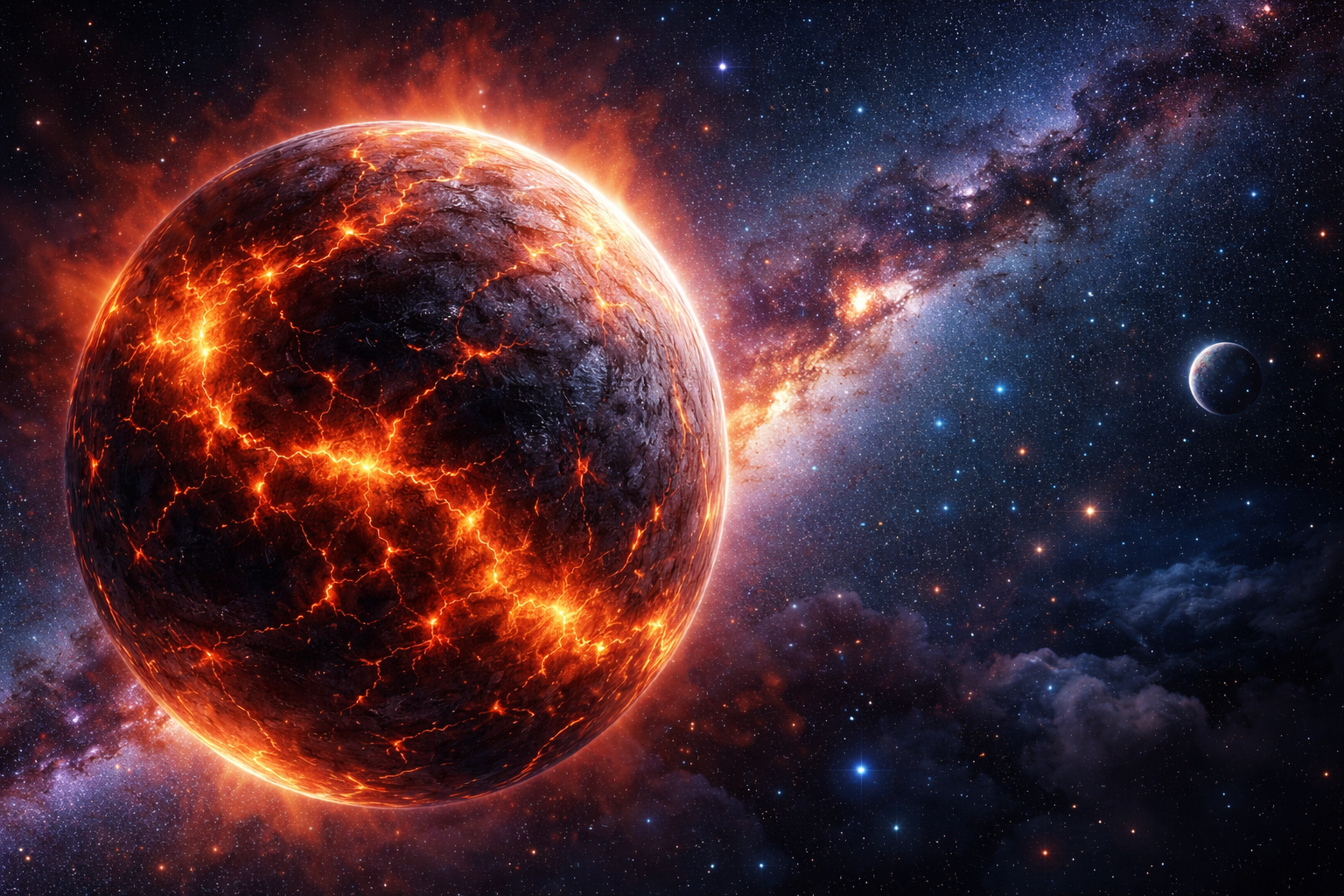
The detection of hydrogen sulfide in the atmosphere of the exoplanet HD 189733b represents a critical milestone in characterizing the chemical complexity of gas giants outside our solar system. While popular discourse focuses on the sensory experience of "rotten eggs," the strategic significance lies in the sulfur cycle's role as a tracer for planetary formation history and atmospheric evolution. This discovery, facilitated by the James Webb Space Telescope (JWST), provides the first empirical evidence of sulfur-bearing species in an exoplanetary atmosphere, offering a blueprint for understanding how heavy elements are distributed across the galaxy.
The Sulfur-to-Oxygen Ratio as a Formation Metric
The presence of hydrogen sulfide ($H_2S$) is not merely a chemical curiosity; it is a diagnostic tool for determining the "metallicity" of a planet—the abundance of elements heavier than hydrogen and helium. In the context of HD 189733b, a "Hot Jupiter" located 64 light-years away, sulfur serves as a proxy for the solids present in the protoplanetary disk during the planet’s infancy. If you found value in this post, you should read: this related article.
- The Enrichment Gradient: Planets that form further from their host star and migrate inward often sweep up more solid icy material. Because sulfur is more volatile than iron but less so than water, its concentration relative to the star’s composition indicates whether the planet formed in a "clean" gas environment or a "dirty" solid-rich one.
- Chemical Partitioning: On HD 189733b, the high temperatures—exceeding 900°C—ensure that sulfur remains in a gaseous state. In cooler environments, sulfur might be sequestered in clouds or condensed onto the core. The visibility of $H_2S$ allows for a direct mass-balance calculation of the planet’s total sulfur budget.
Thermal Dynamics and the Molten Surface Fallacy
Mainstream reports frequently conflate "Hot Jupiters" with "lava planets." It is imperative to distinguish between the two. HD 189733b is a gas giant; it lacks a solid or liquid surface in the conventional sense. Instead, it possesses a deep, high-pressure envelope where gas transitions into a supercritical fluid.
The "lava" analogy often stems from the extreme thermal radiation emitted by the planet. It is tidally locked, meaning one side perpetually faces the star while the other remains in shadow. This creates a permanent day-side temperature that melts most silicate minerals, but these minerals exist as vapor or suspended aerosols, not as a "lava ocean." The heat transport mechanism on HD 189733b is dominated by supersonic winds—measured at over 5,000 miles per hour—which redistribute thermal energy from the day-side to the night-side. This creates a planetary-scale heat engine that drives the chemical cycles of sulfur and carbon. For another angle on this story, refer to the recent coverage from The Next Web.
The Mechanics of $H_2S$ Detection and Signal Processing
The identification of hydrogen sulfide requires resolving specific spectral lines amidst a "noisy" background of water vapor ($H_2O$), carbon dioxide ($CO_2$), and methane ($CH_4$). The process involves transmission spectroscopy: as the planet passes in front of its star, the atmosphere filters the starlight.
The JWST’s Near-Infrared Spectrograph (NIRSpec) captures these dips in light at specific wavelengths. The technical challenge arises from the "haze" problem. HD 189733b is notoriously hazy, with high-altitude particles scattering light and flattening the spectral features. The successful extraction of the $H_2S$ signal proves that current deconvolution algorithms can penetrate these aerosol layers, effectively "seeing through" the smog to the underlying chemical constituents.
Structural Constraints on Planetary Habitability
While sulfur is essential for life as we know it on Earth, its abundance on HD 189733b serves as a counter-indicator for habitability. The concentration of sulfur compounds at these temperatures creates an aggressively corrosive environment.
- Photochemistry: Ultraviolet radiation from the host star breaks down $H_2S$ and $CH_4$, creating a suite of secondary radicals. These radicals facilitate the formation of high-altitude photochemical hazes, similar to the tholins found on Saturn’s moon Titan, but at vastly higher energy states.
- Aerosol Composition: The "glass rain" often associated with this planet is a result of silicate condensation. When combined with sulfur, these silicates likely form complex sulfates that further insulate the lower atmosphere, driving temperatures even higher through an enhanced greenhouse effect.
The Evolution of the Gas Giant Model
The data from HD 189733b forces a recalibration of the "Standard Model" for gas giant atmospheres. Previously, sulfur was assumed to be present but undetectable due to limitations in telescope sensitivity. The quantification of sulfur allows for the creation of more accurate pressure-temperature profiles.
The relationship between sulfur and carbon is particularly telling. If a planet has high sulfur but low carbon, it suggests a specific temperature window during its formation where carbon-bearing ices were absent but sulfur-bearing minerals were abundant. This "fingerprinting" allows astronomers to map the chemical geography of the Milky Way, identifying regions where specific elements are more or less concentrated.
The Bottleneck of Atmospheric Escape
A critical factor often overlooked in the analysis of HD 189733b is the rate of atmospheric mass loss. The planet is so close to its star that its outer atmosphere is "boiling away." The presence of heavy elements like sulfur in the upper layers suggests that the vertical mixing is incredibly efficient.
Internal convection currents must be powerful enough to lift heavy molecules from the deep interior to the observable upper atmosphere before they are stripped away by the stellar wind. This implies a high internal heat flux, likely fueled by the tidal stretching the planet undergoes as it orbits its star in just 2.2 Earth days. The planet is not just a static ball of gas; it is a dynamic, bleeding system losing thousands of tons of material every second.
Strategic Implications for Future Exoplanetary Surveys
The success of the HD 189733b study dictates a shift in observational priorities for the next decade. The focus moves from "discovery" (is there a planet?) to "forensics" (what is the planet’s precise history?).
- Refinement of Chemical Models: Current models must now account for sulfur chemistry as a standard variable, rather than an optional parameter. This increases the computational complexity of atmospheric simulations by an order of magnitude.
- Target Selection: The ability to detect $H_2S$ in a hazy atmosphere makes other "smoggy" planets high-value targets. If we can see sulfur on HD 189733b, we can likely detect it on smaller, more temperate worlds that might harbor biological signatures.
- Cross-Disciplinary Integration: The analysis of these data sets requires tighter integration between planetary science and high-temperature laboratory chemistry. We need more ground-based data on how $H_2S$ behaves at 1,000°C under 100 bars of pressure to accurately interpret the signals JWST sends back.
The discovery of sulfur on HD 189733b is the end of the "simple" era of exoplanet science. We are no longer looking at silhouettes; we are performing remote chemistry at interstellar distances. The presence of $H_2S$ confirms that the elemental building blocks of the universe are ubiquitous, but their arrangement depends entirely on the brutal physics of orbital proximity and stellar radiation.
Future missions must prioritize high-resolution spectroscopy of the 3-5 micron range, where sulfur and carbon signatures are most distinct. The immediate objective is to determine if HD 189733b is an outlier or if sulfur enrichment is a universal feature of planets that undergo inward migration. If the latter is true, our understanding of the "chemical snow line" in solar system formation requires a fundamental overhaul to account for the unexpected mobility of volatile sulfur species during the early stages of planetary accretion.