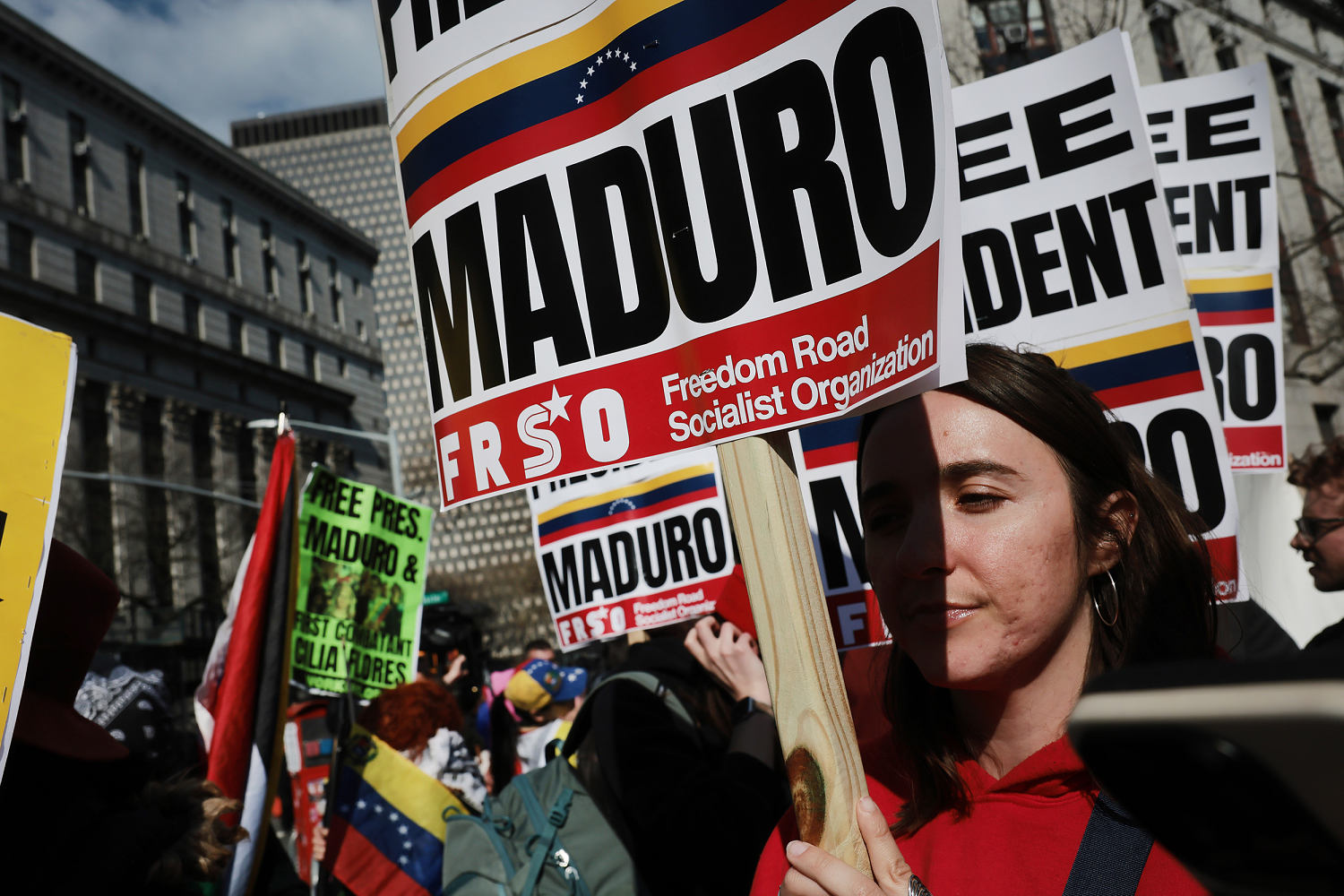
The air in Lower Manhattan carries a specific, metallic tang. It is the scent of old money, sea salt, and the relentless machinery of the American judicial system. On this particular morning, the sidewalk outside the federal courthouse didn't feel like a standard New York thoroughfare. It felt like a boundary. On one side lay the hum of a city obsessed with its own pace; on the other, the heavy, silent weight of a geopolitical collapse that has been years in the making.
Nicolás Maduro and his wife, Cilia Flores, stepped into this reality not as the untouchable architects of a socialist dream, but as defendants.
There is a profound dissonance in seeing figures who once commanded the fate of millions—shaping the very caloric intake of a nation—standing beneath the fluorescent hum of a United States District Court. For years, the narrative from Caracas was one of defiance. It was a story of "the people" against the "empire." But in the sterile silence of a courtroom, the grand oratory of the revolution tends to wither. It is replaced by the dry, rhythmic shuffling of legal briefs and the quiet, insistent click of a court reporter’s keys.
The Architecture of a Fall
To understand why this moment resonates beyond the wood-paneled walls of the courtroom, you have to look at the people who aren't in the room. You have to look at the families in Maracaibo who haven't seen a steady flow of electricity in months. You have to consider the grandmother in Petare who weighs her medicine against her bread.
For these people, Maduro isn't a political figure. He is a weather system. He is the reason the currency in their pockets feels like confetti.
The charges facing the couple are not about ideology. The Southern District of New York doesn't litigate political theory. They litigate narco-terrorism. They litigate the movement of white powder and the laundering of green paper. Federal prosecutors allege that for decades, the Venezuelan leadership transformed the state into a massive, functioning transit point for global drug trafficking.
When the couple appeared before the judge for this first post-arraignment hearing, the stakes were invisible but massive. This wasn't just a procedural check-in. It was the formal beginning of a process meant to dismantle a legacy of "Cartel de los Soles"—the Cartel of the Suns.
The name itself sounds like something out of a myth. But the reality is far more grounded. It refers to the sun insignias on the uniforms of high-ranking Venezuelan military officers. It suggests a corruption that isn't just a side effect of the government, but the very sun around which the government orbits.
The Power of the Proxy
Cilia Flores has often been called the "First Combatant." It’s a title that suggests a woman who is more than a spouse; she is a partner in the struggle. In the courtroom, however, the "combat" is of a different sort. It is a war of discovery motions and evidentiary hurdles.
The prosecution’s case relies on a web of informants and intercepted communications that would make a spy novelist blush. But for the average observer, the human element is found in the eyes of the defendants. There is a specific kind of fatigue that sets in when a person realizes their private world is being laid bare for a jury of strangers.
Imagine, for a moment, the transition. One day you are walking the halls of the Miraflores Palace, surrounded by guards whose only job is to ensure your comfort and safety. The next, you are subject to the whims of a court calendar. You are told when to sit. You are told when to speak. You are a small part of a very large, very indifferent machine.
This is the great equalizer of the American legal system. It doesn't matter if you have controlled the largest oil reserves on the planet. It doesn't matter if you have redefined the constitution of your homeland to suit your whims. In this room, you are a file number. You are a set of allegations.
The Ghost in the Room
The hearing focused heavily on the timeline for trial. The government has a mountain of evidence—thousands of hours of recordings, ledgers that track the movement of illicit funds across borders, and testimony from former insiders who have decided that their loyalty to the regime was less valuable than a plea deal.
The defense, meanwhile, faces a Herculean task. How do you humanize a client who has been the face of a national exodus? Since Maduro took power, millions of Venezuelans have fled. They have walked across the Andes. They have paddled across the Caribbean. They have sought refuge in every corner of the globe, carrying nothing but their stories and a deep, abiding sense of betrayal.
Their presence was felt in the courtroom, even if they weren't allowed inside. Every time a prosecutor mentioned a specific bribe or a particular shipment of narcotics, they were speaking about the money that could have been spent on hospitals. They were talking about the resources that should have gone toward schools.
The tragedy of Venezuela isn't just a tragedy of bad policy. It is a tragedy of lost potential. It is a story of a country that had everything and chose a path that led to this: a quiet room in New York, where the "First Combatant" and her husband must answer for the shadows they have cast.
The Slow Grind of Justice
Justice is rarely fast. It is a slow, grinding process that prioritizes procedure over passion. To the families waiting for news in Caracas, the pace of the New York court system must feel agonizing. They want answers. They want accountability. They want to know why their lives were traded for the enrichment of a select few.
But the law requires a different approach. It requires the meticulous assembly of facts. It requires that every "i" is dotted and every "t" is crossed, ensuring that when a verdict is eventually reached, it is beyond reproach.
During the hearing, Maduro sat with a stoicism that felt practiced. It was the face of a man who spent his life performing for the cameras. But every now and then, the mask would slip. A flicker of frustration. A glance toward his wife. In those moments, you saw the human underneath the titles. You saw two people who are beginning to understand that the world they built is no longer under their control.
The invisible stakes of this trial are not just about whether two people go to prison. They are about the definition of sovereignty. Does a leader have the right to use their nation as a personal bank? Can a government operate as a criminal enterprise and expect the rest of the world to look away?
The Southern District of New York is betting that the answer is a resounding "no."
The Shadow on the Wall
As the hearing drew to a close, the lawyers gathered their papers. The judge set the next date. The bailiffs prepared to escort the defendants back to their reality.
Outside, the city of New York continued its frantic dance. Tourists took photos of the Brooklyn Bridge. Delivery drivers darted through traffic. For most of the world, this was just another day. But for the millions of people whose lives have been shaped by the decisions made in Caracas, this day was a marker.
It was a reminder that no one is truly untouchable. It was a sign that the walls of the palace are not as thick as they seem.
The story of Nicolás Maduro and Cilia Flores is still being written. It is a narrative of power, greed, and the eventual, inevitable collision with the truth. As they left the courtroom, the sunlight hit the pavement with a brightness that felt almost accusatory.
The "Cartel of the Suns" was facing the dawn.
There was no cheering. There was no grand finale. There was only the sound of a heavy door closing, and the quiet realization that for some, the journey back to the palace has been permanently blocked by the weight of their own history.
The Venezuelan people are still waiting for their ending. They are still looking for the moment when the narrative shifts from one of survival to one of hope. In that Manhattan courtroom, the first few sentences of that new chapter were being drafted in the margins of a legal transcript.
The world watched. The city moved on. And in the silence that followed, the ghosts of a broken nation seemed to lean in, listening for the verdict that has been a generation in the making.