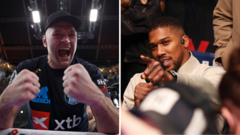
Tyson Fury is back in the win column, but the heavyweight landscape he returns to is fundamentally broken. His dominant victory over Arslanbek Makhmudov at Tottenham Hotspur Stadium on April 11, 2026, was a masterclass in survival and adaptation. It proved that despite his 37 years and the bruising losses to Oleksandr Usyk in 2024, the "Gypsy King" still possesses the ring IQ to dismantle a raw powerhouse. However, this win does not clear the path to undisputed glory. It merely adds another layer of complexity to a division paralyzed by fragmented titles, competing broadcast platforms, and a mandatory system that feels increasingly like a shakedown.
The heavyweight division is currently a three-headed dragon with no body. You have Oleksandr Usyk, the ghost of the division, holding the WBC title and preparing for a bizarre crossover defense against kickboxing legend Rico Verhoeven in Egypt. You have Daniel Dubois, the IBF champion, who validated his status by wrecking Anthony Joshua but is now forced into a WBO defense against Fabio Wardley. Then you have Fury, a man with the biggest name in the sport but no belt, attempting to bully his way back into a conversation that he was effectively cast out of eighteen months ago.
The Myth of the Comeback
Fury’s win over Makhmudov was visually impressive because it looked like the old Fury. He weighed in at 267.9 lbs, his leanest fighting weight in years, showing a level of discipline that was absent during his disastrous 2024 campaign. He moved well. He flicked the jab with enough sting to keep the Russian at bay. But we must be honest about the opposition. Makhmudov was a hand-picked rebound. He was a stationary target for a mobile giant.
This win provides a narrative arc for Netflix and the Saudi investors, but it doesn't solve the structural problem of 2026. The real reason the division is failing to deliver the fights fans want is the "Mandatory Trap." While Fury was out of the ring, the sanctioning bodies—the WBC, WBA, IBF, and WBO—began aggressively enforcing their own rankings to justify their sanctioning fees. This is why we see a talent like Martin Bakole, perhaps the most avoided man on the planet, stuck in an IBF final eliminator against Agit Kabayel instead of fighting for a world title.
The Anthony Joshua Problem
Anthony Joshua remains the elephant in the room. He has earned upwards of $200 million and is currently nursing the physical and psychological scars of a fifth-round knockout loss to Dubois. His promoter, Eddie Hearn, is talking about a summer return, yet Joshua finds himself in a career purgatory. He is too big to be a "gatekeeper" but currently lacks the ranking to demand a title shot.
Fury’s post-fight call-out of Joshua was predictable. It’s the biggest money fight in British history, but it’s a fight about nostalgia, not championships. If Fury and Joshua fight in late 2026, they do so as two former kings trying to convince the world they still have the keys to the castle. Meanwhile, the actual champions are elsewhere.
- Oleksandr Usyk: Preparing for Rico Verhoeven (May 23, 2026).
- Daniel Dubois: Defending against Fabio Wardley (May 9, 2026).
- Tyson Fury: Fresh off a win, looking for a way to bypass the line.
The sports-entertainment industrial complex prefers the Fury-Joshua narrative because it sells tickets regardless of the stakes. But for the health of the sport, this fixation on two aging stars is suffocating the next generation.
The Rise of the New Guard
While the veterans play political chess, a group of younger, hungrier heavyweights is ready to burn the board. Moses Itauma is no longer a prospect; he is a problem. His recent destruction of Jermaine Franklin proved he is ready for top-ten opposition. Similarly, Jared Anderson is making his UK debut against Solomon Dacres in Manchester this May. These are the fighters who will define the 2027-2030 era.
The problem is that the big money remains tied to the old guard. Broadcasters are hesitant to put 21-year-old Itauma in a headliner when they can squeeze one more pay-per-view out of Deontay Wilder, who recently scraped past Derek Chisora in a fight that felt like a localized tragedy rather than a world-class sporting event. Wilder is now chasing a WBA "Regular" title against Murat Gassiev. It is a desperate grab for relevance in a division that is moving on.
The Undisputed Dream is Dead
Let’s be clear. We are unlikely to see another undisputed heavyweight champion in 2026. The politics are too thick. To become undisputed, a fighter must pay fees to four different organizations, each with its own "mandatory" challenger waiting in the wings. If Usyk beats Verhoeven, the WBC will likely demand he fight their number one contender. If Dubois beats Wardley, the WBO will do the same.
The only way out of this deadlock is a complete overhaul of how the sport is governed, or a single entity—like the Riyadh Season organizers—simply buying out the sanctioning bodies' influence. Neither seems imminent. Instead, we are left with a fragmented landscape where "world champion" means less than it did a decade ago.
The Financial Reality
Boxing in 2026 is a game of leverage. Fury used his win over Makhmudov to re-establish his leverage. He knows that despite the losses to Usyk, he is still the most charismatic draw in the heavyweights. He is banking on the fact that fans would rather see him fight Joshua for a "Silver" belt than see Daniel Dubois fight a technical master like Bakole for the actual IBF world title.
He isn't wrong.
The market follows the personality, not the trophy. This is why we see crossovers like Usyk vs. Verhoeven. It’s not about boxing legacy; it’s about "events." The danger is that the heavyweight division becomes a series of high-profile exhibitions rather than a legitimate sporting competition.
The Immediate Future
The next sixty days will determine if the heavyweight division can regain its footing.
- April 25: Jarrell Miller vs. Lenier Pero. A WBA eliminator that will decide who gets to chase the winner of Wilder-Gassiev.
- May 9: Daniel Dubois vs. Fabio Wardley. A massive domestic clash that could consolidate Dubois as the true face of British heavyweights.
- May 23: Oleksandr Usyk vs. Rico Verhoeven. A spectacle that risks devaluing the WBC title if it turns into a glorified sparring session.
Fury will likely sit out these dates, waiting for the smoke to clear. He is positioned as the "final boss" for whoever emerges with the most momentum. If Dubois destroys Wardley, the clamor for Fury vs. Dubois will be deafening. If Usyk struggles with a kickboxer, the calls for a third Fury-Usyk fight will vanish, replaced by the demand for the long-delayed Joshua showdown.
The heavyweight division is not in a golden age. It is in a gilded age—shiny on the surface, but hollow underneath. Fury’s win over Makhmudov was a necessary correction for his brand, but it does nothing to fix the systemic rot of a sport that prizes the deal over the fight.
Stop looking for a clear path to one champion. Accept that the heavyweight division is now a collection of competing islands. Fury has just secured his own island for another year. Whether he actually tries to bridge the gap to the others remains the only question worth asking.
Get used to the mess. It isn't going away.


.png?format=1500w)