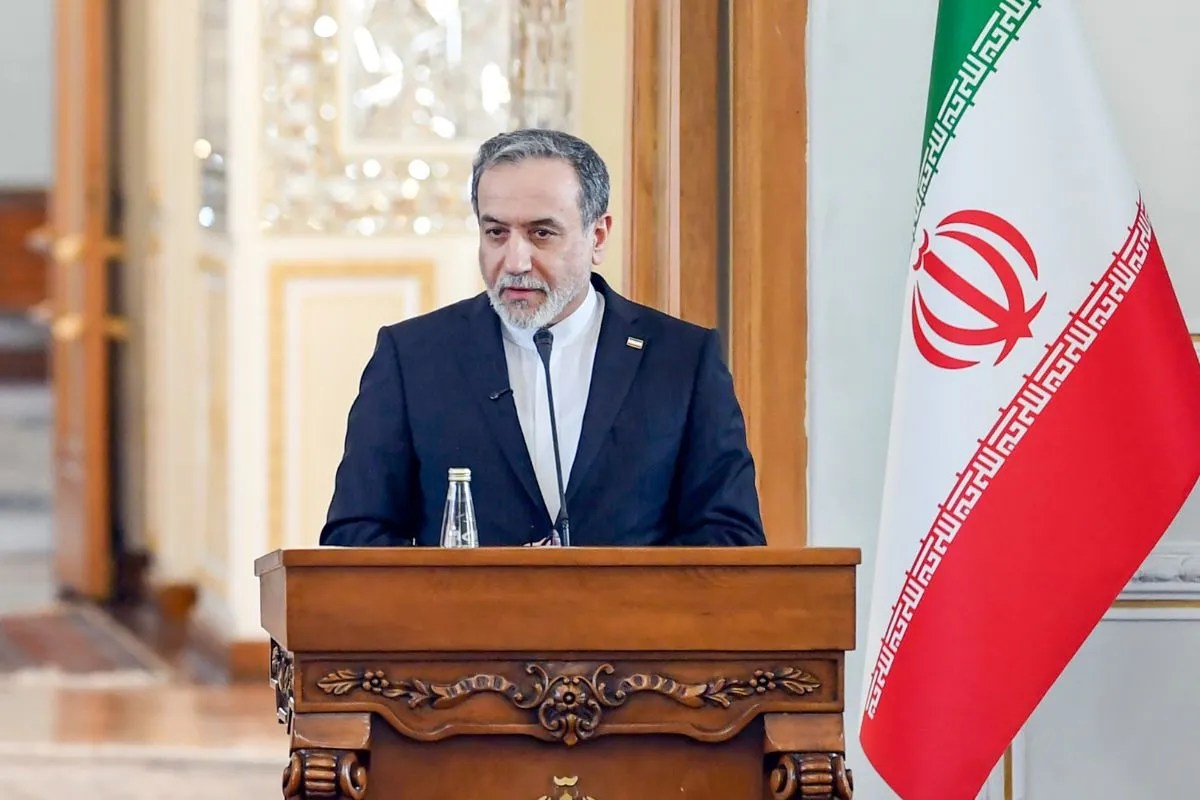
Geopolitics is often a game of high-stakes bluffing where the loudest voice in the room is usually the one with the weakest hand. Iranian Foreign Minister Abbas Araghchi recently doubled down on the tired rhetoric that Tehran has the "right" to stop "hostile" ships in the Strait of Hormuz. It sounds terrifying. It makes for great headlines. It suggests a global economic apocalypse is just one Iranian commander's bad mood away.
It is also a logistical and strategic fantasy.
The "lazy consensus" among armchair analysts and cable news pundits is that Iran holds a metaphorical knife to the throat of the global economy. They point to the 21 million barrels of oil flowing through that narrow 21-mile-wide choke point every day. They see the map and assume that because Iran sits on the northern shore, it owns the water.
They are wrong. They are missing the distinction between harassment and control.
The Sovereignty Myth
Araghchi’s claim hinges on a convenient misinterpretation of the United Nations Convention on the Law of the Sea (UNCLOS). While Iran has signed the treaty, it hasn't ratified it. More importantly, the Strait of Hormuz is governed by the legal regime of "transit passage."
In plain English: even if the waters fall within the territorial sea of a coastal state, ships have the right to continuous and expeditious transit. You don't get to pick and choose based on "hostility" unless there is an active state of declared war—and even then, the blowback would be terminal for the regime in power.
When a diplomat talks about "rights" in a waterway that services 20% of the world's liquid petroleum consumption, they aren't talking to international lawyers. They are talking to their domestic hardliners. They are trying to project power they cannot sustain.
The Economic Suicide Pact
Let's dismantle the idea that Iran would actually benefit from closing the Strait.
I have seen analysts argue that Iran could weather a total maritime shutdown because they are already under heavy sanctions. This ignores the basic mechanics of how a petro-state survives. China is Iran’s primary customer. If Tehran chokes off the Strait, they aren't just hurting "hostile" Western nations; they are cutting the throat of the Chinese economy.
Beijing does not trade in loyalty; it trades in energy security. The moment Iran disrupts the flow of oil to the East, its only meaningful geopolitical lifeline vanishes.
Furthermore, Iran’s own economy relies on the import of refined products and essential goods through these same lanes. To block the Strait is to blockade themselves. It is the equivalent of a person claiming they have the "right" to stop breathing just to make the person next to them uncomfortable.
The Technical Reality of "Closing" a Strait
How do you actually close a waterway? You don't just put up a "Closed" sign. You have to physically prevent passage.
- Mines: Iran has a massive stockpile of naval mines. They are cheap, effective, and terrifying. But mines are indiscriminate. They don't check the flag of the ship before they explode. A mined Strait is a Strait closed to Iran’s friends and its own navy.
- Anti-Ship Missiles: The Noor and Ghadir systems are formidable. But using them transforms a "maritime dispute" into a shooting war with the U.S. Fifth Fleet.
- Small Boat Swarms: The IRGC Navy loves its fast-attack craft. They are perfect for harassment, seizing a single tanker (like the Stena Impero in 2019), or creating a PR nightmare. They are useless against a coordinated carrier strike group escorting a convoy.
I have spent years watching how these maritime skirmishes play out. Every time Iran "seizes" a vessel, it is a calculated, low-level provocation designed to gain leverage in a specific negotiation—usually related to frozen assets or nuclear talks. It is a tactical flea bite, not a strategic decapitation.
The Ghost of the Tanker War
People love to cite the 1980s "Tanker War" as proof that Iran can disrupt shipping. During that conflict, over 500 ships were attacked. Global oil prices spiked.
What the history books often gloss over is the outcome: Operation Praying Mantis in 1988. In a single day, the U.S. Navy destroyed half of Iran's operational fleet. It wasn't a "limited engagement." It was a clinical removal of Iran's ability to project power at sea.
The Iranian leadership remembers this, even if Abbas Araghchi pretends he doesn't. They know that "stopping ships" is a one-time-use card. Once you play it, you lose the assets you used to play it.
The Real Threat is Not the Blockade
If you want to worry about the Strait of Hormuz, stop looking at the warships. Look at the insurance premiums.
The "contrarian" truth is that Iran doesn't need to close the Strait to win. They just need to make it expensive. By merely threatening action—by making statements like Araghchi’s—they force Lloyd’s of London to hike "war risk" premiums. They force shipping companies to reconsider their routes.
$P = \frac{R}{L}$
In this simple logic, the perceived risk ($R$) divided by the logistics ($L$) determines the price ($P$). Iran’s strategy is to keep $R$ high through rhetoric alone.
When the world reacts with panic to these statements, we are giving Tehran the exact economic leverage they lack in reality. We are validating a "right" that doesn't exist and a capability they cannot afford to use.
The Premise is Flawed
The media keeps asking: "Can Iran close the Strait?"
The better question is: "Why do we keep pretending it matters?"
Even if the Strait were blocked today, the world is not the same as it was in 1973. The U.S. is a net exporter of oil. The East-West Pipeline in Saudi Arabia and the Habshan–Fujairah pipeline in the UAE can bypass the Strait for millions of barrels per day. It would hurt, yes. It would be a global recession trigger, perhaps. But it would be the end of the Islamic Republic as a functioning entity.
Araghchi isn't issuing a threat; he's issuing a plea for relevance. He wants us to believe Iran is the gatekeeper of the world. In reality, they are a tenant in a building they don't own, threatening to break the front door while they are still locked inside.
Stop reading the headlines and start looking at the hull designs of the ships actually traversing those waters. They aren't turning around. Neither should our policy.
The Strait is open. It will stay open. Not because Iran allows it, but because the alternative is their total annihilation.