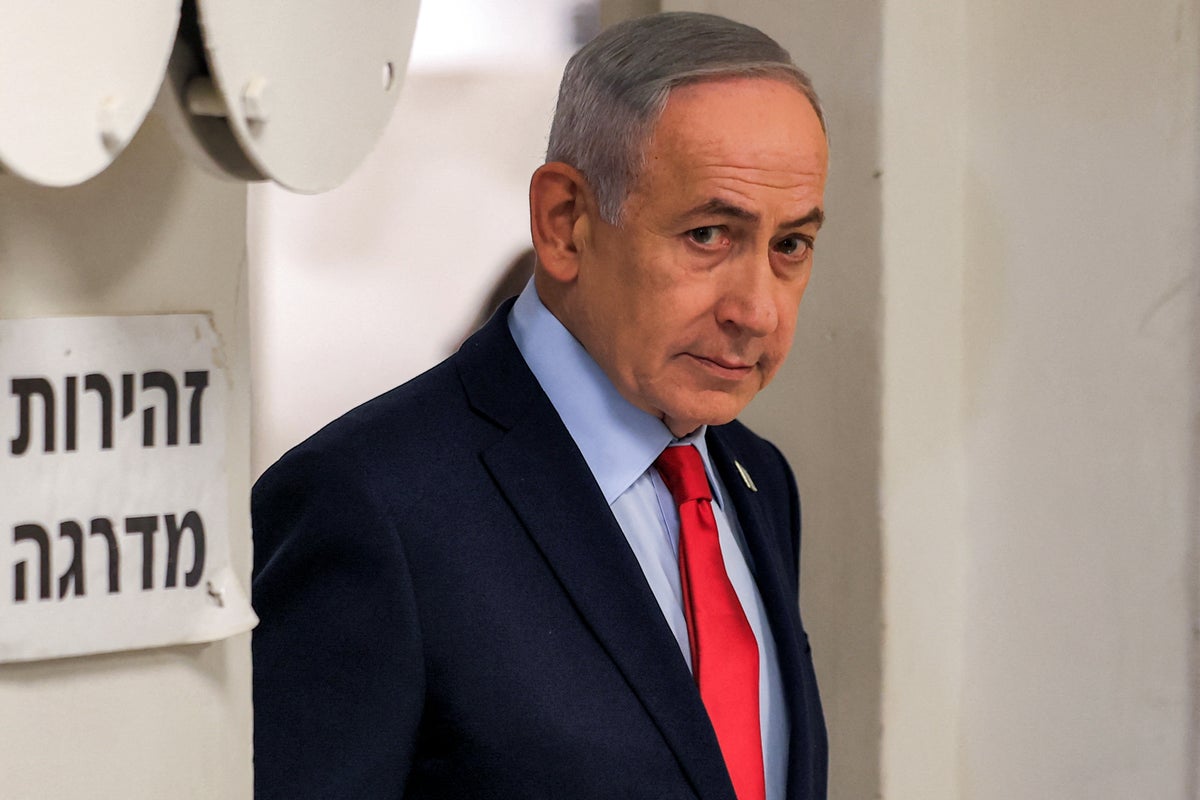
The operational pause in direct kinetic engagement between Israel and Iran marks the transition from external military necessity to internal judicial reality. Benjamin Netanyahu’s corruption trial, suspended under the emergency protocols of the October 7 aftermath and subsequent regional escalations, is scheduled for resumption. This shift indicates that the "Security Prime Minister" narrative has reached a point of diminishing returns regarding domestic legal immunity. The resumption of the trial—specifically Case 4000 (Bezeq-Walla), Case 1000 (Luxury Gifts), and Case 2000 (Yedioth Ahronoth)—forces a collision between the Prime Minister's executive duties and his status as a criminal defendant.
The Tripartite Model of Political Survival
The stability of the current Israeli administration rests on three distinct pillars. When external friction with Iran decreases, the internal load on these pillars increases proportionally.
- The Security Imperative: The mobilization of the Israel Defense Forces (IDF) and the management of the multi-front conflict (Gaza, Lebanon, and the direct Iranian exchange) created a functional moratorium on domestic political dissent and judicial proceedings.
- The Coalition Adhesive: Netanyahu’s ultra-nationalist and Haredi partners view the judicial system with skepticism. Their support provides the parliamentary "Iron Dome" protecting the Prime Minister from no-confidence motions, provided he continues to deliver on their specific sectarian or territorial agendas.
- The Judicial Counterweight: The Jerusalem District Court represents the independent variable. Unlike the Knesset or the Cabinet, the court operates on a timeline governed by evidentiary standards and witness availability rather than geopolitical cycles.
The decompression of the Iranian threat—characterized by the recent cycle of calibrated strikes and counter-strikes—removes the primary justification for further trial delays. Emergency regulations that limited court activity to "urgent matters" have expired, and the judiciary is signaling a return to procedural normalcy.
Case 4000 and the Mechanics of Regulatory Capture
The most significant threat to Netanyahu’s tenure is Case 4000. This case examines the alleged quid pro quo between Netanyahu (acting as Communications Minister) and Shaul Elovitch, the former controlling shareholder of the telecommunications giant Bezeq.
The prosecution’s logic follows a specific flow:
- The Favor: Netanyahu allegedly steered regulatory benefits worth hundreds of millions of shekels to Bezeq.
- The Benefit: In exchange, the Walla news site (owned by Elovitch) provided favorable coverage of the Prime Minister and his family while censoring political rivals.
- The Intent: The prosecution aims to prove that this was not merely a standard political-media relationship but a structured bribery scheme where regulatory power was traded for personal political capital.
The resumption of this case is particularly volatile because it involves the testimony of former top-tier aides who have turned state's witnesses. The granular detail of how government policy was allegedly bent to serve the interests of a private corporation undermines the "security-first" persona Netanyahu has cultivated.
The Defense Strategy: Institutional Friction and Procedural Delay
Netanyahu’s legal team utilizes a "Defense by Attrition" framework. This is not a search for a single exonerating fact, but rather a strategy designed to maximize the time elapsed between the alleged crime and the final verdict.
The Exhaustion of Witnesses
The defense employs exhaustive cross-examinations, often lasting weeks for a single witness. The goal is twofold: to find minor inconsistencies that can be used to challenge the credibility of the entire investigation and to push the trial's end date further into the future.
The Conflict of Interest Loophole
Netanyahu has argued that his involvement in judicial reform and the appointment of senior legal officials is necessary for the country, while the Attorney General, Gali Baharav-Miara, maintains that his criminal status creates a permanent conflict of interest. The resumption of the trial intensifies this friction. Every time the Prime Minister speaks on the legal system, he risks a High Court petition for "incapacitation" (navtzurut), the legal mechanism to declare a leader unfit for office due to a conflict of interest.
Macro-Political Implications of the Trial Resumption
The timing of the trial’s return is functionally tied to the "Post-War" planning phase. As the intensity of the Gaza operations shifts to a lower-scale insurgency management, the Israeli public’s focus is reverting to pre-October 7 grievances.
The political cost function for Netanyahu changes as the trial progresses:
- Public Perception Decay: Long-term exposure to trial testimonies regarding expensive gifts (Case 1000) creates a disconnect between the Prime Minister’s lifestyle and the economic sacrifices being made by the reservist class and the displaced citizens in the North and South.
- Coalition Fragility: While his partners currently support him, a Prime Minister spending three days a week in a courtroom is a Prime Minister with diminished capacity to manage the complex needs of a fractious cabinet.
- The Shadow of the Successor: Potential challengers within the Likud party and the opposition (such as Benny Gantz or Yair Lapid) utilize the trial as evidence of a "leadership deficit." They argue that a leader distracted by legal survival cannot effectively manage the existential threats posed by the Axis of Resistance.
The Role of the Attorney General and the High Court
The Attorney General serves as the ultimate arbiter of the Prime Minister's ability to govern while under indictment. The resumption of the trial forces the AG to re-evaluate the "Conflict of Interest Agreement" signed by Netanyahu.
If the trial reveals new evidence of interference in the justice system or if Netanyahu uses his executive powers to undermine the prosecution, the AG may be forced to move toward a declaration of incapacitation. This would trigger a constitutional crisis without precedent in Israeli history. The Supreme Court would then be forced to rule on whether a democratically elected leader can be removed by a non-elected legal official based on the principle of institutional integrity.
Economic Volatility and Judicial Risk
The Israeli economy, already strained by the high cost of the war and the mobilization of 300,000+ reservists, views the resumption of the trial as a signal of impending political instability.
Market indicators respond to three primary risks associated with the trial:
- Legislative Paralysis: A government focused on legal defense is less likely to pass the necessary, and potentially unpopular, budgets required for post-war recovery.
- Credit Rating Pressure: Rating agencies have explicitly cited the strength of Israel’s institutions and the independence of its judiciary as key factors in the country's sovereign credit rating. Any attempt to use the war to permanently stall the trial is interpreted as a weakening of those institutions.
- Investment Uncertainty: Foreign direct investment (FDI) in the high-tech sector—the engine of the Israeli economy—is sensitive to the "rule of law" narrative. A protracted legal battle involving the head of state creates a "political risk premium" that discourages long-term capital commitment.
The Strategic Path Forward
The convergence of the trial's resumption and the regional stalemate with Iran creates a narrow window for Netanyahu. To maintain power, he must execute a "Double Pivot":
First, he must maintain a level of low-grade external friction that justifies his continued leadership without escalating into a full-scale regional war that would once again suspend the legal process and invite greater international pressure.
Second, he must navigate the evidentiary phase of Case 4000 without a "smoking gun" testimony that could alienate his base or force his coalition partners to reconsider their allegiance.
The trial is no longer a peripheral distraction; it is the central gravitational force around which Israeli domestic and foreign policy will rotate for the foreseeable future. The "Security Prime Minister" must now survive the Jerusalem District Court, where the rules of engagement are defined by the penal code rather than military doctrine.
The most likely outcome is not a swift verdict, but a prolonged period of "Institutional Gridlock," where the Prime Minister’s survival depends on his ability to keep the trial in a state of perpetual procedural motion while simultaneously managing the most complex security environment in the state’s history. Failure to balance these two spheres will result in either a plea bargain that necessitates his resignation or a constitutional breakdown that would fundamentally reshape the Israeli state.
The immediate strategic move for the opposition and the civil society movements is to demand a strict adherence to the court’s schedule, treating any attempt at further delay as a direct assault on the democratic separation of powers. For Netanyahu, the play is to transform the courtroom into a political stage, framing the prosecution not as a legal necessity but as a "judicial coup" by an unelected elite—a narrative that has historically resonated with his core constituency but faces diminishing returns in a post-October 7 landscape.