The global proliferation of Iranian-designed Unmanned Aerial Systems (UAS), specifically the Shahed-136/Geran-2 family, has fundamentally altered the cost-exchange ratio of modern air defense. Traditional surface-to-air missile (SAM) systems operate on an unsustainable economic trajectory when intercepting low-cost loitering munitions. Ukraine, having functioned as the primary laboratory for high-intensity UAS attrition since 2022, is now exporting a refined tactical framework to five nations—Israel, the United Kingdom, the United States, Germany, and Poland—seeking to bridge the gap between kinetic interception and electronic warfare (EW). This transfer of expertise is not merely a diplomatic gesture but a hard-coded export of operational data, signal intelligence (SIGINT), and decentralized command-and-control (C2) logic.
The Economic Asymmetry of Loitering Munitions
The Shahed-136 functions as a "poverty-tier" cruise missile. Its efficacy lies not in its sophistication, but in its ability to force a negative cost-value trade-off. An interceptor missile costing $2 million (e.g., an MIM-104 Patriot variant) utilized against a $20,000–$50,000 drone represents a 40:1 or 100:1 cost disadvantage for the defender. Over a sustained campaign of 500+ launches, this leads to rapid inventory depletion of high-end interceptors, leaving strategic assets vulnerable to more traditional ballistic or cruise missile threats.
Ukrainian experts have categorized the defense against these threats into three distinct layers of attrition:
- The Acoustic and Visual Detection Layer: Utilizing a mesh network of thousands of microphones and mobile sensors to track the distinct low-frequency "lawnmower" engine signature of the MD-550 powerplant.
- The Mobile Fire Group (MFG) Intercept: Using high-mobility vehicles equipped with thermal optics and heavy machine guns or autocannons (e.g., Gepard or ZU-23-2) to achieve a positive cost-exchange ratio.
- The Electronic Warfare and GNSS Spoofing Layer: Forcing the drone to lose satellite navigation lock, triggering an "inertial drift" that misses the target coordinates.
The Five-Nation Knowledge Transfer: Tactical Pillars
The collaboration with international partners centers on the democratization of "kill chain" data. While Western nations possess superior satellite surveillance, they lack the granular, real-time telemetry data that Ukraine has harvested from thousands of successful and unsuccessful Shahed interceptions.
Pillar I: Signal Fingerprinting and Library Development
Iranian UAS navigation relies on a combination of GNSS (GPS/GLONASS) and an Inertial Navigation System (INS). Ukraine has shared the precise radio-frequency (RF) profiles used by these drones to resist jamming. By analyzing captured "CRPA" (Controlled Reception Pattern Antennas), Ukrainian engineers have helped Western allies develop more effective "smart" jammers. These units do not just flood the spectrum with noise; they specifically target the null-steering logic of the drone’s antenna, rendering its anti-jamming capabilities moot.
Pillar II: Decentralized C2 Architectures
Centralized air defense systems like the Aegis or Patriot are designed for high-altitude, high-velocity threats. They are ill-suited for a "swarming" attack of low-altitude drones. Ukraine’s contribution to its allies is the "Delta" situational awareness system—a battlefield management platform that integrates data from civilian spotters, acoustic sensors, and military radar onto a single digital map. This allows for a decentralized response where the nearest Mobile Fire Group is vectored to the threat without clogging the primary military communication channels.
Pillar III: Hard-Kill Optimization via Low-Cost Interceptors
A significant portion of the consultancy involves the "Gepardization" of Western air defense. Germany, in particular, has seen the resurgence of the Flakpanzer Gepard as a premier anti-drone platform. The Ukrainian experience has proven that 35mm programmed-burst ammunition is the most efficient "hard-kill" method. This has prompted the UK and US to reconsider short-range air defense (SHORAD) investments, shifting focus from expensive missiles to rapid-fire cannons and laser-directed energy weapons (DEWs) like DragonFire.
The Cost Function of Modern Interception
To quantify the efficiency of the Ukrainian model, one must look at the Mean Intercept Cost (MIC).
$$MIC = \frac{\sum (C_{interceptor} + C_{operational})}{N_{intercepts}}$$
In a traditional Western framework, the MIC exceeds $500,000 per unit. Under the Ukrainian-trained mobile fire group model, the MIC drops to approximately $2,500–$10,000, factoring in fuel, ammunition, and personnel. This reduction is the primary "product" Ukraine is exporting. By lowering the MIC, nations can sustain a defense against massed UAS attacks without depleting their national treasuries or critical missile stockpiles.
Strategic Limitations and Technical Bottlenecks
Despite the successes, three structural limitations remain in the current counter-UAS (C-UAS) strategy:
- Saturation Thresholds: Every defense system has a saturation point. If the number of incoming UAS exceeds the number of available barrels or EW channels, the "leakage" rate increases exponentially.
- The INS Evolution: Newer iterations of Iranian drones are utilizing improved Inertial Navigation Systems that do not rely on GPS. If a drone can maintain its heading and altitude via sophisticated gyroscopes, EW spoofing becomes less effective, forcing a return to more expensive kinetic interceptions.
- Component Obfuscation: Iran utilizes a globalized supply chain of dual-use electronics. Restricting the flow of high-end microchips is nearly impossible when the drones function effectively on consumer-grade hardware found in civilian delivery drones or RC planes.
The Proliferation of the "Shahed-Model" Beyond State Actors
The threat is no longer confined to the Russo-Ukrainian theater. The Houthi rebels in Yemen and various militias in the Levant have adopted the Shahed-136 architecture. By helping the US and Israel integrate Ukrainian "lessons learned," these nations are preparing for a future where non-state actors can launch precision-guided long-range strikes.
Israel’s interest is particularly acute. During the April 2024 Iranian drone and missile attack, the integration of multi-layered defense was tested at scale. The Ukrainian contribution here involves "pre-launch" intelligence—identifying the signatures of mobile launchers and the logistical "tells" that precede a massed launch.
The Mechanism of Adaptive Evolution
The relationship between Ukraine and its five partners is a feedback loop. Ukraine provides the raw data from the kinetic environment; the Western partners provide the high-end processing power and manufacturing capacity to refine C-UAS tools. For example, the US is using Ukrainian data to train AI models for automated target recognition (ATR) in optical sensors. This eliminates human error in identifying a Shahed against a backdrop of birds or civilian aircraft.
This creates a technological "ratchet" effect. Every time Iran or its proxies update the drone software, the Ukrainian sensor network captures the change, and the Western allies update the EW libraries globally.
The Final Strategic Pivot
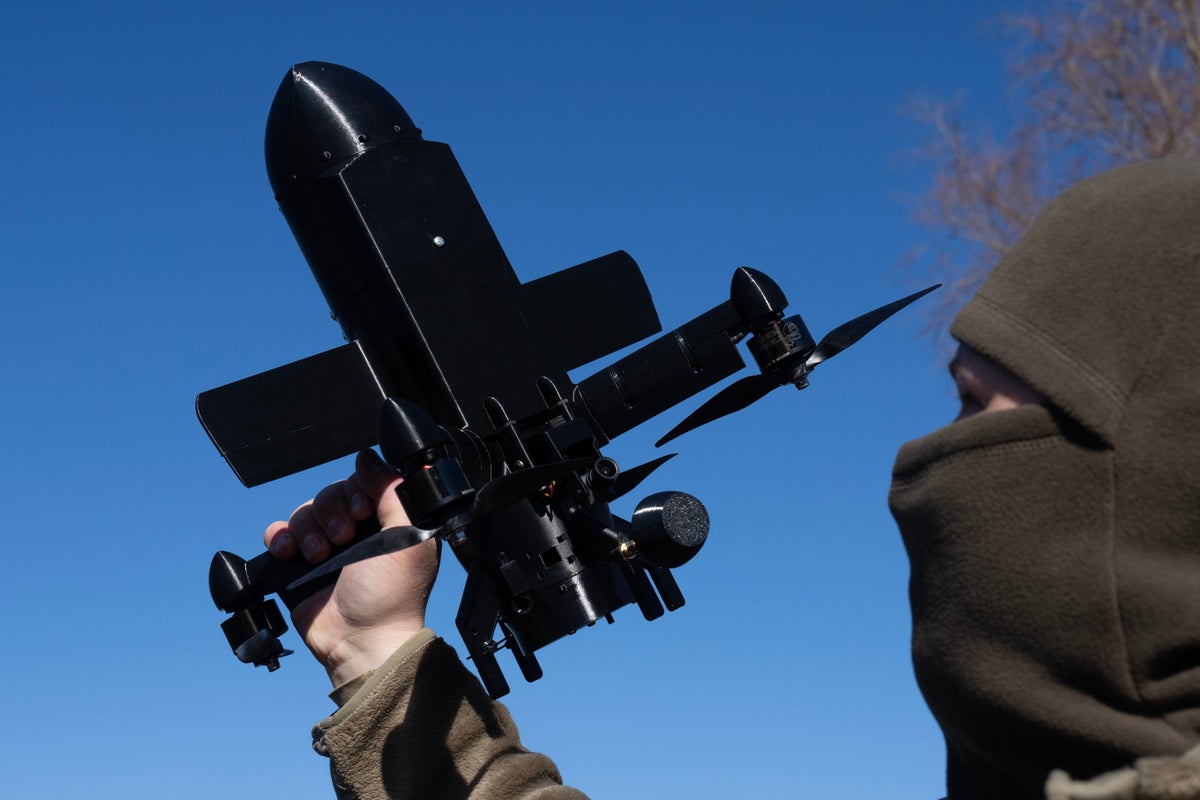
The immediate priority for the five-nation coalition is the transition from reactive defense to proactive neutralisation. This involves the deployment of "Interceptor Drones"—small, high-speed FPV (First Person View) units designed to ram and destroy incoming Shaheds mid-flight. This represents the ultimate convergence of the cost-exchange ratio, where a $1,000 interceptor drone destroys a $30,000 loitering munition.
Nations must now shift their procurement strategy from "High-Value, Low-Volume" (expensive missiles) to "Low-Value, High-Volume" (decentralized sensors and cheap interceptors). The Ukrainian export of expertise is the blueprint for this transition. Future defense budgets will likely prioritize the mass production of 30mm programmable ammunition and the expansion of nationwide acoustic monitoring grids, as the era of the $2 million missile protecting a $50,000 target is functionally over.
Establish a permanent, real-time data link between the Ukrainian "Delta" system and NATO's Integrated Air and Missile Defense (IAMD) to ensure the global EW library remains current against Iranian firmware updates.