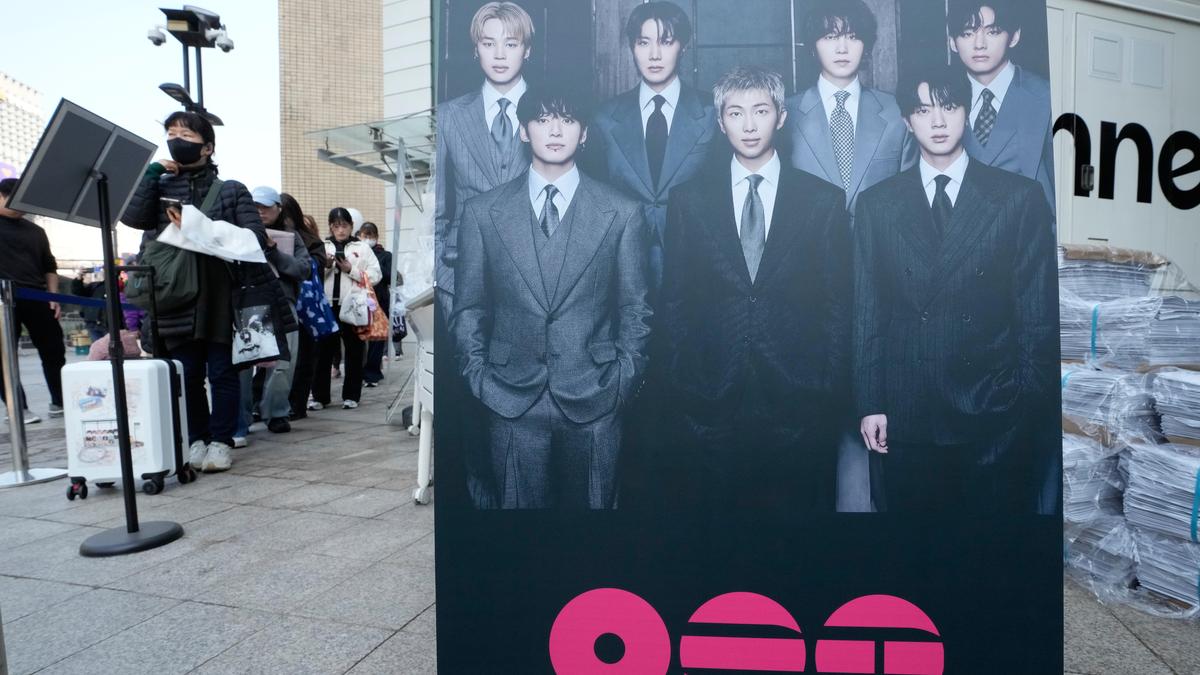
The return of BTS to live performance in Seoul serves as a massive stress test for urban infrastructure, cultural capital valuation, and the logistical limits of the "fan-to-consumer" ecosystem. While mass media focuses on the emotional resonance of the reunion, the actual mechanics of the event represent a complex coordination of paramilitary-grade security, precision-timed public transit adjustments, and the artificial scarcity of physical space. This is not merely a concert; it is a temporary transformation of a metropolitan hub into a high-density economic zone where the primary commodity is proximity.
The Tri-Axial Strain on Urban Infrastructure
The announcement of a "lockdown" in central Seoul is a misnomer for what is actually a surgical redirection of the city’s circulatory system. The strain on the Seoul Metropolitan Government (SMG) falls into three distinct categories:
- Pedestrian Throughput Management: Standard subway station capacities are calculated based on staggered commuter intervals. The BTS return creates a "burst" demand profile where $T$ (throughput) must exceed $V$ (volume) within a 60-minute window post-event. To prevent crowd crush—a heightened concern in Seoul’s recent safety history—the city must implement one-way egress corridors and physical barriers that temporarily decommission primary arterial roads.
- Spectrum and Signal Density: A gathering of 50,000 to 100,000 individuals, each attempting to broadcast high-definition video data (4K/8K) simultaneously, creates a local failure in cellular backhaul. Telecom providers (SK Telecom, KT, LG U+) must deploy Mobile Base Stations (MBS) to prevent a "dark zone" where emergency communications could be compromised by social media uplink demand.
- The Accommodation Premium: The elasticity of hotel pricing in the Gangnam and Songpa districts during this window reveals a "supergroup surcharge." When supply is fixed and demand is global, the price floor for mid-tier lodging shifts upward by 200% to 400%, effectively pricing out domestic fans in favor of high-net-worth international travelers.
The Economic Multiplier of Forced Scarcity
HYBE, the parent company of BTS, utilizes a "Total Experience" model that extends the revenue window far beyond the three-hour performance duration. This strategy rests on three operational pillars:
Integrated Retail Ecosystems
By establishing "pop-up" zones across the city, the organization de-centralizes the merch-buying process. This reduces the bottleneck at the stadium gates but, more importantly, it forces the "ARMY" (the fanbase) to traverse the city, distributing economic impact across multiple districts. This geographic spread maximizes the "average revenue per visitor" by increasing the probability of secondary spending on food, local transport, and third-party retail.
The Virtual Mirror Effect
The live show in Seoul is rarely just a live show. It is the master recording for a global livestream. The physical audience serves as the "ambient noise" and visual proof of high-value cultural stock. For every ticket holder in the stadium, there are an estimated 10 to 15 digital ticket holders globally. The Seoul venue becomes a high-budget film set where the overhead is subsidized by the live audience, while the profit margin is scaled through digital distribution.
Hybrid Intellectual Property Utilization
The return of the group allows for the immediate activation of dormant IP. Merchandise lines, specifically those tied to the group’s "return" branding, capitalize on the psychological state of "reunion relief." The market value of a BTS-related asset is highest at the moment of scarcity—this first show back creates a peak in the valuation of all peripheral content, from documentary rights to limited-edition physical media.
Security Architecture as an Operational Necessity
The mobilization of police and private security is often framed as a response to fan fervor, but the underlying logic is the mitigation of liability and the protection of the group’s physical "asset value."
The security perimeter operates in concentric circles. The outermost circle manages traffic flow and prevents un-ticketed "loitering" which can lead to stampede risks. The middle circle utilizes biometric or QR-linked identification to verify the "proof of fan" (fanclub membership or lottery win), acting as a filter for high-risk individuals. The innermost circle is the sterile zone—the stage and backstage area—where the primary concern is the physical safety of the members, whose health and ability to perform represent billions in market capitalization for KOSPI-listed HYBE.
Any disruption to the performance schedule incurs a compounding cost. Production delays, safety incidents, or logistical failures result in:
- Rebate Liability: Refund requirements for digital and physical tickets.
- Contractual Penalties: Fines from broadcasting partners and sponsors.
- Brand Erosion: A loss of "reliability" in the group’s ability to deliver high-stakes global events.
Limitations of the Supergroup Model
Despite the massive revenue potential, the "Seoul Lockdown" model has inherent vulnerabilities. First, it relies on a hyper-centralized location. If Seoul’s infrastructure fails—due to weather, transit strikes, or technical grid collapse—there is no redundancy. The event cannot be moved.
Second, the environmental footprint of such an event is increasingly at odds with the "Social" component of ESG (Environmental, Social, and Governance) goals. The carbon cost of thousands of international flights, coupled with the massive waste generated by single-use merchandise and plastic packaging, creates a reputational risk that the K-pop industry has yet to quantify or solve effectively.
Strategic Forecast: The Decentralization of the Fan Hub
The current model of "locking down" a city center is likely reaching its terminal phase of efficiency. As the group’s global footprint grows, the cost of hosting a single, massive "homecoming" event in Seoul creates too much friction for the city's permanent residents.
We should expect a shift toward "Permanent Experience Zones"—dedicated, year-round physical spaces that allow the economic impact to be smoothed over 365 days rather than spiked over three. This moves the group’s presence from a "shock event" to a sustainable "cultural utility."
For investors and urban planners, the takeaway is clear: the value of a cultural supergroup is no longer in the music alone, but in their ability to act as a temporary sovereign of urban space. The city that can most efficiently host these bursts of high-intensity economic activity, without collapsing its day-to-day operations, will capture the lion's share of the global entertainment export market.
Audit the current transit-merchandise integration in Seoul. To optimize the next cycle, the SMG and HYBE must transition from "crowd control" to "crowd integration," utilizing real-time GPS data from fan apps to dynamically adjust bus and subway frequencies in 15-minute intervals.