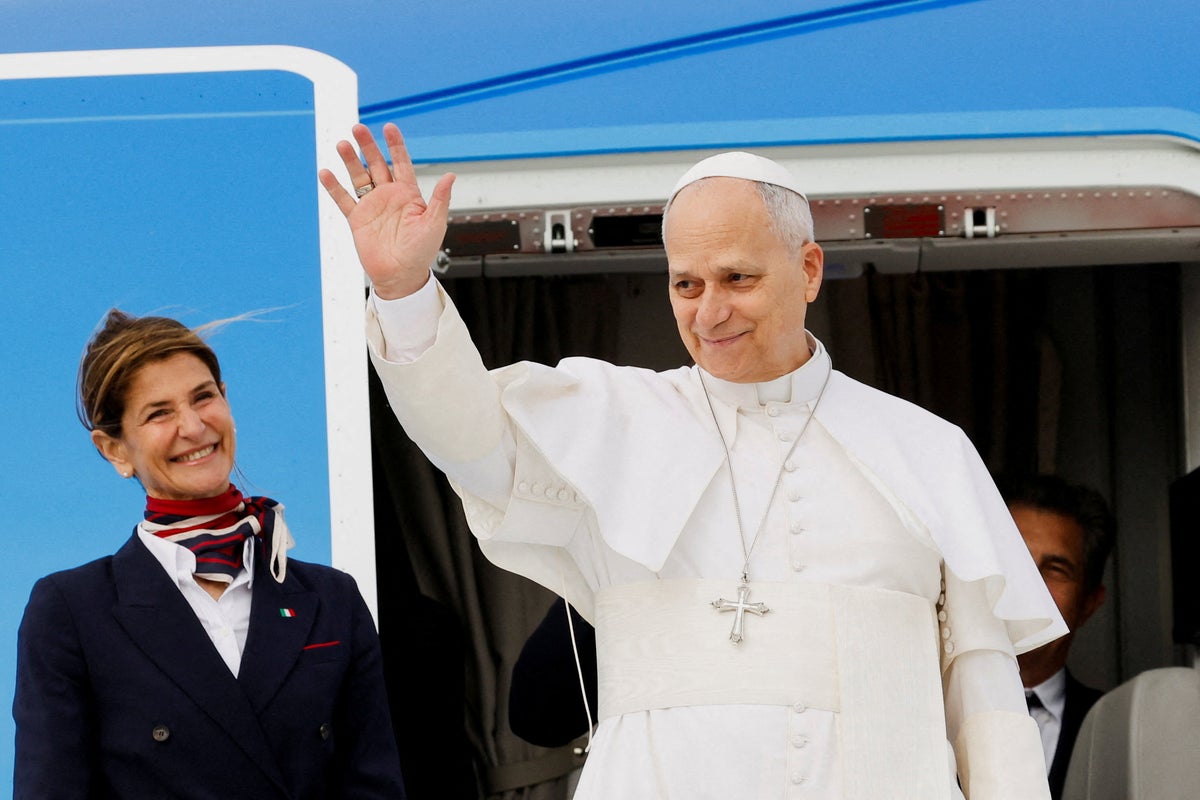
The white robe is a target for dust. In the humid heat of a Kinshasa afternoon, the air doesn’t just sit; it clings. For an eighty-year-old man who moves with the careful deliberation of a glass sculpture, the prospect of an eleven-day trek across the heart of Africa is more than a diplomatic obligation. It is a physical test of faith.
Pope Leo is not merely scheduled to visit four nations. He is stepping into a whirlwind of expectation that has been building for decades. When the wheels of the papal plane touch down on the tarmac, they won't just be landing in a country. They will be landing in a demographic explosion.
The Weight of a Billion Hopes
Consider a young woman named Amara in the suburbs of Nairobi. She represents the shifting gravity of the global church. While cathedrals in Europe sit quiet, echoing with the footsteps of curious tourists, the parishes of Africa are bursting at the seams. For Amara, the Pope’s arrival isn't a headline in a digital feed. It is a validation of her entire world.
The statistics are clear, though numbers often fail to capture the sweat and the song. By the middle of this century, one in every four Catholics on the planet will be African. This journey is a recognition of that reality. Leo is going to where the blood is pumping.
The logistics of an eleven-day tour across four nations—Democratic Republic of Congo, South Sudan, Kenya, and Uganda—are staggering. Security details spend months mapping out every alleyway. Local governments scramble to pave roads that have been neglected for years. There is a joke among the locals that if you want your street fixed, you should pray for a saint to visit. But beneath the cynical humor lies a desperate desire for visibility.
The Invisible Stakes of a Handshake
Peace is often talked about in the abstract. It is a word used by men in suits in climate-controlled rooms in Geneva or New York. In South Sudan, peace is a concrete matter of whether you can plant a crop without fear of the harvest being burned.
When Pope Leo meets with the leaders of these nations, the stakes are invisible but heavy. He isn't bringing a checkbook. He isn't bringing an army. He brings the "soft power" of moral witness. In a region where political legitimacy is often contested, a photograph with the Pontiff can be used as a shield or a sword. Leo knows this. He has to walk a tightrope where every smile is scrutinized for political bias.
The itinerary is a grueling marathon. From the sprawling urban density of Kinshasa to the traumatized landscapes of South Sudan, the transition is jarring. Each stop requires a different tone. In one city, he must be a consoler for those who have lost everything to militia violence. In the next, he must be a stern grandfather, lecturing the elite about the rot of corruption.
The Sound of the Crowd
If you have never stood in a crowd of a million people, it is hard to describe the vibration. It is a physical force. It moves through the soles of your feet before it hits your ears.
When the Pope arrives at the outdoor mass sites, he will face a sea of color. Traditional fabrics, hand-painted banners, and the rhythmic swaying of a people who find joy in the middle of hardship. This is the "E-E-A-T" of the African church: Experience that is lived through the body, not just the mind. It is a faith that dances.
But why now? Why this specific, grueling tour for a man who could easily stay within the cool marble walls of the Vatican?
The answer lies in the shifting tectonic plates of global influence. The West is aging. Its influence is waning in the spiritual and cultural sense. Africa is young, restless, and deeply spiritual. If Leo wants his legacy to survive the next century, he has to plant the seeds here. He has to be seen touching the red soil.
The Cost of the Journey
There is a quiet vulnerability in this tour. We often view the Pope as an institution, a symbol in a tall hat. But look closer at the footage as the days progress. You will see the fatigue in the eyes. You will see the hand trembling slightly as he reaches out to bless a child.
This vulnerability is actually his greatest asset. In many of the places he is visiting, "strongmen" rule through the projection of invulnerable power. By appearing as a frail, elderly man who nonetheless travels thousands of miles to say "I see you," Leo offers a different model of authority. It is a model based on presence rather than dominance.
The tour covers thousands of miles, but the most important distance is the six inches between a hand reached out from a crowd and the hand of the man in white.
Consider the hypothetical case of a coffee farmer in the Ugandan highlands. He has saved for three months to afford the bus fare to Kampala. He will stand in the sun for ten hours just for a three-second glimpse of a passing car. Why? Because for that farmer, the world usually feels like a place where he is forgotten. The presence of the global leader of his faith in his backyard is a signal that his life, his struggle, and his small plot of land matter to the heavens.
Beyond the Scripted Speeches
The official speeches will be polished. They will speak of "reconciliation" and "sustainable development." They will be parsed by journalists for hours. But the real story of these eleven days will happen in the unscripted moments.
It is the moment a security barrier is ignored so he can embrace a victim of war. It is the moment he goes off-script to crack a joke in a local dialect he practiced for weeks. It is the silence that falls over a stadium when he asks for a moment of prayer for those who didn't survive the journey to get there.
The critics will point to the cost. They will point to the contradictions of a wealthy institution visiting the poorest people on Earth. These are valid tensions. Leo doesn't ignore them; he carries them with him. He is a man caught between the history of an ancient office and the urgent, messy reality of the 21st century.
As the plane moves from the lush greenery of Uganda back toward the Mediterranean, the red dust of the continent will still be stuck in the treads of the tires. The crowds will go back to their villages. The paved roads will eventually develop potholes again.
But for those eleven days, the center of the world isn't Rome. It isn't Washington. It isn't Beijing. The center of the world is a series of dusty clearings and crowded stadiums where a billion people see their reflection in a man who came a long way just to listen.
The white robe is no longer pristine. It is stained by the earth it traveled across, a map of every embrace and every mile covered. That is exactly how it was meant to be.