The asphalt between Ankara and the Iranian border doesn't care about geopolitics. It is a grueling, heat-shimmering ribbon of gray that eats tires and tests the sanity of anyone behind a steering wheel for sixteen hours at a stretch. For the drivers of the Turkish Red Crescent, the road is a workplace, a prayer, and a bridge.
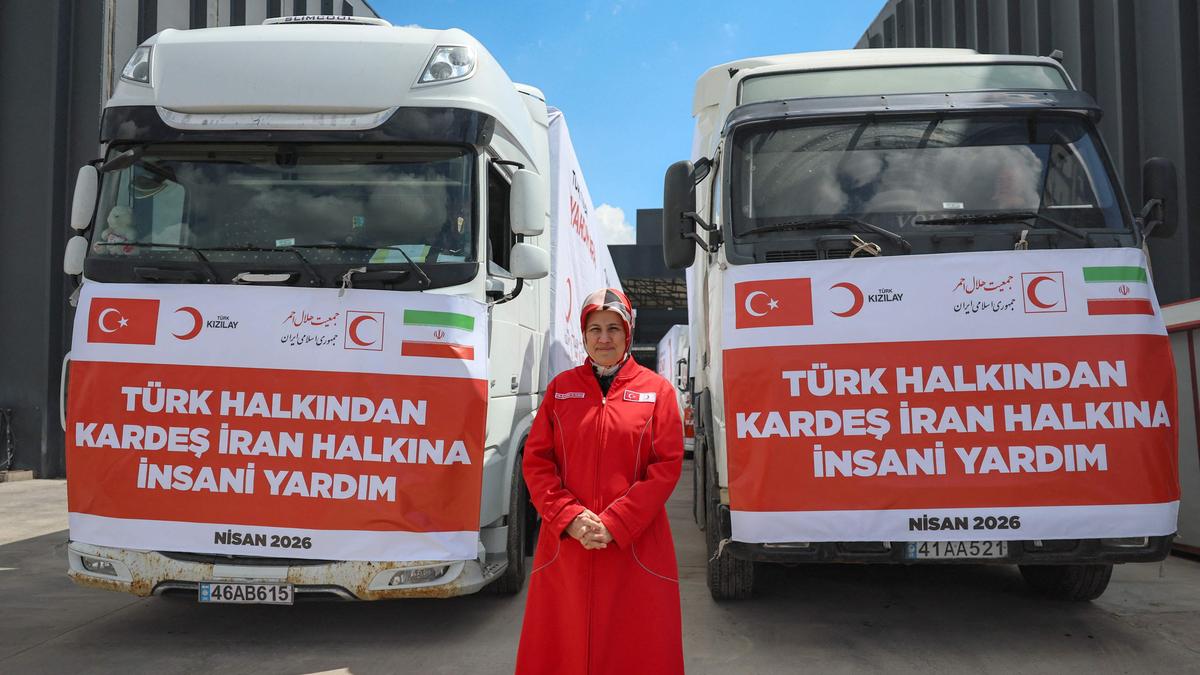
Thirty-three trucks. That is the number. It sounds small when you say it fast, but imagine them lined up, nose-to-tail. They stretch nearly half a kilometer. They are heavy with the weight of human survival—tents, blankets, kitchen kits, and the kind of basic necessities that people only realize are precious once they’ve lost everything.
These trucks are currently vibrating with the low thrum of diesel engines, moving east toward the Gürbulak border crossing. Their destination isn't a marketplace or a warehouse. They are heading toward the grit and the grief of the East Azerbaijan province in Iran, where the earth recently forgot how to be still.
The Anatomy of a Convoy
A convoy is not a parade. It is a logistical heartbeat. Each driver sitting in those high cabs is a character in a story of high-stakes navigation. Consider a man like Ahmet—a hypothetical driver, but one based on the dozens of men who make this run every year. He has a photo of his daughter taped to the dashboard. He has a thermos of tea that has gone lukewarm. He is watching the temperature gauge of his engine because the mountain passes toward Tabriz are steep, and the load he’s carrying—tons of winterized tents—is unforgiving on the transmission.
When a disaster hits, the first forty-eight hours are a blur of adrenaline and chaos. But the days that follow are defined by a different kind of terror: the realization that life must continue without a roof.
The Turkish Red Crescent, or Türk Kızılay, understands this rhythm. They aren't just sending "supplies." They are sending a kit for a new, temporary life. One truck might carry 500 blankets. That is 500 people who will not shiver tonight. Another carries 100 kitchen sets. That is 100 families who can boil water, fry an egg, and maintain the dignity of a hot meal amidst the rubble of their former homes.
Beyond the Border Guard
Border crossings are usually places of friction. There are Forms. There are Stamps. There are men in uniforms with very specific ideas about what is allowed to pass from one sovereign nation to another. But when the ground shakes, those lines on the map tend to blur.
The movement of this convoy from Turkey into Iran is a silent diplomatic dance. It represents a moment where the shared vulnerability of living on a fault line supersedes the noise of international relations. The drivers wait at Gürbulak, the shadow of Mount Ararat loitering in the distance. They watch the sun dip. They wait for the gate to swing open.
Once they cross into Iran, the language on the road signs changes, but the mission remains identical. The trucks will rumble through the Iranian side of the border, heading toward the heart of the damage. The logistics of this are staggering. You cannot simply drive a semi-truck into a disaster zone and hope for the best. You need a recipient. You need a hand to catch the ball you are throwing.
In this case, the Iranian Red Crescent is that hand. The coordination between these two organizations is a masterclass in silent efficiency. They speak the language of "need." How many displaced? How many children? Is there snow on the ground? These are the questions that dictate whether a truck carries medical supplies or heavy-grade plastic sheeting.
The Invisible Stakes of a Blanket
It is easy to look at a news headline about an aid convoy and see it as a footnote. But zoom in.
Imagine a family in a village outside Tabriz. The father is trying to stack stones to create a windbreak. The mother is keeping the children close to a small fire. They have lost their history—the rugs their grandmothers wove, the photos of weddings, the walls that kept the world out.
To them, the sound of thirty-three Turkish diesel engines isn't just "aid." It is proof that they haven't been erased.
There is a psychological weight to a convoy. When those white trucks with the red crescent moon roll into a village, the air changes. The panic, which usually vibrates at a high, thin frequency, begins to settle. People see the tents being unloaded. They see the crates of food. They realize that the world outside their broken valley knows they exist.
The Logistics of Empathy
Logistics is often viewed as a cold science—moving Point A to Point B for the lowest cost. In the context of the Turkey-to-Iran convoy, logistics is an act of empathy.
- Weight Ratios: A truck can carry roughly 20 to 25 tons. If you fill it with blankets, you maximize volume before weight. If you fill it with water, you hit the weight limit long before the truck is full.
- Perishability: Food kits must be shelf-stable. They aren't sending fresh produce; they are sending calories that can survive a week in a vibrating metal box.
- The Last Mile: This is the hardest part. The highways are fine, but the "last mile"—the dirt road that has been cracked by a tremor or blocked by a landslide—is where the real work happens. Often, the supplies from these thirty-three trucks will be broken down into smaller vans or even carried by hand to reach the most isolated hamlets.
The cost of this operation is measured in millions of liras and rials, but the value is measured in hours of sleep. A child who is warm sleeps. A mother who knows there is flour and oil in the kit sleeps.
A Shared Geography of Risk
Turkey and Iran share more than a border. They share the North Anatolian and the East Anatolian fault lines. They are neighbors in a literal, geological sense. They live on a crust that is restless.
This shared risk creates a unique bond. When a major quake hit Van in eastern Turkey years ago, Iranian rescuers were among the first to arrive. Now, the roles are reversed. It is a cycle of "today you, tomorrow me." This isn't charity in the way a billionaire writes a check. This is a neighborhood watch on a continental scale.
The trucks are moving through the night now. The drivers use CB radios to keep each other awake, cracking jokes about the quality of the coffee at the last stop or complaining about the price of fuel. They are ordinary men doing an extraordinary thing, navigating the winding roads of the Iranian plateau.
They are carrying more than just tents. They are carrying a message that says the border is just a line, but the suffering is universal.
The road to Tabriz is long. It is dusty. It is exhausted. But as the first light of dawn hits the windshields of those thirty-three trucks, the destination is finally in sight. The trucks will park. The tailgates will drop. The work of rebuilding a life, one tent at a time, will begin.
The engine stops. The silence of the mountains returns. But for the people waiting in the cold, the silence is finally broken by the sound of help arriving.