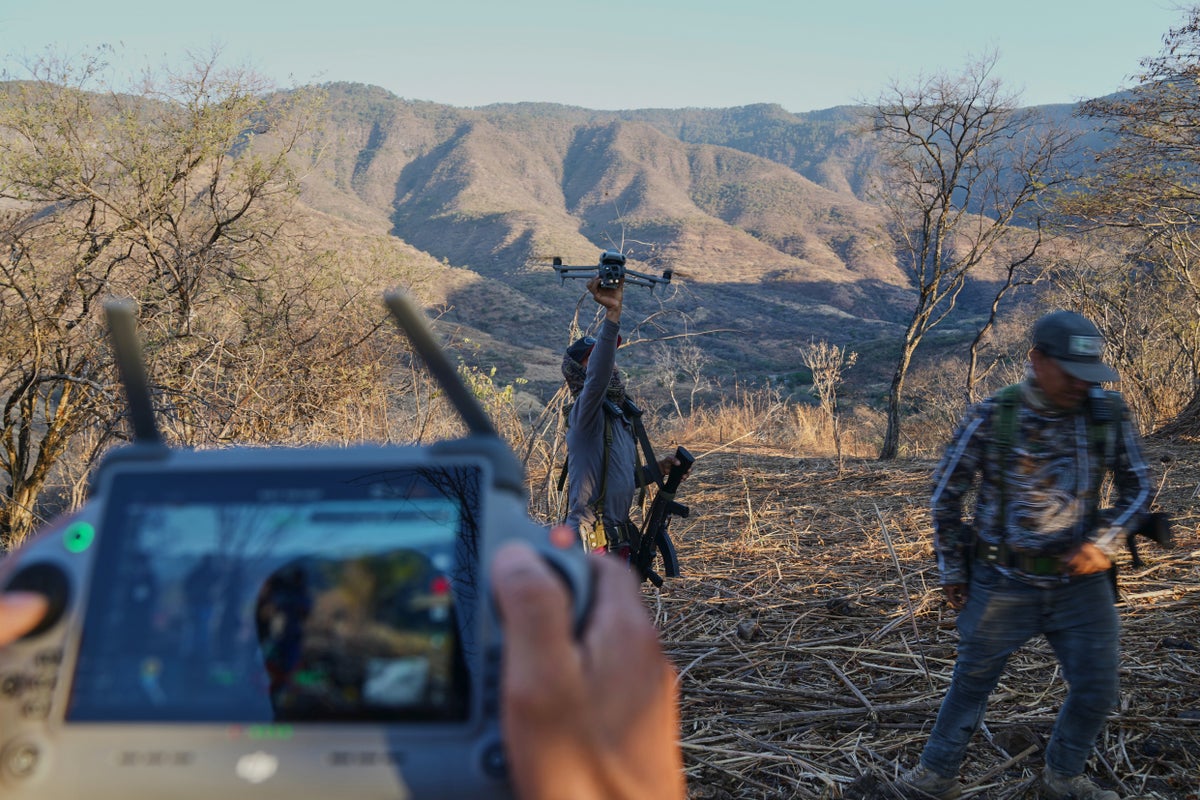
The transition from passive victimhood to active kinetic resistance in rural Mexico represents a fundamental shift in the regional security equilibrium. When the cost of extortion—often referred to as piso—exceeds the projected cost of armed conflict, agrarian populations reach a "survival threshold." This threshold triggers a breakdown in the cartel’s extractive business model and necessitates a decentralized paramilitary response. The recent uprising in Texcaltitlán is not an isolated riot; it is a case study in the failure of criminal governance and the emergence of localized defensive cartels.
The Extortion Multiplier and the Collapse of the Social Contract
The primary driver of rural uprisings is the aggressive expansion of the cartel’s "taxation" base. Traditionally, cartels derived revenue from high-margin, illicit export products (fentanyl, cocaine, methamphetamines). However, diversification into the "protection" of legitimate agricultural commodities—avocados, limes, and livestock—creates a direct friction point with the local labor force.
When a criminal organization like La Familia Michoacana demands a fixed percentage of a crop yield that already operates on thin margins, they are not merely taxing profit; they are seizing the means of subsistence. This creates an existential incentive for the farmer to reallocate capital from seeds and fertilizer toward small arms and munitions.
The Three Pillars of Localized Resistance
The effectiveness of a village-level uprising depends on three specific variables that transform a group of civilians into a viable paramilitary force.
- Topographical Advantage and Tactical Insulation: Rural communities often occupy terrain that negates the advantage of the cartel’s superior numbers. By controlling the limited access roads (choke points), a small group of armed villagers can effectively neutralize a larger mobile force. This is "asymmetric localism," where the defender's knowledge of the micro-terrain compensates for a lack of formal training.
- The Social Cohesion Mandate: Unlike cartels, which are held together by fear and financial incentives, village resistance is built on kinship and shared economic loss. This high level of internal trust prevents the infiltration and "snitching" that usually allow cartels to dismantle opposition before it starts.
- Weaponry Parity: The shift from machetes and hunting rifles to AK-47s and improvised explosives indicates a professionalization of the resistance. These weapons are often sourced from the same black markets that supply the cartels, or in some cases, are "liberated" from previous skirmishes with criminal scouts.
The Cost Function of Defensive Violence
Violence in this context is a rational economic choice. The "Cost of Compliance" (CoC) involves the continuous loss of revenue to extortion, the risk of kidnapping, and the loss of land. The "Cost of Resistance" (CoR) involves the immediate risk of death and the high price of black-market arms.
The uprising occurs when $CoC > CoR + Uncertainty$.
Cartels rely on keeping the CoR prohibitively high through public displays of brutality (the "Terror Premium"). When villagers successfully kill a high-ranking cartel lieutenant, as seen in recent clashes, they shatter this Terror Premium. The perceived power of the cartel undergoes a rapid devaluation, making further resistance more likely across neighboring municipalities.
Logistics of the Agrarian Militia
A village under siege operates as a closed-loop security system. 12-gauge shotguns and semi-automatic rifles are the baseline, but the inclusion of grenades represents a tactical leap. The logistics of maintaining an arsenal in a zone under cartel surveillance requires a decentralized supply chain.
- Ammunition Scarcity: Unlike cartels with deep pockets, militias face a constant ammunition bottleneck. This leads to a tactical preference for high-impact, short-duration ambushes rather than sustained firefights.
- Intelligence Gathering: Villagers utilize local observation posts—often church steeples or high-altitude farmland—to track cartel convoys. This "human SIGINT" (Signals Intelligence) is superior to the cartel's tech-heavy approach because it is invisible and integrated into daily life.
The Sovereignty Void and State Neutrality
The presence of the National Guard or the military often complicates rather than resolves these conflicts. The "Abrazos, no balazos" (Hugs, not bullets) policy creates a power vacuum. When the state refuses to exercise its monopoly on the use of force, it effectively legalizes private violence.
The military often arrives post-facto, documenting the casualties rather than preventing the engagement. This neutrality is interpreted by both cartels and villagers as a green light for total kinetic engagement. The result is a "feudalization" of security, where each village becomes a micro-state responsible for its own borders.
The Lifecycle of an Autodefensa
Historically, these uprisings follow a predictable and dangerous trajectory.
- Phase I: Spontaneous Defense: A specific event (a kidnapped youth, a doubled tax) triggers a violent outburst.
- Phase II: Organization: The village forms a formal "Community Guard."
- Phase III: Corruption or Co-optation: This is the most critical failure point. To sustain a long-term fight against a cartel, the militia needs significant funding. If they do not receive state support, they often turn to rival cartels for "sponsorship" or begin taxing the very community they intended to protect.
This creates a cycle where the "liberators" eventually adopt the extractive behaviors of the original oppressors.
Structural Vulnerabilities in Cartel Expansion
Cartels are currently overextended. By attempting to govern civilian populations while simultaneously fighting inter-cartel wars and evading federal pressure, they have created a "governance deficit." They lack the manpower to occupy every village they tax. Their model relies on "skimming" from a distance. When a village refuses to pay and kills the collection squad, the cartel must decide whether to commit a significant force to a "punitive expedition" or retreat.
A punitive expedition is costly. It draws heat from the federal government and depletes the cartel's frontline soldiers. If multiple villages rise up simultaneously, the cartel's regional command structure faces a multi-front war it is not equipped to manage. This is the "Insurgency Tax" that is currently devaluing the cartel's territorial assets.
Strategic Forecast for Regional Security
The proliferation of grenades and high-caliber rifles among the peasantry signals a shift toward "low-intensity civil war" in the states of Guerrero, Michoacán, and México. We should expect a fragmentation of territory where cartels control the transit corridors (highways), but lose control of the production zones (the fields).
For stakeholders and analysts, the metric to watch is not the body count, but the "price of commodities." When lime or avocado prices spike, it is a lagging indicator of cartel interference. When prices stabilize despite cartel presence, it suggests a successful, if violent, stalemate has been reached by local militias.
The immediate tactical play for these communities is the formation of a "Regional Defensive Bloc." By linking the communications of multiple villages, they can move from a static defense to a mobile response force. This would force the cartels to either negotiate a lower "tax rate" or face a coordinated paramilitary threat that rivals their own. The state's role will remain reactionary until the "Autodefensa" movement threatens the national macro-economy, at which point a heavy-handed, and likely indiscriminate, federal intervention will be triggered to re-establish the appearance of order.
Direct kinetic investment in local defense is currently the only high-probability survival strategy for these agrarian zones. The "Texcaltitlán Model" will likely be replicated in any region where the cartel’s extractive demands exceed the caloric minimum required for the population's survival.

.jpg?width=1200&auto=webp&trim=0%2C100%2C0%2C100)