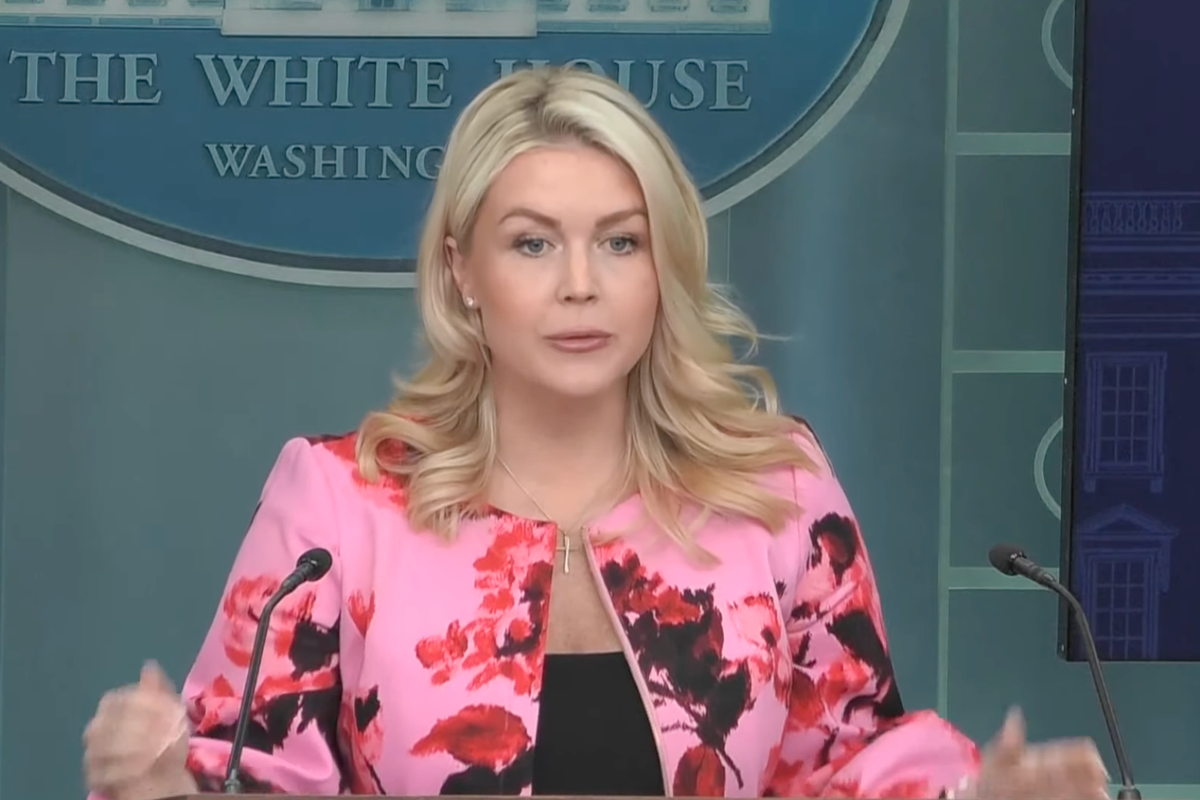
The media is hyperventilating because Karoline Leavitt mentioned a "loud prayer" before stepping behind the podium. They call it a breach of the secular-political divide. They call it performative. They’re missing the point entirely. The real story isn't that a press secretary prays; the story is the absolute delusion of the "neutral" observer.
For decades, the White House briefing room has operated under a gentleman’s agreement of feigned objectivity. Reporters pretend they aren't looking for a viral clip to boost their Substack, and press secretaries pretend they are simply "relaying facts." It's a theater of the absurd. By bringing a prayer into the mix, Leavitt hasn't introduced bias into a sterile environment; she has simply stopped lying about the internal engine driving the machine.
The Objective Reporter Is a Dead Species
We need to kill the idea that "secular" equals "unbiased." Every human being walking into that room is governed by a dogma. Some worship at the altar of partisan ideology, others at the feet of careerism, and some at the shrine of institutional legacy.
When a journalist rolls their eyes at a "loud prayer," they aren't defending the First Amendment. They are defending their own monopoly on moral signaling. I’ve sat in rooms with editors who would fire a writer for a typo but give a pass to a blatant fabrication if it served the "greater good" of their narrative. That is a religion. It just doesn't have a hymnbook.
The outcry over Leavitt’s prayer is a classic "displacement activity." It’s easier to argue about a thirty-second spiritual moment than it is to address the fact that the entire briefing process is a broken, ritualized charade.
Authenticity as a Tactical Weapon
In the world of high-stakes communication, "authenticity" is usually a buzzword used by consultants to sell mediocrity. But in a polarized environment, radical transparency about one’s worldview—even if that worldview involves prayer—is a tactical masterstroke.
Why? Because it eliminates the "gotcha" moment.
If you know exactly where someone stands, you can't "expose" them. The press corps thrives on peeling back layers to find a hidden motive. When Leavitt leads with her motive, she effectively disarms the room. You can't "unmask" a person who is already standing there without a mask.
I've watched corporate leaders try to "neutralize" their public image to avoid offending anyone. They end up looking like plastic mannequins. Nobody trusts them. Then comes the leader who says, "This is what I believe, and this is how I’m going to run this company." Half the room hates them instantly, but the other half would walk through fire for them.
Leavitt is choosing the latter. It's not about the prayer; it's about the signal of unyielding identity.
The Productivity of Conviction
Let’s talk about the actual mechanics of "loud prayer" in a high-pressure environment. If you’ve ever managed a team through a crisis, you know that the biggest enemy isn't the opposition; it's the internal friction of doubt.
In any high-stress boiler room—whether it's a political campaign, a floor at a hedge fund, or a surgical unit—you need a "syncing" mechanism. Some teams use a morning huddle. Some use shots of espresso and screaming matches. Leavitt’s team used prayer.
From a purely organizational standpoint, the specific content of the ritual matters less than the collective alignment it produces. It creates a psychological "us against the world" fortress. Critics call it exclusionary. In the context of a high-performance team, that’s exactly what it’s supposed to be. You are either inside the fortress or you are the target.
The Myth of the Secular State
The "separation of church and state" is the most misunderstood phrase in the American lexicon. It was designed to keep the government out of the church, not to lobotomize the individuals who serve in government.
The idea that a public servant should leave their core convictions in the coat closet before entering the West Wing is not only impossible; it’s dangerous. Do you really want a leader who has no North Star? Someone whose only compass is the latest polling data or the whims of a focus group?
We have tried the "technocrat" model. We have tried the "managerial" model where "efficiency" is the only god. It gave us endless bureaucracy and a total vacuum of accountability.
The High Cost of the Middle Ground
There is a cost to this contrarian approach. When you stop playing the "neutrality" game, you lose the ability to appeal to the "undecideds." You alienate the institutionalists. You invite 24/7 scrutiny of your personal life.
But in 2026, the middle ground is a graveyard.
The companies and political figures who are winning are the ones who have realized that a lukewarm "maybe" is worse than a "no." If you try to be for everyone, you are for no one. Leavitt’s "loud prayer" is a line in the sand. It tells the public: "This is the team. This is the vibe. If you don't like it, there's the door."
Dismantling the "People Also Ask" Nonsense
People are asking: "Is it legal to pray in the White House?"
Wrong question. The question is: "Why are you so afraid of it?"
If a press secretary mentioned they did a "group meditation" or a "manifestation circle," the same critics would be praising their "mindfulness." The issue isn't the spiritual practice; it's the specific tradition. It’s the aesthetic of conviction that terrifies the institutionalists.
People are asking: "Does this make the press corps' job harder?"
Yes. Good.
The press corps' job shouldn't be easy. It shouldn't be a cozy exchange of scripted questions and prepared talking points. It should be a clash of worldviews. When the press secretary stops pretending to be a neutral vessel of information, it forces the journalists to stop pretending to be neutral seekers of truth. It brings the conflict into the light.
The End of the Performance
The "loud prayer" wasn't the start of a performance; it was the end of one. It was the moment the mask slipped, and instead of a terrified bureaucrat, people saw a team with a mission.
Whether you agree with that mission is irrelevant to the analysis of its effectiveness. In an era of infinite noise, the loudest thing you can do is be unapologetically yourself.
Stop looking for "unbiased" sources. They don't exist. Look for the people who are honest about their biases. Look for the people who pray loudly, or argue loudly, or lead loudly. At least with them, you know where the blade is coming from.
The era of the polite, neutral, soul-crushing briefing is over. Good riddance.
Stop asking for "balance" and start asking for clarity. If clarity comes wrapped in a prayer, so be it. The alternative is a polite lie, and we’ve had enough of those to last a century.
Pick a side or get out of the way.