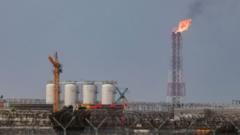
In the dark, the South Pars gas field doesn't look like a geopolitical powder charge. It looks like a constellation fallen into the sea. Thousands of steel arteries pulse beneath the turquoise waters of the Persian Gulf, carrying the literal warmth of nations through a labyrinth of valves and high-pressure tubing. If you stood on a rig at midnight, the hum of the turbines would vibrate through the soles of your boots, a constant, mechanical reminder that modern civilization is merely a series of controlled explosions.
But the control is slipping.
Recent rhetoric from the Mar-a-Lago Situation Room has moved past the standard chess of diplomacy into something far more visceral. Donald Trump has signaled a shift in the American posture that borders on the biblical: the total destruction of Iran’s energy crown jewel should Tehran strike Qatar again. We are no longer talking about surgical strikes or frozen bank accounts. We are talking about erasing the engine of an economy.
The Invisible Architect of the Middle East
To understand why a gas field matters more than an army, you have to look at the map—not the one with borders, but the one with pipes. Qatar and Iran sit atop the North Field-South Pars complex. It is the largest natural gas deposit on Earth. It is a shared inheritance, a massive subterranean lake of energy that ignores the religious and political fractiousness above it.
Imagine two neighbors sharing a single, massive well. One neighbor, Qatar, has used its half to build glass towers and global influence. The other, Iran, views its half as its final lung—the only thing keeping a sanctioned, struggling economy breathing. When Trump threatens to "blow up the entirety" of this field, he isn't just threatening a refinery. He is threatening to collapse the very floor upon which the Iranian state stands.
Natural gas is a fickle, terrifying master. Unlike oil, which sits in sluggish pools, gas is under immense, screaming pressure. A major kinetic strike on the South Pars infrastructure wouldn't just result in a fire. It would create a thermal event visible from low earth orbit. The pressure release alone could destabilize the geological integrity of the wells, potentially ruining the reservoir for generations.
The Human Cost of a Blown Valve
Consider a technician named Elias. He is a hypothetical composite of the thousands of engineers who live on these offshore platforms for weeks at a time. Elias doesn't care about the revolutionary guard or the nuances of the Monroe Doctrine. He cares about the pressure gauge on Line 4. He knows that if the atmospheric sensors trip, he has exactly ninety seconds to reach a life pod.
When world leaders talk about "blowing up" energy infrastructure, they rarely mention the Eliases of the world. They talk in "macro-effects" and "deterrence vectors." But the reality is a wall of flame three hundred feet high. It is the sudden, violent unemployment of millions of Iranians who rely on gas for heating, electricity, and the basic manufacture of bread.
The stakes for Qatar are equally existential. Because the field is shared, a catastrophic explosion or a massive pressure drop on the Iranian side could physically damage the Qatari side of the reservoir. It is a suicide pact written in hydrocarbons. If Iran attacks Qatar, and the U.S. retaliates by leveling South Pars, the entire region loses its primary source of wealth. The smoke would choke the very sky that the world's flight paths depend on.
The Mechanics of the Threat
Trump’s strategy is built on a specific brand of hyper-leverage. By targeting the gas field, he is bypassing the Iranian military and going straight for the "off" switch of the country.
- Economic Decapitation: Natural gas accounts for a massive chunk of Iran's domestic energy consumption and its remaining export revenue.
- Environmental Catastrophe: A full-scale strike would lead to a methane release of such magnitude that it would dwarf previous industrial disasters, creating a localized "greenhouse effect" and poisoning the waters of the Gulf.
- Regional Contagion: The debris and fire would halt shipping in the Strait of Hormuz, through which a fifth of the world’s oil passes.
The logic is simple. Brutal. Effective? That remains the terrifying question.
History shows us that when you corner a regime and threaten its most vital organ, they don't always surrender. Sometimes, they decide that if they are going to burn, they might as well turn the rest of the world into an ash heap. This is the "Samson Option" of the energy world.
A World Held in the Balance
The silence of the Persian Gulf is deceptive. Beneath the waves, the gas is moving at hundreds of miles per hour, pushed by the weight of the earth itself. Above the waves, the rhetoric is moving even faster. We have reached a point where the infrastructure of our lives—the things that keep our lights on and our houses warm—has been fully weaponized.
We are watching a high-stakes poker game where the chips are the literal atoms of the planet. If the "entirety" of South Pars goes up, it won't just be a win for one side or a loss for the other. It will be a scar on the earth that lasts for centuries.
The gauges are in the red. The engineers are watching the screens. And the men in the air-conditioned rooms are holding the matches, waiting to see who blinks first in the heat of the coming fire.
One spark is all it takes to turn a constellation into a supernova.