The sky over the Emirates doesn't just turn gray; it bruises. It becomes a heavy, violet weight that hangs low over the Hajar Mountains and the vast, sandy basins of the interior. When the clouds finally break, the transformation of the earth is instantaneous. Dry, cracked wadis—canyons that have been silent and parched for months—suddenly wake up. They don't just flow. They roar.
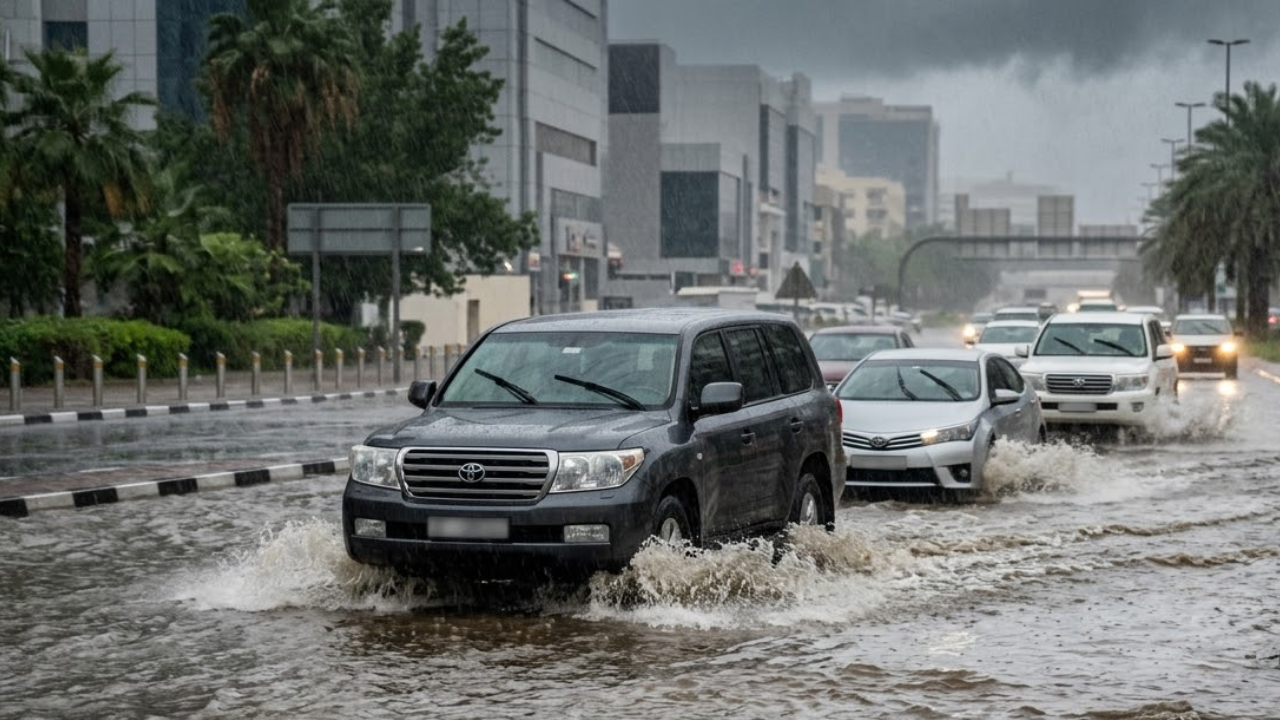
Ahmed knew the sound, but he didn't respect it. He was thirty minutes late for a dinner in Fujairah, idling in his white SUV at the edge of a crossing where the asphalt simply vanished under a swirling tea-colored tide. To his left, the water looked shallow, perhaps only reaching the hubcaps. He could see the road emerging on the other side, barely fifty meters away. It was a gap he had crossed a hundred times in the dry season.
He shifted into gear. He thought about the time he’d save. He didn't think about the physics of moving water or the legislative hammer waiting on the other side of the rain.
The Illusion of Heavy Metal
There is a false sense of security that comes with sitting two meters above the ground in a leather-trimmed cabin. We believe that two tons of steel and four-wheel drive make us indifferent to nature. This is the first mistake.
When a wadi floods, the water is dense with silt, rocks, and debris. It isn't like the water in a swimming pool. It acts more like liquid concrete. Once that flow reaches the chassis of a vehicle, it exerts a lateral force that few engines can overcome. Buoyancy begins to work against you. The very air trapped inside your car, the thing keeping you dry and comfortable, turns your vehicle into a boat. But it is a boat without a rudder.
Ahmed felt the steering wheel go light. It was a sickening, floaty sensation, as if the tires were suddenly made of mist. For a moment, the world stayed silent, save for the muffled thrum of his air conditioning. Then, the current caught the rear of the SUV, swinging it sideways like a toy.
The authorities in the UAE have watched this scene play out on CCTV and body-cam footage too many times. They have seen the bravado of drivers turn into the frantic scratching at windows as the electrical systems short-circuit, locking doors and trapping occupants in a rising tide. This isn't just about a driver being reckless; it’s about the resources required to fix the mistake. Every time a car enters a flooded valley, a chain reaction begins. Search and rescue teams, divers, and helicopter crews are pulled away from other potential emergencies.
The Ledger of Risk
Because logic often fails in the heat of a "quick shortcut," the law has had to become the voice of reason. The Ministry of Interior doesn't issue warnings as suggestions. They are cold, hard boundaries designed to protect the reckless from themselves.
If you decide that your schedule is more important than the flood markers, the cost starts at Dh2,000. That is the immediate fine for entering a flooded valley, regardless of whether you get stuck or glide across. It is a steep price for a few minutes of saved time, but the financial sting is only the surface of the consequence.
In the UAE, the "Black Point" system is the true measure of a driver’s standing. Twenty-four points, and your license is gone. A single excursion into a restricted wadi during a storm hands you 23 black points. It is a near-total wipeout of your right to drive. You are left hovering on the precipice, one minor indicator error away from a complete ban.
Consider the logistical nightmare that follows. Along with the fine and the points, the vehicle is impounded for 60 days. Two months. Sixty mornings of finding a taxi, sixty evenings of asking for rides, sixty days of seeing an empty spot in your driveway—all because of a decision that took three seconds to make.
The Hidden Currents
Beyond the fines and the impoundment lots lies a deeper, more invisible stake: the erosion of community safety. When the National Center of Meteorology (NCM) issues a red or amber alert, it is a data-driven prophecy. They are monitoring the convergence of high-pressure systems and moisture-laden winds. When they tell us to stay away from the valleys, they are looking at the volume of water falling on the mountains, knowing it will eventually funnel into the narrow veins of the wadis with terrifying speed.
We often treat weather warnings like background noise, a digital "cry wolf" in our notification center. But the desert has no drainage system like a coastal metropolis. The sand can only drink so fast. The rest of the water stays on the surface, searching for the lowest point.
Ahmed’s SUV eventually snagged on a submerged outcrop of rock. He was lucky. A police patrol, already stationed near the wadi mouth to prevent exactly what he had tried to do, saw his hazard lights flickering through the downpour. They didn't see a "master of the road." They saw a man who had gambled his life, his finances, and his mobility on the depth of a puddle.
The rescue took three hours. It involved twelve men and a specialized recovery vehicle. While they worked, the road behind them remained blocked, delaying families who were trying to get home safely and stopping emergency vehicles that were needed elsewhere.
The Anatomy of a Warning
Why 23 points? Why 60 days? These numbers are not arbitrary. They are calculated to be life-altering. The legal framework is built on the understanding that human ego is a powerful force. We tell ourselves, "My car is bigger," "I know this road," or "I'm a better driver than the rest."
The law removes the "if" from the equation. It doesn't matter if you are a professional rally driver or a novice; the wadi does not discriminate. The 23-point penalty is a "one-strike" policy. It is the government saying that some risks are so great they forfeit your privilege to be behind the wheel.
It is a sobering thought to realize that the most expensive thing you can do in a rainstorm isn't losing your car to the water—it’s the cost of the consequences that follow you home. The fine is paid and forgotten, but the 60 days of lost autonomy and the shadow of those black points linger like the dampness in a flooded engine.
The Silence After the Storm
When the rain stops in the UAE, the transformation is once again sudden. The sun comes out, the air feels scrubbed clean, and the desert blooms with an impossible green hue for a few fleeting days. The wadis return to being peaceful, rocky paths.
But for those who ignored the red flags, the storm is just beginning. There are court dates to attend, impoundment lots to visit, and the long, slow realization that a single "shortcut" has fundamentally rewritten their daily life for the next year.
The desert is beautiful, but it is indifferent. It doesn't care about your dinner plans, your heavy SUV, or your confidence. It only follows the path of least resistance. Our task is to ensure we aren't standing in its way.
The next time the sky bruises and the sirens hum in the distance, look at the water. Notice how it moves—not as a surface to be conquered, but as a force that has been carving through stone for millennia. Your car, no matter how powerful, is just a temporary visitor in its path.
The road will still be there when the water clears. The question is whether you will still have the right to drive on it.
Would you like me to find the specific locations of the most flood-prone wadis in the Northern Emirates so you can plan your next trip safely?