The desert does not keep secrets; it only buries them. If you stand in the empty quarters of the Arabian Peninsula at dusk, the silence is so absolute it feels heavy. It is a physical weight on the eardrums. For generations, that silence represented peace. Today, for the people living beneath that vast, darkening canopy, silence is the sound of a threat you cannot see until it is too late.
In a series of clinical briefings in Washington, a number was recently etched into the ledger of global geopolitics: $16 billion. To a policy analyst, it is a line item. To a defense contractor, it is a windfall. But to the families in Riyadh, Abu Dhabi, and Kuwait City, that number is the cost of buying back the stillness of the night.
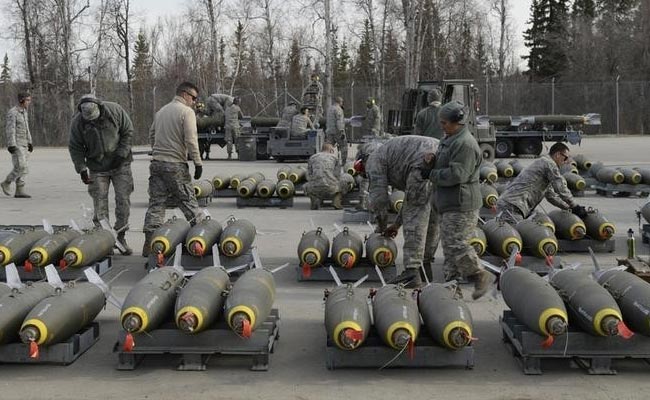
The United States has formally cleared a massive wave of munitions, missile systems, and logistical support for its Gulf allies. We are talking about thousands of Hellfire missiles, advanced radar arrays, and the sophisticated nervous systems required to knit them together. This isn't just a shopping spree. It is a frantic fortification against a sky that has grown increasingly crowded with the humming signatures of Iranian-made drones and the ballistic arcs of proxy-fired missiles.
The Ghost in the Machine
Consider a father in a coastal Saudi village. Let’s call him Ahmed. Ahmed doesn’t care about the intricacies of Section 36(b) of the Arms Export Control Act. He cares about the low, lawnmower-like drone of a Shahed-136 UAV. He remembers the 2019 attacks on the Abqaiq and Khurais oil facilities—a morning when the sky rained fire and the global economy stumbled.
That morning changed the psychology of the region. It proved that even the most expensive traditional militaries could be humbled by "asymmetric" tools—cheap, buzzing robots that fly low enough to hug the dunes and bypass traditional sensors.
When the State Department greenlights the sale of $1.2 billion in TOW missiles or $2.8 billion in logistics for the Saudi land forces, they aren't just selling hardware. They are selling the hope that Ahmed’s children won't wake up to the sound of an explosion. The hardware is the "what," but the "why" is a bone-deep, regional anxiety that has been simmering since the shadow war with Iran moved from the docks of the Persian Gulf to the very air people breathe.
The Invisible Shield
Money moves faster than metal. While the approvals are public, the delivery of these systems takes years. This creates a strange, liminal space where a nation is "protected" on paper but remains vulnerable on the ground.
The centerpiece of this $16 billion package isn't just the flashy missiles. It is the data. A significant portion of the deal involves "Integrated Air and Missile Defense" (IAMD). This is the digital glue. Imagine a thousand different eyes—radars on ships, sensors on drones, satellites in orbit—all trying to spot a single needle moving at Mach 5. Without the American-made software to sync these eyes, they are just isolated observers.
The complexity is staggering. One must distinguish between a commercial airliner, a flock of migrating birds, and a cruise missile programmed to zig-zag through a mountain pass. A single mistake costs lives. A single success goes unnoticed by the public. That is the thankless nature of defense; your best days are the ones where absolutely nothing happens.
The Weight of the Ledger
There is a hollow feeling in the gut when you realize that $16 billion could build entire cities, fund a decade of medical research, or green the desert. The tragedy of the Middle East is often measured in this "opportunity cost."
Why now? The timing is no accident. With the conflict in Yemen remains a flickering ember and the broader regional tensions with Iran reaching a boiling point, the Gulf nations are no longer content with "good enough." They are seeing what is happening in Ukraine, where the sky is a constant battlefield of attrition. They see that in modern war, you don't run out of courage—you run out of interceptors.
The US, meanwhile, plays a delicate game. By approving these sales, Washington is tethering these nations to American technology for the next thirty years. You don’t just buy a Patriot missile battery and walk away. You buy the technicians, the software updates, the training, and the political alignment that comes with it. It is a marriage of necessity, signed in ink and defended with gunpowder.
A Sky Reclaimed
We often talk about "arms races" as if they are sporting events with a clear finish line. They aren't. They are marathons run in the dark.
The $16 billion spent today is a bet on the future. It is a bet that by making the cost of an attack too high, the attack will never happen. It is a gamble on the deterrent power of a well-stocked warehouse.
Back in the desert, as the sun dips below the horizon, the stars begin to poke through the purple haze. For the people below, the goal isn't military glory or regional hegemony. It is much simpler than that. They just want to look up at the vast, shimmering expanse and know that if they hear a sound in the distance, it’s only the wind shifting the sand.
The ledger is signed. The crates are being packed. The price of silence has been paid, but the peace remains as fragile as a glass ornament in a sandstorm.


