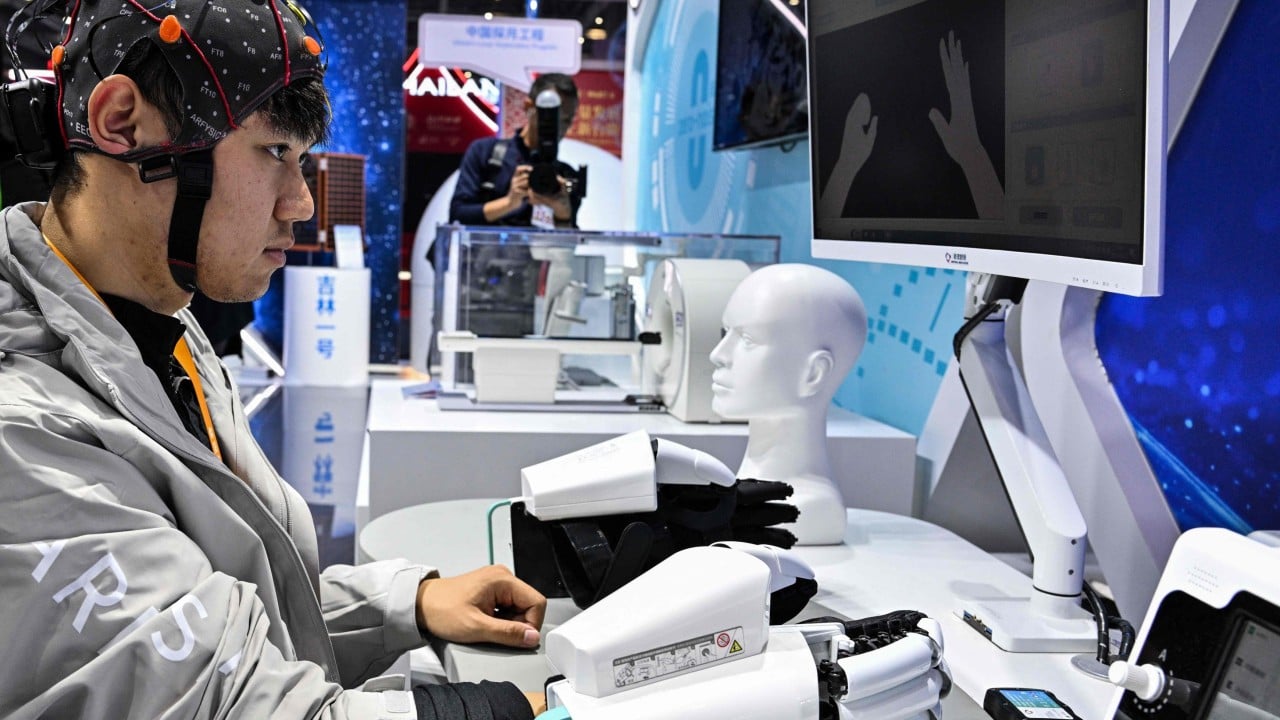
In a sterile lab in Shanghai, a macaque monkey reaches for a virtual grape on a screen. He doesn’t use his hands. He doesn’t even twitch a muscle. He simply thinks, and the digital cursor obeys. This is not a scene from a high-budget sci-fi thriller. It is Tuesday. While the world was distracted by the loud, clashing cymbals of trade wars and social media cycles, a far more profound shift occurred in the quiet, microscopic spaces between neurons.
The United States once held the keys to this kingdom. For decades, the American approach to Brain-Computer Interfaces (BCI) was the gold standard, defined by the pioneering work of Utah-based researchers and the aggressive, headline-grabbing promises of Silicon Valley billionaires. But something shifted. The momentum stalled. Now, the map of neural innovation has a new epicenter, and it isn't in California.
Consider a hypothetical patient named Elias. He is forty-five, a former carpenter, and currently locked in a body that refuses to move due to a spinal cord injury. In 2005, Elias would have looked to American clinical trials as his only North Star. Today, if he wants the most advanced, integrated, and rapidly evolving neural lace, he might find himself looking toward the East. This isn't because American scientists lost their spark. It’s because they got tangled in their own safety nets while their competitors decided to sprint.
The Cost of Caution
American innovation is often a victim of its own rigor. The "Doctrine of the Mean," a philosophical pillar usually associated with Confucian balance, has ironically become the defining trait of the U.S. regulatory approach. We seek the middle ground. We prioritize the mitigation of every conceivable risk. We wait.
In the U.S., the path from a lab-proven electrode to a human skull is a marathon through a field of broken glass. The Food and Drug Administration (FDA) requires years of longitudinal data. While this protects patients from immediate harm, it creates a "valley of death" for funding. Investors are fickle. They want returns in five years, not fifteen. Consequently, many American BCI startups wither in the pre-clinical phase, their breakthroughs relegated to academic journals that no one outside of a university library reads.
China, meanwhile, has adopted a different rhythm. By designating BCI as a "national strategic priority" in its 14th Five-Year Plan, the Chinese government removed the friction. They didn't just provide grants; they built entire ecosystems. In 2023 alone, China’s patent filings in BCI technology surpassed the U.S. by a significant margin. According to data from the China Academy of Information and Communications Technology, China now accounts for roughly 35% of global BCI patents, while the U.S. share has dipped toward 30%.
Numbers are cold. The reality is warmer, and more visceral. It is the difference between a patient waiting a decade for a trial and a patient receiving an implant in eighteen months.
A Tale of Two Philosophies
To understand the gap, we have to look at the hardware. For years, the "Utah Array" was the undisputed king—a tiny bed of silicon needles poked into the brain. It worked, but it was invasive. It caused scarring. The brain, being a jealous organ, eventually attacked the foreign object, coating it in glial cells until the signal went dark.
American researchers, wary of failure, spent years trying to perfect the "non-invasive" or "minimally invasive" approach. They aimed for headsets that read signals through the bone or stents that traveled through blood vessels. They wanted the reward without the risk of open-brain surgery. It was a noble pursuit. It was also slow.
Across the Pacific, the strategy was more direct. Chinese teams at institutions like Tsinghua University and companies like NeuraMatrix focused on "high-bandwidth, low-latency" semi-invasive systems. They accepted the surgical reality and focused on miniaturization and biocompatibility at a scale that defies traditional manufacturing. They weren't looking for a "mean" or a middle ground. They were looking for a connection.
The result? In 2024, a team at Beijing Xuanwu Hospital successfully restored motor function in a quadriplegic patient using a wireless BCI called the NEO (Neural Electronic Opportunity). The device is about the size of two coins. It doesn't require batteries inside the skull; it powers up through high-frequency induction from a wearable headset. It is elegant. It is functional. And most importantly, it is actually inside a human being.
The Invisible Stakes
Why does this matter to someone who isn't paralyzed? Why should the average person care about who wins the "brain race"?
Because the brain is the final frontier of labor and agency. We are moving toward a world where the bandwidth of our thumbs on a glass screen is no longer sufficient. Whether it is managing complex industrial systems, treating refractory depression, or simply keeping pace with Artificial Intelligence, the BCI is the bridge.
If the U.S. cedes this territory, it isn't just losing a market. It is losing the ability to set the ethical and technical standards for how humans merge with machines. When you own the infrastructure, you own the rules. The Chinese model of BCI development is deeply integrated with their national data strategy. Imagine a world where your most private thoughts—the neural impulses that precede action—are processed through a framework designed by a state that prioritizes collective stability over individual privacy.
The stakes are not just medical. They are existential.
The Great Deceleration
There is a specific kind of frustration felt by American neurobiologists today. It is the feeling of running a race in a swimming pool while your opponent is on a track.
Take the case of "Neural Dust," an American concept for tiny, wireless sensors that could monitor nerves. It was a brilliant, "game-changing" (to use a forbidden term) idea born at Berkeley. But the transition from a brilliant idea to a mass-produced medical reality in the States is hampered by a lack of specialized manufacturing.
China has turned the Yangtze River Delta into a "Neural Valley." They have the specialized lithium battery plants, the high-precision medical-grade plastics factories, and the rapid-prototyping labs all within a twenty-mile radius. An engineer in Shanghai can have a new electrode design fabricated, tested in a lab, and iterated upon in forty-eight hours. In Pittsburgh or Austin, that same process might take six weeks.
Speed creates a feedback loop. More trials lead to more data. More data leads to better algorithms. Better algorithms attract more talent.
The Human Element
Let’s go back to Elias.
If Elias is in Boston, he is told to be patient. He is told that the technology is "coming," but the regulatory hurdles are there for his protection. He sits in his chair, watching the seasons change through a window, waiting for a committee to decide if a certain millivolt of electricity is safe enough for his motor cortex.
If Elias were in a similar position in a high-tech hub in China, he might already be part of a "Green Channel" program. He would be an early adopter, a pioneer in a national project. He might face more risk—a higher chance of infection or a shorter device lifespan—but he would have his agency back.
Which is the more "human" path?
The American "Doctrine of the Mean" argues that protecting the individual from harm is the highest virtue. The Chinese "Strategic Sprint" argues that restoring the individual to the collective—giving them back their ability to work and communicate—is the greater good. It is a clash of fundamental values, played out in the folds of the cerebral cortex.
The Turning Tide
The lead is not yet insurmountable, but the gap is widening. The U.S. still produces the most cited research papers in neuroscience, but citation counts don't move paralyzed limbs. Clinical application does.
We are seeing a migration of talent. Brilliant young Ph.D. students from MIT and Stanford are increasingly looking at the regulatory flexibility and massive state funding in Asia as a more viable path for their life's work. They don't want to spend their thirties writing grant applications that get rejected because they are "too ambitious." They want to build.
The silence in the American BCI sector is the sound of a missed opportunity. It is the quiet hum of a lab where the lights are off because the startup ran out of runway. Meanwhile, the sound in China is the rhythmic clicking of a robotic arm, controlled by a mind that refused to wait for permission.
History is rarely changed by those who played it safe. It is shaped by those who were willing to be first, even if it meant being messy. We are currently witnessing the colonization of the human mind, and the flags being planted aren't the ones we expected to see.
The monkey in Shanghai continues to move the cursor. He doesn't care about the "Doctrine of the Mean." He just wants his grape. And as long as he keeps getting it faster than his counterparts in the West, the center of gravity for human evolution will continue to shift, one neuron at a time.
Imagine the look on the carpenter’s face when he realizes the tools he needs are being built in a language he cannot read.