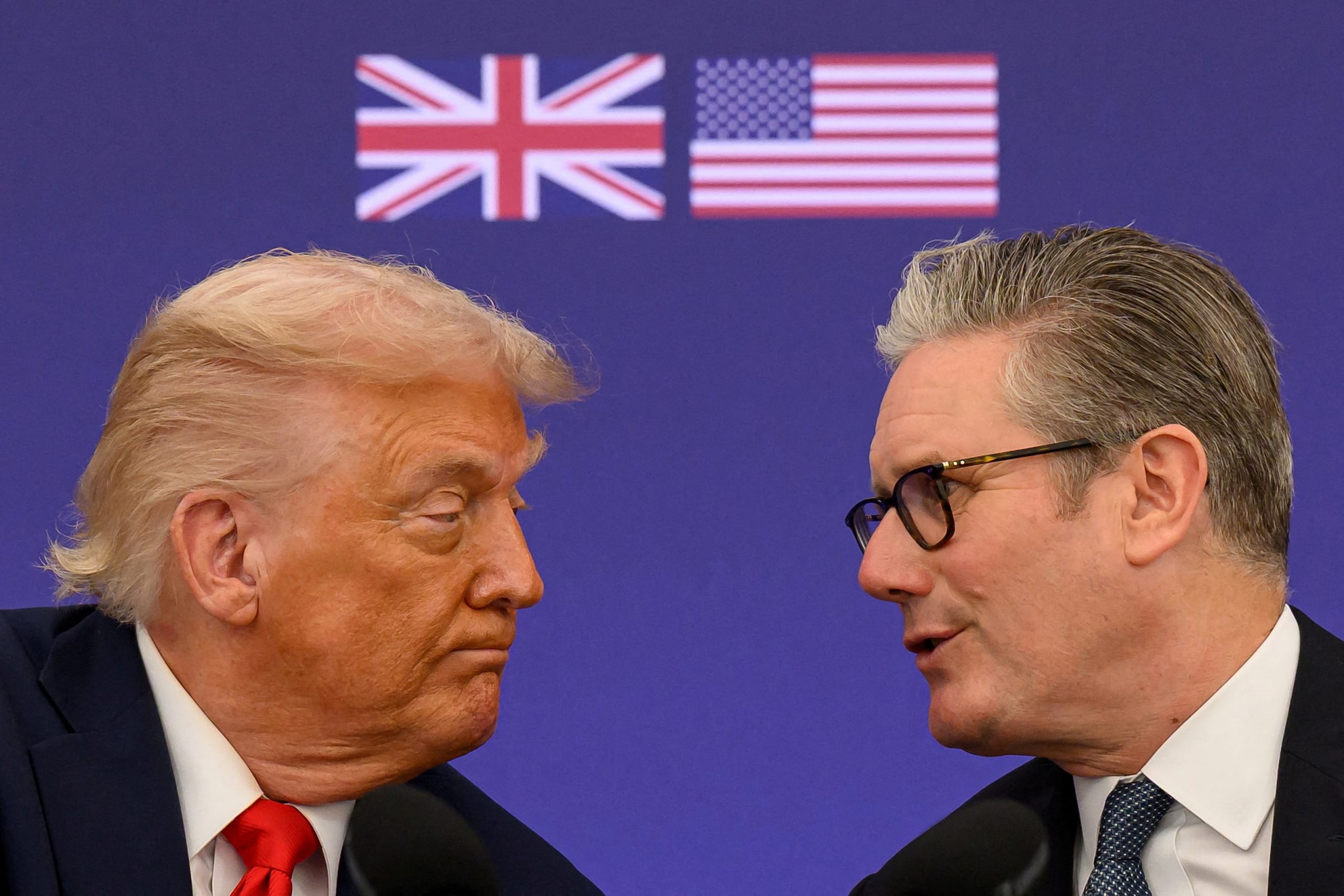
Keir Starmer is "fed up." That is the narrative leaking out of Downing Street like gas from a fractured North Sea pipe. The Prime Minister wants you to believe that your heating bill is a geopolitical hostage situation, orchestrated by a villainous duo of Donald Trump’s protectionism and Vladimir Putin’s pipelines. It’s a convenient story. It’s also a total abdication of domestic reality.
Pointing at Washington or Moscow is the ultimate political get-out-of-jail-free card. It shifts the burden of proof from Whitehall to the world stage, where Starmer has zero jurisdiction and even less leverage. If you believe the problem is purely external, you’ll stop asking why the UK’s energy infrastructure has the resilience of a wet paper towel.
The truth is colder. The UK isn’t suffering from a global energy crisis; it’s suffering from a decades-long, bipartisan commitment to systemic fragility.
The Trump and Putin Red Herring
Blaming Putin for high gas prices in 2026 is like blaming a storm for a house falling down when you knowingly built it on a swamp. Yes, the invasion of Ukraine disrupted global flows. Yes, the weaponization of Nord Stream changed the math for Europe. But the UK’s vulnerability to those shocks was a choice.
We entered the crisis with the lowest gas storage capacity of any major European economy. While Germany and France were stuffing every salt cavern and tank they owned with reserves, the UK was content to live hand-to-mouth on the spot market. When the price spiked, we didn't have a buffer. We had a bill.
Then there’s the Trump factor. The Prime Minister’s "concern" about American energy policy is a smokescreen for the UK's failure to secure bilateral stability. If a shift in U.S. LNG export priorities or a tariff tweak in D.C. can send British pensioners into fuel poverty, that isn't a "Trump problem." That is a "sovereignty problem." Dependence is not a policy; it’s a weakness. Calling out Trump is just a pre-emptive strike to mask the fact that the UK has failed to diversify its energy mix fast enough or deep enough to matter.
The Grid is the Real Enemy
The competitor press loves to talk about "rising costs." They rarely talk about marginal pricing.
In the UK, the most expensive MWh of electricity needed to meet demand sets the price for the entire market. Most of the time, that expensive MWh comes from a gas-fired power station. This means that even when the wind is howling and the North Sea is spinning every turbine we have, you are still paying gas prices for wind energy.
Starmer talks about "Great British Energy" as if a new logo and a state-owned office in Aberdeen will magically decouple these costs. It won't. Until the market mechanism is ripped up and replaced, the "green transition" will remain a financial burden on the consumer rather than a relief. We are building 21st-century generation on a 19th-century pricing model. It’s a Ferrari engine hooked up to a horse-drawn carriage.
I have sat in boardrooms where energy traders laugh at the "green energy will lower bills" mantra. Under the current "Locational Marginal Pricing" (LMP) debates, the government is terrified to move. They fear it will discourage investment. So, they keep the status quo, and you keep paying the "gas tax" on your solar power.
The Insulation Scandal Nobody Wants to Fund
The most effective way to lower energy costs isn't to buy cheaper gas from Qatar or beg for favors from the White House. It’s to use less energy.
The UK has the oldest, leakiest housing stock in Western Europe. We are literally heating the outdoors. For every £100 the average household spends on heating, a significant chunk is vanishing through uninsulated walls and single-pane glass.
Starmer’s "fed up" routine ignores the fact that a massive, national-scale retrofitting program would do more for energy security than any trade deal. But retrofitting isn't sexy. It doesn't allow for grandstanding at the UN. It requires digging up streets, training thousands of heat pump installers, and spending billions on boring things like loft lagging.
Instead, we get "blame Putin." It’s cheaper than fixing a roof.
Why Your "Cheap" Renewables are Currently a Lie
Let’s dismantle the biggest myth in the UK energy sector: that wind and solar are already the cheapest forms of power.
On a Levelized Cost of Energy (LCOE) basis, they are. It is undeniably cheaper to build a wind farm than a nuclear plant or a gas station. However, LCOE is a deceptive metric because it ignores system integration costs.
Because wind doesn't blow 24/7, we need "firming" power. Currently, that's gas. We also need to reinforce a grid that was designed for five big coal plants, not 5,000 tiny wind turbines. Those grid upgrades cost billions. Under the current system, those costs are tacked onto your standing charge.
- The Battery Illusion: Everyone says "just use batteries." To back up the UK grid for just 24 hours of total wind stillness would require a battery array that doesn't exist and would cost more than the national debt.
- The Nuclear Delay: We are finally building Hinkley Point C, but it’s decades late and billions over budget. By the time it’s online, it will provide "expensive" baseload that we desperately need because we killed off our coal and aging nuclear fleet before the replacements were ready.
Imagine a factory that only runs when it’s sunny. The workers still need to get paid. The rent is still due. That is the UK grid. We are paying for the "backup" gas plants to sit idle just in case, and we are paying the wind farms to turn off when it’s too windy because the wires can’t handle the load. This is "curtailment," and it’s a multi-billion pound hidden fee on your bill.
Stop Asking "How Do We Get Cheaper Gas?"
The premise of the question is the trap. If the UK remains a price-taker on the global gas market, we will always be at the mercy of the next despot or the next American election.
The real question is: "How do we stop the grid from being a parasitic drain on the economy?"
The answer is brutal and politically unpopular:
- Zonal Pricing: People in Scotland, where the wind is, should pay pennies for power. People in London, where the demand is, should pay the premium. This forces industry to move to where the power is generated, reducing the need for £50bn in new transmission lines.
- Nuclear at Scale: Stop building "bespoke" mega-projects. Move to Small Modular Reactors (SMRs) that can be mass-produced in factories.
- Mandatory Retrofits: Stop subsidizing bills and start subsidizing windows. If the government spent the billions it used on the Energy Price Guarantee on actual insulation, the demand curve would have flattened permanently.
The Industry Insider’s Warning
I’ve watched energy companies post record profits while the government blames "market volatility." The volatility is the product. The uncertainty is where the money is made.
When Starmer blames Putin, he is signaling to the markets that he has no intention of fixing the underlying structural rot. He is telling them that he accepts the UK is a victim of circumstances. That is blood in the water for speculators.
If the Prime Minister were serious, he wouldn’t be talking about being "fed up." He would be talking about decoupling. He would be talking about why the UK grid is a bottleneck that prevents us from using the very energy we produce.
The "rising cost" isn't a Trump tax or a Putin penalty. It’s a legacy tax. It’s the price of thirty years of "just-in-time" energy policy and a refusal to build anything that takes longer than a single election cycle to finish.
Stop Falling for the Geopolitical Drama
The next time you see a headline about Starmer lashing out at foreign leaders over energy, look at your standing charge. Look at the "Green Levies" and the "Constraint Payments."
The calls are coming from inside the house.
We don't need a Prime Minister who is "fed up" with the world. We need one who is brave enough to admit that the UK’s energy crisis is a self-inflicted wound, kept open by a refusal to modernize the market and a desperate need for a foreign scapegoat.
Stop looking at the Kremlin. Look at the Department for Energy Security and Net Zero. That’s where your money is disappearing.
Fix the grid, or shut up about the dictators.