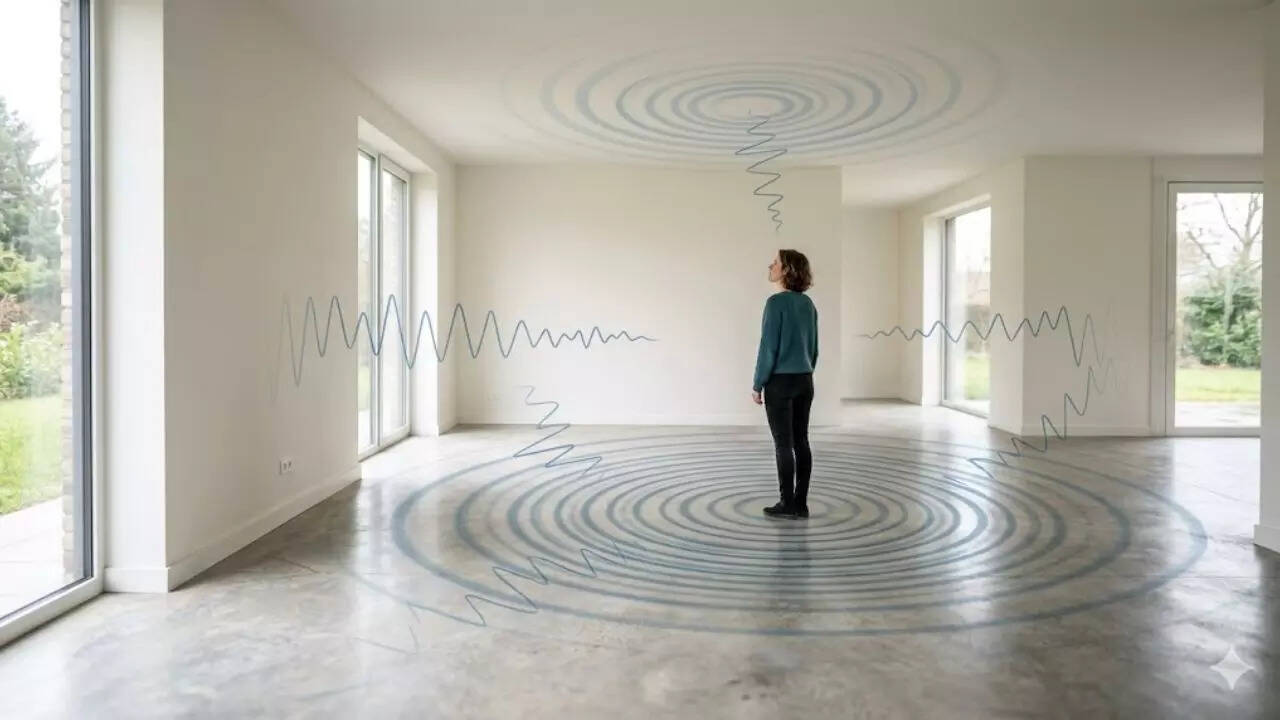
The standard explanation for room echoes is a lazy half-truth. You’ve read the blog posts: sound waves hit a hard surface, they bounce back, and because there’s no furniture to "soak them up," you get that annoying repetition. It’s physics for middle schoolers. It’s also fundamentally wrong about why your high-end living room sounds like a municipal swimming pool.
An empty room doesn’t "create" an echo. The echo was always there, inherent in the geometry of the box you call a home. What you are actually experiencing is the failure of human architectural vanity. We build "clean" spaces that ignore the acoustic reality of the human ear, then we act surprised when the laws of physics don't care about our minimalist aesthetic.
The Myth of the "Absorbent" Sofa
The biggest lie in interior design is that soft things stop echoes. People tell you to "just throw down a rug" or "get some heavy curtains." This is the acoustic equivalent of putting a Band-Aid on a gunshot wound.
Most consumer-grade rugs are too thin to do anything but dampen high frequencies. You aren't fixing the echo; you're just muffling the "shh" sounds while the low-end mud continues to bounce around the room like a pinball. Sound waves aren't just one size. A low-frequency wave at $100\text{ Hz}$ is roughly $3.4\text{ meters}$ (over 11 feet) long. Your decorative West Elm rug is $0.5\text{ centimeters}$ thick.
Thinking that rug will stop a standing wave is like trying to stop a tidal wave with a screen door.
Why Parallel Walls are Architectural Malpractice
If you want to find the real culprit, look at your floor plan. Almost every modern room is a series of parallel planes. Floor to ceiling. Wall to wall. This creates what professionals call flutter echo.
When sound is trapped between two flat, parallel surfaces, it doesn't just "bounce." It reflects back and forth at a rate dictated by the distance between the surfaces, creating a metallic, ringing sensation.
I’ve seen homeowners spend $50,000 on Italian marble floors and then complain that they can’t hear their kids talking across the kitchen island. They blame the "emptiness" of the room. The room isn't empty; it's a resonant chamber. By choosing hard, parallel surfaces without any geometric diffusion, you have effectively built a giant wooden flute and decided to live inside it.
Diffusion Over Absorption: The Contrarian Fix
The "lazy consensus" says you need to absorb sound. I’m telling you that you need to break it.
If you take a perfectly "dead" room—one lined entirely with thick foam—you will hate it. It feels unnatural, oppressive, and literally sickening to the inner ear. Human beings evolved to hear reflections; we use them for spatial awareness. The goal isn't to kill the sound. The goal is to prevent it from returning to your ear in a coherent, organized strike.
This is where diffusion comes in.
Instead of a flat wall, you want surfaces that scatter sound in multiple directions. A bookshelf filled with books of different sizes is a world-class acoustic treatment. Why? Because it creates a non-linear surface. When a sound wave hits a bookshelf, the different depths of the books cause the wave to break apart and scatter.
- The Flat Wall: Reflects $90%$ of the energy back at you in a straight line.
- The Bookshelf: Scatters that energy into a thousand weak fragments.
If you’re complaining about echoes, stop looking for "acoustic panels" that look like cheap office dividers. Buy some clutter. Build some depth into your walls.
The RT60 Trap
In the world of professional acoustics, we measure the time it takes for a sound to decay by $60\text{ decibels}$. This is known as $RT_{60}$.
The "common sense" advice tells you to get that number as low as possible. This is a mistake. A room with an $RT_{60}$ of zero is a tomb. A room with an $RT_{60}$ that is too high is a cavern. The sweet spot for a living space is usually between $0.4$ and $0.6$ seconds.
The problem is that most people "fix" their rooms unevenly. They put down a huge carpet and hang thick drapes. Now, the high frequencies (the "treble") are absorbed instantly, but the mid and low frequencies (the "meat" of the sound) are still bouncing off the drywall.
The result? A room that sounds "dark," "muddy," and "stuffy." You’ve traded a crisp echo for a dull roar. You didn't fix the physics; you just ruined the EQ.
Stop Asking "Why Does It Echo?" and Start Asking "Where is the Geometry?"
People ask why empty rooms echo because they want a simple solution they can buy at a furniture store. The real answer is that your room is a box, and boxes are acoustically hostile.
If you want a room that sounds like a million dollars, you have to stop thinking about "stuffing" the room and start thinking about breaking the planes.
- Angles over Fabric: A slanted ceiling or a non-parallel wall does more for acoustics than a thousand dollars worth of velvet curtains.
- The Rule of Threes: If you have a flat floor, you need a textured ceiling. If you have two flat walls, one of them needs to be broken up by furniture, art with depth, or shelving.
- Mass Matters: Thin foam is a scam. If a material doesn't have mass (weight), it isn't stopping a sound wave. If you can blow air through it easily, it’s only catching the highest frequencies.
The Professional’s Admission
I’ll be honest: my own studio has some parallel surfaces. It’s almost impossible to avoid in modern construction. But I don't "fix" it by filling the room with useless fluff. I use heavy, dense materials placed at the primary reflection points—the specific spots on the wall where the sound from my mouth or speakers hits first before reaching my ears.
You don't need to carpet your whole house. You just need to stop being so obsessed with flat, "clean" lines that turn your home into a resonance chamber.
Minimalism is an aesthetic choice that carries an acoustic tax. If you aren't willing to pay it with specialized treatments, stop complaining that your house sounds like a parking garage. You chose the "clean" look. This is what "clean" sounds like.
Go buy a bookshelf. Put some actual objects on your walls. Stop living in a box and wondering why it acts like one.