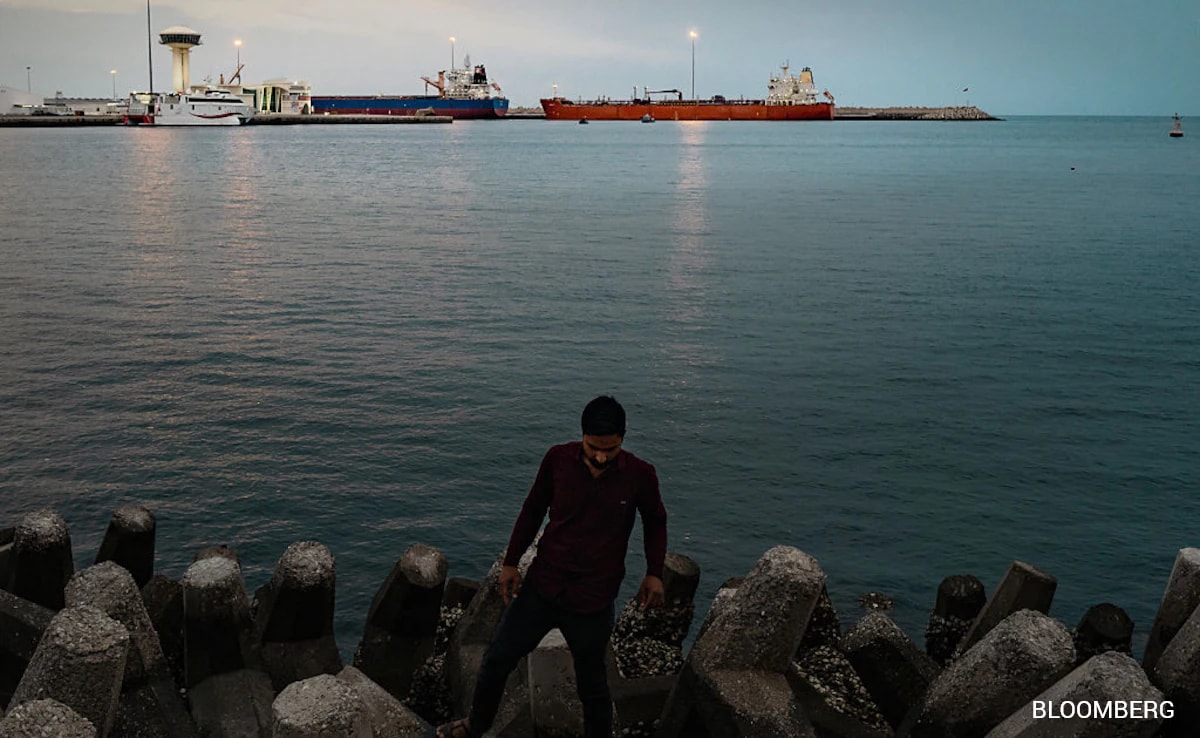
If you're looking at a map of the Middle East and focusing on capital cities, you're looking at the wrong thing. Stop staring at Tehran or Tel Aviv for a second. Instead, zoom in on a tiny, jagged tooth of water between Oman and Iran. That’s the Strait of Hormuz. It’s only about 21 miles wide at its narrowest point, but it's the most important piece of real estate on the planet right now.
Most people think the current tensions with Iran are about religious ideology or ancient grudges. Those things exist, sure. But the real game? It’s about who keeps the lights on in Beijing, Tokyo, and New Delhi. It’s about the fact that roughly 20% of the world's total petroleum consumption passes through that one narrow chokepoint. If that water closes, the global economy doesn't just stumble. It breaks. Don't forget to check out our recent post on this related article.
The "Iran War" isn't a hypothetical future event anymore. We've been in a slow-motion version of it for years. Now, the mask is off. The strategy from the Iranian side isn't to win a traditional dogfight or a tank battle. They know they’d lose that. Their strategy is to hold the world’s jugular vein. They’re betting that the West won't risk $200-a-barrel oil to stop them. It’s a massive, high-stakes gamble on the future of global energy security.
Why the World Cringes at a Hormuz Shutdown
Let’s talk numbers because they're terrifying. Every single day, around 20 million barrels of oil move through the Strait. To put that in perspective, that’s more than the entire daily consumption of the United States. It isn't just oil, either. About 20% of the world’s Liquefied Natural Gas (LNG) travels this same route, mostly coming from Qatar. To read more about the context here, Al Jazeera offers an in-depth breakdown.
When people talk about "energy independence," they often forget how interconnected the market is. Even if a country produces its own oil, a spike in global prices hits everyone. If Hormuz closes, the price of everything—gas, plastic, food, shipping—goes vertical. I’m talking about a global recession triggered in a weekend.
Iran knows this is their "great equalizer." Their navy isn't built to fight the U.S. Fifth Fleet in the open ocean. It’s built for "asymmetric warfare." They have thousands of fast-attack boats, sea mines, and shore-to-ship missiles hidden in the rugged coastline of the Persian Gulf. They don't need to sink every ship. They just need to make insurance rates so high that no tanker captain will dare enter the Gulf.
The Asymmetric Nightmare for the West
Modern warfare usually favors the side with the most expensive toys. In the Strait of Hormuz, that logic flips. A billion-dollar destroyer is a big, slow target in a narrow channel. Iran’s Revolutionary Guard (IRGC) uses swarming tactics. Imagine fifty small boats, some remote-controlled and packed with explosives, all rushing a single target at once. It’s chaotic. It’s cheap. And it’s incredibly hard to defend against perfectly.
We also have to look at the sea mines. These aren't just old-school floating balls from World War II movies. Modern "smart" mines can sit on the ocean floor and wait for the specific acoustic signature of a large tanker before detonating. Clearing these takes weeks, sometimes months. You can’t just "bomb" a minefield away. You need specialized ships to crawl through the water, making them sitting ducks for shore-based missiles.
This isn't just speculation. Look at the "Tanker War" in the 1980s. During the Iran-Iraq conflict, both sides attacked hundreds of merchant vessels. The U.S. had to step in with Operation Earnest Will to escort tankers. It was the largest naval convoy operation since WWII. Today, the weapons are ten times more precise. The risk is ten times higher.
Beyond the Oil Question
While everyone focuses on the oil, there’s a deeper geopolitical shift happening. China is the biggest customer of Gulf oil. You’d think they’d be the first to demand the Strait stays open, right? It’s complicated. China has signed a 25-year strategic partnership with Iran. They’re buying Iranian oil despite sanctions, often through "dark fleets" that turn off their transponders.
For Iran, the Strait of Hormuz is a diplomatic tool. Whenever the West tightens sanctions, Tehran mentions the Strait. It’s a reminder that they can inflict pain on the global economy far beyond their own borders. It’s a "suicide vest" strategy. If Iran feels its regime is truly under threat of collapse, they might just pull the trigger and shut the Strait, even if it hurts them too.
The geography is a curse for the neighbors. Countries like the UAE and Saudi Arabia have tried to build pipelines that bypass the Strait, like the East-West Pipeline in Saudi Arabia or the Habshan-Fujairah line in the UAE. These help, but they can't handle the full volume. Most of the world’s spare production capacity is still stuck behind that 21-mile gap.
The Reality of a Blockade
If Iran actually tries to block the Strait, the response will be immediate and violent. The U.S. military has made it clear for decades that keeping the Strait open is a "red line." But "opening" it isn't like opening a door. It would mean a full-scale air and sea campaign to destroy Iran’s coastal defenses, their drone bases, and their naval ports.
That’s where the "Opinion: Iran War" headline comes from. It wouldn't be a contained skirmish. It would be a regional conflagration. Iran would likely respond by using its proxies—Hezbollah in Lebanon, the Houthis in Yemen—to attack other oil infrastructure throughout the Middle East. We saw a preview of this in 2019 with the Abqaiq-Khurais drone attacks on Saudi oil facilities. One strike knocked out half of Saudi Arabia’s oil production in an afternoon.
The world’s economy is currently built on a "just-in-time" delivery model. We don't have massive stockpiles of everything everywhere. We rely on the constant, rhythmic flow of these tankers. Any interruption ripple effects through supply chains faster than we can fix them.
Moving Past the Rhetoric
We need to stop treating the Strait of Hormuz like a footnote in a news story. It is the story. Every move Iran makes in its nuclear program or its regional influence is backed by the implicit threat of what they can do to that water.
If you want to understand where the conflict is going, watch the insurance markets in London. Watch the "war risk" premiums for tankers. When those start to climb, you know the talk is getting serious. We’ve entered an era where energy is the primary weapon, and the Strait is the barrel of the gun.
Don't expect a clean resolution. There is no "peace treaty" that permanently secures the Strait as long as the underlying tension between Iran and the West remains. It’s a permanent state of high-tension standoff. The best we can hope for is a managed friction where neither side is desperate enough to flip the table.
Check the daily transit reports from the Energy Information Administration (EIA). They track the volume of oil moving through chokepoints. If you see those numbers dip without a clear economic reason, start worrying. Diversifying energy sources isn't just a "green" goal anymore; it’s a survival tactic to reduce the world's collective exposure to 21 miles of dangerous water. Follow the flow of the tankers, not just the words of the politicians. That's where the real power lies.