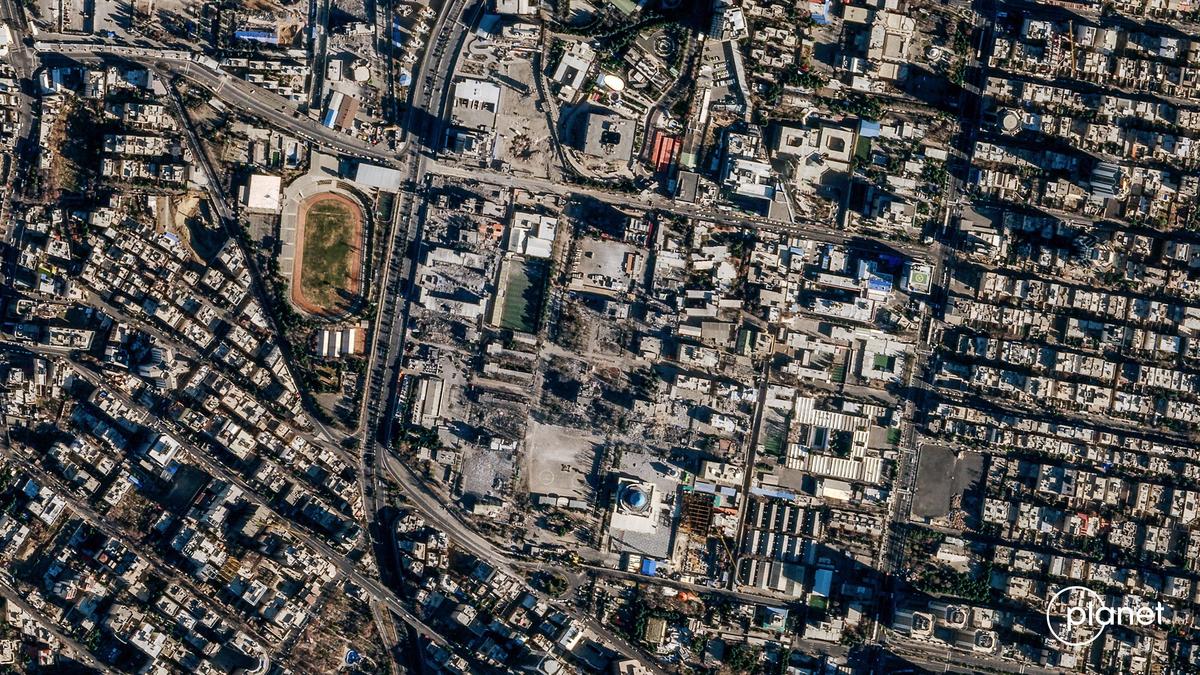
Commercial satellite imagery has transitioned from a niche intelligence asset to a primary driver of public perception and tactical transparency in modern warfare. When Planet Labs—a dominant player in the SmallSat sector—chooses to indefinitely withhold high-resolution imagery of specific conflict zones, such as the escalating friction points in Iran, it is not merely a corporate PR decision. It is a calculated response to the Triple Constraint of Private Intelligence: regulatory pressure, operational risk, and the degradation of strategic ambiguity. This shift marks the end of the "democratization of space" era and the beginning of a period where commercial actors function as unofficial extensions of state-level information control.
The Mechanistic Drivers of Image Redaction
The decision to suppress imagery is governed by a logic of risk mitigation that far outweighs the marginal revenue generated by open-market sales. Three specific mechanisms dictate this behavior:
1. Shutter Control and Regulatory Compliance
Under the Land Remote Sensing Policy Act and subsequent updates through the Department of Commerce (NOAA), the United States government maintains the legal authority to impose "shutter control." This allows the state to restrict private imaging for reasons of national security or international obligations. While formal shutter control is rarely invoked publicly to avoid the appearance of censorship, the threat of its application creates a "chilling effect" where firms self-censor to maintain their operating licenses. Planet Labs operates under a US jurisdiction; therefore, their global data pipeline is structurally tethered to US Department of Defense (DoD) priorities.
2. The Liability of Tactical Transparency
In high-intensity conflict zones, commercial imagery provides near real-time Battle Damage Assessment (BDA) for non-state actors or nations with limited orbital assets. By providing $3$-meter or sub-meter resolution of Iranian nuclear facilities or military installations during active hostilities, a private company becomes an unwitting participant in the "kill chain." If a commercial image is used to calibrate a counter-strike, the providing company faces:
- Kinetic Risk: Physical threats to ground stations or personnel.
- Cyber Risk: State-sponsored retaliatory strikes against digital infrastructure.
- Political Risk: Permanent exclusion from future domestic markets or international partnerships.
3. Contractual Monopsony
The National Reconnaissance Office (NRO) and the National Geospatial-Intelligence Agency (NGA) are the primary purchasers of high-cadence satellite data. When a commercial firm enters into multi-billion dollar "Electro-Optical Commercial Layer" (EOCL) contracts, they effectively trade their autonomy for fiscal stability. The government doesn't need to censor the images; they simply purchase the exclusive rights to the "first look" or the entirety of the capacity over a specific coordinate, effectively removing it from the public domain.
The Economic Impact of Intentional Information Scarcity
The valuation of a satellite constellation is derived from its "revisit rate"—the frequency with which it can image a specific point on Earth. By withholding imagery of Iran, Planet Labs creates an artificial "data desert." This has immediate downstream effects on the information economy.
The Price of Verification
Open-source intelligence (OSINT) communities rely on commercial data to verify state claims. When this data is removed, the "cost of truth" spikes. Journalists and analysts must pivot to secondary providers—such as European (Airbus), Israeli (ImageSat), or Chinese (Chang Guang) entities—who may have different geopolitical alignments or lower-resolution sensors. This fragmentation prevents a unified consensus on ground truth, allowing disinformation to proliferate in the vacuum.
Market Cannibalization
By refusing to sell high-demand conflict imagery, Planet Labs risks ceding market share to international competitors who are not bound by US regulatory frameworks. However, the technical barrier to entry—specifically the ability to manage a constellation of hundreds of "Doves" (small satellites) for daily global coverage—is high enough that Planet maintains a temporary monopoly on high-cadence data. The decision to withhold data is a bet that their dominant market position can survive a period of restricted output.
The Architecture of Clandestine Observation
To understand why Iran is the specific focus of this redaction, one must analyze the technical signatures of Iranian military infrastructure. Unlike traditional battlefields, Iranian strategic assets are often "hardened and deeply buried" (HDB).
The detection of activity at these sites relies on:
- Change Detection: Identifying minute shifts in soil piles or vehicle patterns.
- Multispectral Analysis: Using non-visible light to detect thermal signatures or chemical exhaust.
- SAR (Synthetic Aperture Radar): Seeing through clouds or at night.
Planet Labs' primary strength is its high revisit rate. While a single image might be unremarkable, a time-series of 30 images over 30 days reveals a pattern of life that constitutes actionable intelligence. By withholding the entire stream, they prevent analysts from building a longitudinal model of Iranian defensive posture. This is not about hiding a single explosion; it is about hiding the preparation for one.
The Erosion of the Global Commons
The "Global Commons" of space was predicated on the idea that orbital observation is a neutral act. The precedent set by withholding Iran war images shatters this neutrality. It signals to the world that commercial space assets are "aligned sensors" rather than "objective observers."
This creates a Bifurcated Orbital Economy:
- Zone A (Transparent): Regions where data is freely available for environmental, agricultural, and commercial use.
- Zone B (Opaque): Geopolitical flashpoints where data is sequestered by state-aligned corporations.
This bifurcation forces non-aligned nations to develop their own sovereign launch and sensing capabilities, leading to an increasingly crowded and contested Low Earth Orbit (LEO). The proliferation of "sovereign constellations" is a direct response to the unreliability of Western commercial data providers during times of crisis.
Tactical Realignment for OSINT and Commercial Intelligence
As the primary "big data" providers in space move toward selective redaction, the strategy for information acquisition must shift. Relying on a single provider for "Ground Truth" is a systemic vulnerability.
Analysts must now adopt a Diversified Sensor Strategy:
- Platform Arbitrage: Sourcing data from multiple jurisdictions (e.g., combining US-based Maxar with Finnish ICEYE or Japanese Synspective) to bypass local shutter control.
- Cross-Domain Fusion: Correlating low-resolution, publicly available satellite data with alternative datasets such as AIS (Automatic Identification System) for shipping or ADS-B for aircraft tracking.
- Synthetic Truth Construction: Using AI to interpolate missing frames in a satellite sequence based on historical patterns and secondary data points.
The era of easy, commercial-off-the-shelf (COTS) intelligence for high-stakes geopolitical events is closing. Planet Labs’ move is a signal that in the next decade, the most valuable data will not be what is seen, but what is intentionally hidden. The strategic play for observers is no longer simply "buying the picture," but building the analytical capacity to interpret the silence. Organizations that fail to account for the "managed opacity" of commercial providers will find themselves blind at the exact moment the fog of war descends.