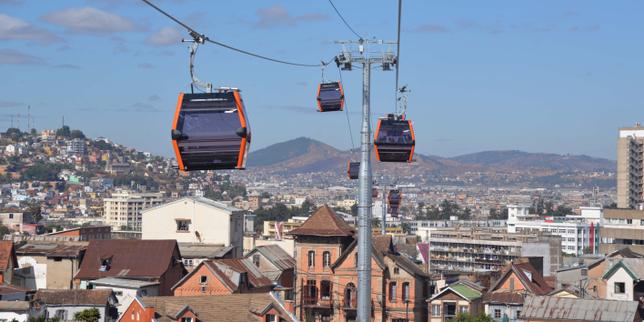
The suspension of the Antananarivo cable car project, coupled with a 150 million euro debt burden, represents a classic failure of capital allocation in emerging market infrastructure. When a state prioritizes high-visibility prestige projects over foundational urban utility, it creates a fiscal trap where debt servicing costs outpace the economic utility of the asset. The Madagascar case demonstrates the breakdown of three critical pillars: technical-spatial fit, fiscal sustainability, and operational transparency.
The Cost Function of Symbolic Infrastructure
Infrastructure investment in developing economies generally follows a hierarchy of needs. Antananarivo, characterized by extreme topographic density and a crumbling terrestrial road network, theoretically benefits from aerial transit. However, the capital intensity of the cable car system—financed through a 151.8 million euro loan from French banks (Société Générale and BNP Paribas)—diverges sharply from the city’s immediate economic reality.
The project’s cost-to-utility ratio is skewed by the fundamental mismatch between the currency of debt and the currency of revenue.
- Currency Mismatch: The debt is denominated in Euros, while the projected revenue is in Malagasy Ariary. In a volatile exchange environment, the "real" cost of the debt escalates even if the principal remains static.
- Maintenance Intensity: Cable car systems require specialized technical parts and foreign expertise for upkeep, creating a permanent drain on foreign exchange reserves.
- Opportunity Cost: The 150 million euros allocated to 12 kilometers of cable lines could have refurbished a significant percentage of the existing bus and road network, which handles 95% of current commuter volume.
By choosing a high-capex solution for a low-liquidity environment, the Malagasy state ignored the principle of incrementalism. Successful urban transformations usually scale through modular improvements rather than singular, debt-heavy interventions.
The Debt-Service Bottleneck
The financial structure of the project relies on the assumption that the "Transport par Câble" (TPC) would generate enough surplus to contribute to its own debt servicing. This assumption collapses under the weight of Madagascar’s low purchasing power.
To break even, the fare for the cable car would need to be set at a level significantly higher than the current "Suburban" taxi-be rates. If the government subsidizes the fare to ensure ridership, the subsidy becomes a recurring liability on an already strained national budget. This creates a feedback loop:
- Debt Accrual: Interest accumulates during the construction delays and current stoppage.
- Budget Crowding Out: Funds meant for education or healthcare are diverted to satisfy the sovereign guarantee provided to the French lenders.
- Asset Deterioration: As the project sits idle, the physical components—cables, cabins, and mechanical sensors—suffer from environmental degradation, increasing the eventual "restart" cost.
The current "à l'arrêt" status is not merely a pause in construction; it is an active destruction of value. Every month of inactivity increases the Net Present Value (NPV) loss of the project.
Theoretical vs. Realized Ridership
The logic used to justify the project often cites the "30-minute commute" versus the "2-hour traffic jam." While logically sound on a whiteboard, this ignores the First and Last Mile problem.
Urban mobility functions as a network, not a line. If the cable car stations are not seamlessly integrated with existing transit hubs, the time saved in the air is lost on the ground. In Antananarivo, the lack of a multimodal integration strategy means the cable car acts as a "point-to-point" novelty rather than a systemic solution.
- Spatial Inefficiency: The stations are located in high-density areas where land expropriation is costly and legally complex.
- Socio-Economic Exclusion: The primary commuters in Antananarivo are informal sector workers. Their movement patterns are erratic and price-sensitive. A rigid, high-cost cable car system lacks the flexibility of the informal bus networks (taxi-be) that currently dominate the market.
Structural Incentives and The Agency Problem
The persistence of the project despite clear fiscal warnings suggests an agency problem. The incentives for the political class (visibility, international prestige, and construction-phase contracts) are decoupled from the long-term fiscal health of the nation.
European lenders and construction firms (such as Poma and Colas) operate with different risk profiles. For the lenders, the sovereign guarantee mitigates the risk of project failure. For the contractors, the profit is realized during the construction phase. The Malagasy taxpayer is the only stakeholder bearing the 25-year tail risk of the debt.
This creates a "White Elephant" trajectory:
- Phase 1: High-profile announcement and debt signing.
- Phase 2: Rapid initial construction to create "sunken cost" bias.
- Phase 3: Stagnation due to technical or fiscal hurdles.
- Phase 4: Long-term state bailouts to keep a non-viable asset operational for political optics.
Technical Limitations of Aerial Transit in High-Wind Corridors
Beyond the financial metrics, the technical feasibility of the TPC in Antananarivo’s specific climate must be scrutinized. The city is prone to high winds and seasonal cyclones.
A cable car system has a "wind-stop" threshold. In many similar installations globally, operations must cease when gusts exceed 60-70 km/h. For a city that relies on this as a primary artery, frequent weather-related shutdowns render the system unreliable for professional commuters. The competitor narrative misses this operational volatility. If the system cannot guarantee 99% uptime, it cannot replace the (albeit slow) terrestrial alternatives.
The Path to Liquidation or Pivot
The 150 million euro debt is now a sunk cost, but the ongoing interest and maintenance represent avoidable future losses. There are only two viable strategic paths remaining for the Malagasy administration.
The first is a Debt-for-Nature or Debt-for-Infrastructure Swap. Madagascar could negotiate with the French treasury to reclassify a portion of this commercial debt as developmental aid, tied to specific urban greening or drainage goals that actually improve the city's resilience. This removes the immediate pressure of the 151 million euro liability.
The second is Radical Privatization. The state should divest itself of the operational risk entirely. If a private consortium believes the 30-minute commute is marketable, they should manage the farebox and maintenance. However, it is unlikely any private entity would take on this risk without a massive state guarantee, which brings the problem back to the treasury.
The current paralysis is the most expensive option. The government must move to either finish the first line (Anosy-Soarano) to test the minimum viable product (MVP) or formally mothball the project and negotiate a debt restructuring. Maintaining a "zombie" project that is neither operational nor cancelled is a terminal drain on the nation's credit rating. Madagascar must prioritize the completion of a single, functional segment to prove the concept or accept the loss and pivot toward terrestrial road rehabilitation. Anything else is fiscal negligence.