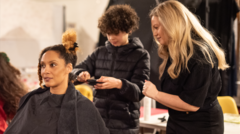
The commercialization of Afro-textured hair care often fails because it treats the act of styling as a purely aesthetic transaction. This miscalculation ignores the reality that Afro hair management functions as a high-stakes transfer of cultural capital and psychological safety. When workshops move beyond simple "how-to" sessions, they are actually optimizing for three distinct variables: technical proficiency, institutional trust, and the mitigation of social friction. Analyzing these gatherings through a rigorous lens reveals they are not merely social clubs; they are decentralized educational infrastructures designed to bypass systemic failures in the professional beauty industry and public education.
The Infrastructure Deficit in Professional Cosmetology
A primary driver for the rise of independent hair care workshops is the measurable gap in standard cosmetology curricula. In many Western jurisdictions, licensing requirements focus heavily on chemical processing and heat-based styling—methods historically used to alter Afro-textured hair to meet Eurocentric professional standards—rather than the maintenance of its natural state.
The technical bottleneck occurs because the structural properties of Type 4 hair (kinky-coily) require a different physics of manipulation. The elliptical shape of the hair shaft and the uneven distribution of cortical cells create specific points of fracture that do not exist in Type 1 or Type 2 hair. Because professional training often omits the chemistry of moisture retention for high-porosity coils, a vacuum is created. Workshops fill this void, functioning as a shadow education system. They provide the technical data—pH balancing, tensile strength management, and sebum mimicry—that formal institutions have failed to standardize.
The Social Cost Function of Hair Management
The decision to wear natural Afro-textured hair involves a complex cost-benefit analysis. For the individual, the "cost" is measured in time, financial investment in products, and potential social penalties in professional environments.
- The Temporal Tax: Natural hair maintenance requires significant time blocks for detangling, deep conditioning, and protective styling. Without efficient techniques, this tax becomes unsustainable.
- The Acquisition Penalty: The market is saturated with products containing drying alcohols or heavy silicones that provide short-term shine but long-term damage. The cost of trial and error is high.
- The Professional Friction: There is a documented correlation between hair texture and perceived "professionalism" in corporate hierarchies.
Workshops act as a mechanism to lower these costs. By sharing optimized "wash-day" algorithms, participants reduce their temporal tax. By crowdsourcing product efficacy data, they minimize the acquisition penalty. Most importantly, by fostering a collective aesthetic standard, they create a buffer against professional friction, shifting the burden of "belonging" from the individual to a reinforced group identity.
Defining the Three Pillars of Communal Styling
To understand why these workshops result in a sense of "belonging," we must deconstruct the specific functions they perform. The emotional outcome is a byproduct of three logical pillars.
Technical Sovereignty
True belonging cannot exist in a state of dependency. When individuals lack the skill to manage their own physiological traits, they are at the mercy of external service providers who may or may not understand their requirements. Workshops transfer technical sovereignty. This involves teaching the mechanics of:
- Sectioning and Tension Control: Managing the hair in small, controlled quadrants to prevent mechanical breakage.
- Product Layering (LOC/LCO Methods): Applying liquid, oil, and cream in a specific sequence to lock moisture into the cuticle.
- Protective Styling Geometry: Understanding how braids and twists distribute weight to avoid traction alopecia.
The Validation Loop
The psychological impact of these workshops is often described as "belonging," but scientifically, it is a recursive validation loop. Participants observe their own traits mirrored in others across a spectrum of age and professional status. This peer-to-peer data sharing confirms that their biological reality is not an "outlier" or a "problem to be solved," but a standard variable. This shifts the internal narrative from pathology to physiology.
Institutional Trust Substitutes
Because medical and beauty industries have historically marginalized Afro-textured hair, there is a rational lack of trust in "official" advice. Workshops operate on a trust-based network. Information is vetted by communal experience rather than marketing departments. This creates a high-trust environment where participants can discuss sensitive issues like hair loss, scalp conditions, and the trauma of forced assimilation without fear of judgment or clinical coldness.
The Economic Impact of the Belonging Model
The "belonging" factor is not just a feel-good metric; it is an economic driver. The global Black hair care market is projected to reach multi-billion dollar valuations, yet brand loyalty is notoriously fickle. Consumers migrate toward brands that facilitate these communal spaces.
The shift is from a Product-Centric Model to a Community-Centric Model.
- Product-Centric: "Buy this cream to fix your frizz." (Low retention, high competition).
- Community-Centric: "Join this workshop to master the science of your hair." (High retention, brand advocacy, lower customer acquisition costs).
Companies that sponsor these workshops are not just performing "outreach"; they are performing R&D. They are gaining direct access to the pain points of their most sophisticated consumer segment. This allows for rapid iteration of product formulations based on real-time feedback from power users.
Measuring Success Beyond the Mirror
We must move away from evaluating these workshops based on the final hairstyle. The true KPIs (Key Performance Indicators) of a successful workshop are:
- Rate of Technical Skill Adoption: How many participants can replicate the detangling method at home?
- Reduction in Product Waste: Do participants feel more confident in reading ingredient labels to avoid unnecessary purchases?
- Mental Load Mitigation: Is there a measurable decrease in the anxiety associated with daily hair maintenance?
The "belonging" that participants report is the emotional resonance of having these technical and social needs met simultaneously. It is the relief of finding an environment where the "default" settings of the world are calibrated to your specific biology.
The Barrier of Scalability
Despite their efficacy, these workshops face a significant bottleneck: scalability. Because the instruction is often high-touch and personalized, it is difficult to replicate the quality of a small-group workshop in a digital-only or mass-market format. The physical presence of a mentor who can feel the texture of the hair and adjust a participant's hand positioning is a critical component of the learning transfer.
Furthermore, the "safe space" aspect of these workshops relies on a specific demographic density. If the group becomes too large or too diverse in a way that centers Eurocentric beauty standards, the psychological safety mechanism breaks down. The challenge for the industry is to scale the information without diluting the environment.
Strategic Implementation for Stakeholders
For organizers and brands looking to elevate this model, the focus must be on rigorous curation.
- Curriculum over Conversation: While the social aspect is vital, the core value proposition must remain the transfer of hard skills. A workshop that prioritizes "vibes" over "valves" (the mechanisms of hair care) will have low long-term utility.
- Data-Driven Feedback: Implement pre- and post-workshop assessments to track the increase in participant confidence and technical knowledge.
- Hybrid Models: Use digital platforms for the "theory" (chemistry of hair, ingredient analysis) to save in-person time for "practicals" (hand-on styling techniques).
The evolution of Afro hair care workshops represents a shift toward a more sophisticated, decentralized model of beauty education. It recognizes that the hair is not the problem; the lack of a supportive, informed infrastructure is the problem. By building that infrastructure through communal effort, these workshops do more than style hair—they provide the technical and social tools necessary for individuals to navigate a world that was not built with them in mind.
The final strategic play is to institutionalize these decentralized networks. Rather than waiting for cosmetology boards to update their standards, beauty brands and community leaders should establish an independent accreditation for "Textured Hair Specialists" that prioritizes the health and integrity of Type 3 and 4 hair. This would turn the informal "belonging" of a workshop into a formal, professional standard, effectively forcing the rest of the industry to catch up or face obsolescence.