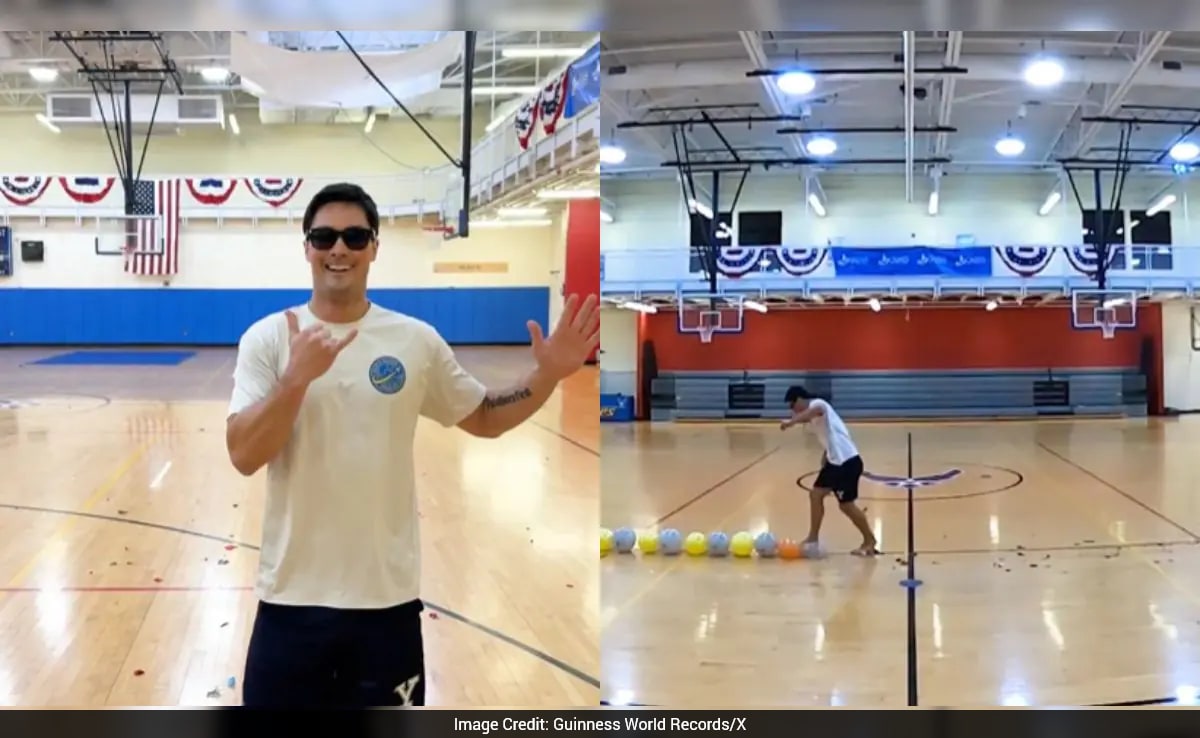
The air in the room tastes like static and cheap latex. It is a heavy, synthetic scent that clings to the back of the throat, the kind of smell that usually signals a children’s birthday party or a half-hearted office celebration. But there is no cake here. There are no screaming toddlers. There is only the rhythmic, pressurized hiss of a pump and the absolute, deafening silence of a man staring at the floor.
David Rush is not looking at the floor because he’s tired. He is looking at it because, for the next twenty seconds, that floor is his entire universe.
On the surface, what David does sounds like a punchline. He pops balloons with his feet. If you say it out loud at a dinner party, people smile politely and wait for the part where you explain why it actually matters. They think of clumsy stomping. They think of a clown losing his temper. They don't think of the physics of a strike, the micro-adjustments of a heel, or the way the human nervous system has to be rewired to ignore the biological instinct to flinch at a series of rapid-fire explosions.
The Architecture of a Burst
To understand the magnitude of 19.78 seconds, you have to understand the resistance of a single balloon. A balloon is a tensioned membrane. It wants to stay whole. When you press a foot against it, the latex stretches, redistributing the pressure, fighting back. Most people stomp. They use the blunt force of their weight. That is the first mistake.
If you stomp, you are slow. You have to lift your entire leg, bring it down, and then—critically—recover your balance before the next strike. In the world of high-stakes record-breaking, balance is the currency. If you lose your center of gravity for even a millisecond, the rhythm breaks. The record dies.
David doesn't stomp. He dances.
He has spent months analyzing the structural weaknesses of the 100 balloons laid out before him. This isn't just a feat of strength; it is a feat of geometry. He knows that to hit a sub-twenty-second mark, he cannot afford a full range of motion. He has to stay low. His feet have to move like pistons in a high-performance engine, oscillating with a frequency that seems almost blurred to the naked eye.
Consider the math. One hundred balloons. 19.78 seconds. That is roughly five balloons per second.
Think about that. Try to tap your fingers on a desk five times in one second. Now imagine doing that with the weight of your entire body, moving across a room, while the air around you is filled with the sharp, concussive "thwip-crack" of bursting rubber. It is a sensory assault.
The Internal War
Every time a balloon pops, your brain sends a signal. Danger. Sharp noise. Protect the eyes. Retreat. It is a primal response, a remnant of a time when loud cracks meant a branch breaking under a predator's weight or a lightning strike nearby.
David has to kill that part of his brain.
He enters a state of flow where the noise becomes a metronome. He isn't reacting to the pops; he is creating them. When you are the source of the chaos, the chaos becomes predictable. But the physical toll is localized and punishing. The arches of the feet take the brunt of it. The constant, repetitive impact against the floor—interrupted only by the thin, slippery skin of the balloons—threatens to bruise the bone.
He wears shoes that are less like footwear and more like surgical instruments. They need to be grippy enough to catch the latex so it doesn't squirt out from under the foot, but thin enough to allow for maximum tactile feedback. He needs to feel the pop. He needs to know the exact moment the resistance vanishes so he can transition his weight to the other foot.
The Weight of the Invisible
Why do this? Why spend weeks of your life staring at bags of colorful rubber, calculating angles of approach and calf muscle endurance?
We live in a world that often feels impossibly complex, where success is measured in abstract digital metrics and long-term "deliverables" that we can’t even touch. There is something deeply, almost spiritually satisfying about a task with a clear beginning, a clear end, and a binary result. The balloon is either full of air, or it is gone. There is no middle ground. There is no "nuance" in a burst.
For David, this is about the democratization of greatness. Not everyone can be born with the height of a basketball star or the lungs of an Olympic swimmer. But anyone can choose to be the best in the world at something if they are willing to obsess over the details that everyone else ignores. He is a master of the overlooked.
He stands at the starting line. His breath is shallow. The official with the stopwatch looks at him, a silent executioner of his ambitions.
"Ready?"
David isn't thinking about the 100 balloons anymore. He is thinking about the first one. Then the second. He has built a mental map of the floor, a sequence of strikes that he has practiced in his head until it’s more real than the room itself.
The Twenty-Second Blur
The start signal isn't a sound David hears; it's a trigger he feels.
He moves. It isn't a walk. It's a chaotic, beautiful shuffle. To the observer, it looks like a man having a controlled seizure across a sea of color. But if you slow the film down, you see the precision. The heel strikes the center. The weight shifts. The ankle pivots.
Pop-pop-pop-pop-pop.
The sound isn't rhythmic like music; it's rhythmic like a machine gun. The debris—shreds of red, blue, and yellow—flies into the air like plastic confetti. David’s face is a mask of pure, unadulterated focus. There is no joy here, not yet. There is only the execution of a plan.
Halfway through, the lungs begin to burn. It’s not a long time, twenty seconds, but when you are moving with that level of explosive intensity, the body screams for oxygen. He ignores it. He is on balloon sixty. Seventy. Eighty.
The floor is becoming slippery. The discarded skins of the fallen balloons are a hazard now. One wrong step on a piece of lubricated latex and he’ll go down. He adjusts his stride by millimeters. He keeps his center of gravity forward, almost falling into the next row, using his momentum as a hammer.
Ninety. Ninety-five.
The last five are always the hardest. The finish line is in sight, and the temptation to rush—to truly, blindly stomp—is at its peak. But David stays disciplined.
Ninety-nine. One hundred.
He stops. He doesn't look at the stopwatch. He looks at his feet. They are vibrating. The silence that rushes back into the room is heavier than the noise that preceded it. It’s the silence of a vacuum, a space where something existed seconds ago and has now been utterly erased.
19.78 seconds.
The Residual Echo
The record is a number on a piece of paper, a digital entry in a database. But the reality is the shredded remains on the floor.
David stands in the middle of the wreckage, sweat dripping from his chin, breathing in that thick smell of latex. His feet ache. His ears ring. But for one brief window of time, he was perfectly synchronized with the world. He took a chaotic, absurd challenge and applied a level of rigor and discipline that most people reserve for "serious" pursuits.
Maybe that’s the point. We spend so much of our lives trying to be serious that we forget how to be excellent. We dismiss the "silly" records because we’re afraid of looking ridiculous. We avoid the things that make us look frantic or strange.
But there is a specific kind of dignity in the frantic. There is a nobility in being the man who can pop 100 balloons with his feet faster than anyone else on the planet. It is the dignity of the specialist. It is the pride of the man who looked at a pile of rubber and saw a mountain to be climbed.
As he walks away, the red and blue scraps of his victory stick to the soles of his shoes, a colorful trail marking the path of a man who found his own version of perfection in the middle of a burst of air.
The floor is clear now, but the air still carries the tension of the pop.