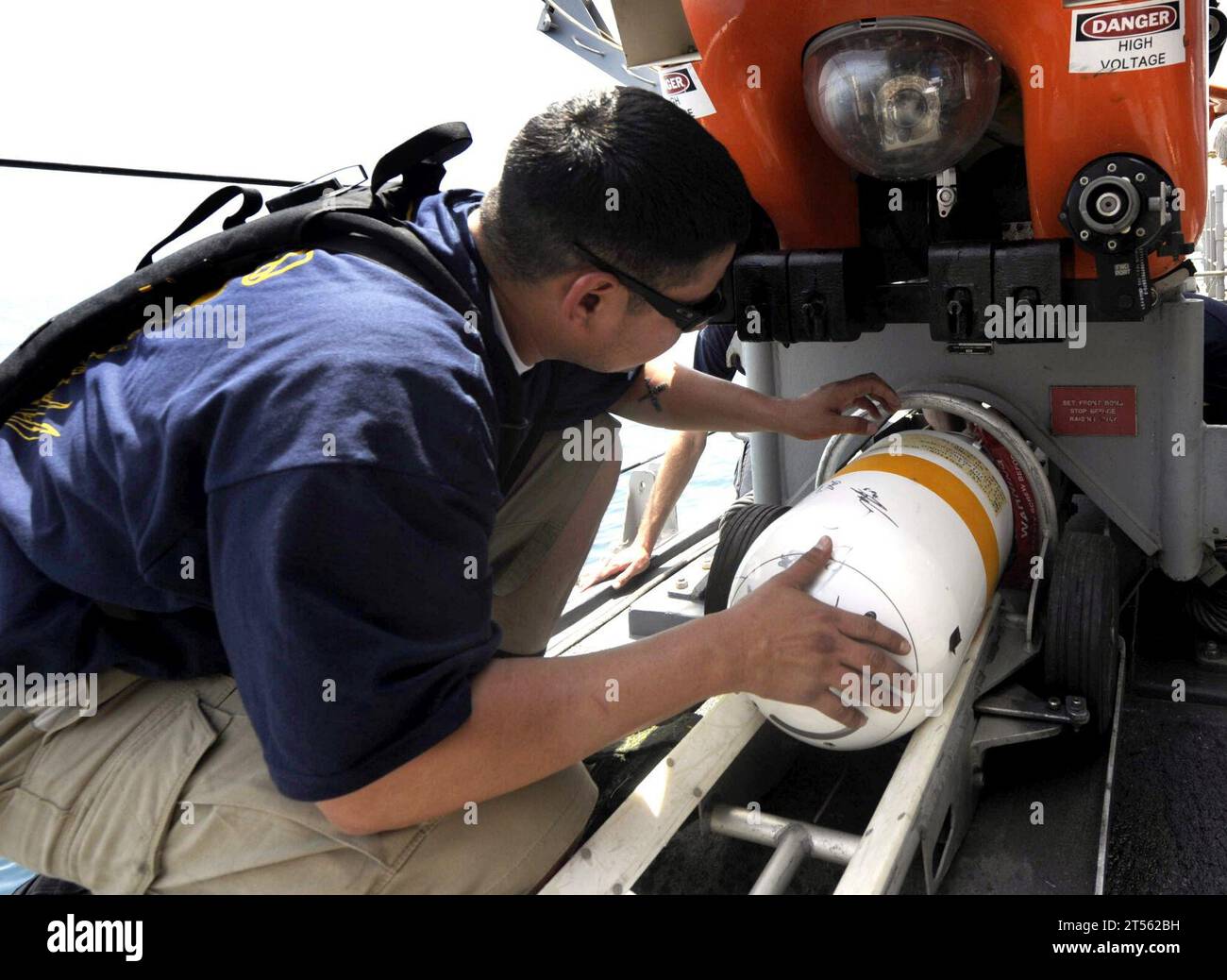
The headlines are predictable. The US Navy moves a few Avenger-class mine countermeasures ships or deploys the latest underwater drones to the Strait of Hormuz, and the global markets breathe a collective, unearned sigh of relief. The narrative is always the same: American naval supremacy is the only thing standing between global commerce and a total energy collapse.
It is a comforting story. It is also a lie. In related news, take a look at: The ASEAN Collision Course and the End of Strategic Ambiguity.
Most defense analysts treat mine-clearing operations like a high-stakes game of Minesweeper where the Navy holds all the cheat codes. In reality, we are watching a $13 billion fleet try to solve a $15,000 problem using tactics that haven’t fundamentally changed since the Cold War. The Strait of Hormuz is not a "chokepoint" that can be "cleared." It is a 21-mile-wide tactical nightmare where the physics of modern naval warfare favor the insurgent, not the superpower.
The Mathematical Absurdity of Modern Mine Warfare
The "lazy consensus" suggests that if the Navy puts enough sensors in the water, the risk to shipping drops to zero. This ignores the brutal reality of Search Width vs. Sowing Speed. Al Jazeera has also covered this important subject in extensive detail.
An adversary doesn't need to sink a carrier to win. They only need to create doubt. To "clear" a shipping lane to a 99% confidence level—the kind of confidence required for Lloyd’s of London to insure a VLCC (Very Large Crude Carrier)—takes weeks, if not months. Meanwhile, a swarm of fast-attack craft can dump a fresh batch of "dumb" contact mines in forty-eight minutes.
We are bringing a scalpel to a landfill fight. The Navy’s reliance on the Littoral Combat Ship (LCS) and its troubled Mine Countermeasures (MCM) mission package is the perfect example of technological overreach. We traded rugged, wooden-hulled ships that actually worked for aluminum "Formula 1" ships that crack in heavy seas and rely on remote sensors that struggle with the high salinity and thermal layers of the Persian Gulf.
Why Underwater Drones Are Not the Silver Bullet
The industry is currently obsessed with UUVs (Unmanned Underwater Vehicles). The pitch is simple: "Keep the sailor out of the minefield." It sounds smart. It looks great in a Raytheon PowerPoint.
But here is the friction:
- Communication Lag: Water is a terrible medium for data. High-bandwidth communication doesn't exist deep underwater.
- Battery Life: Current tech allows for a few hours of operation before a "recharge" is needed, which means the host ship—a massive, expensive target—must sit stationary in a high-threat environment.
- The False Positive Problem: The floor of the Strait is littered with shipwrecks, discarded shipping containers, and literal trash. Every piece of scrap metal looks like a mine to a sonar rig.
I have watched exercises where "state-of-the-art" autonomous systems spent twelve hours identifying a discarded refrigerator while the "threat" mine sat two hundred yards away, undetected because it was buried under three inches of silt. An adversary doesn't need stealth technology; they just need a shovel.
The Economic Asymmetry Nobody Wants to Discuss
Let’s look at the balance sheet.
A single Mk 65 Quickstrike mine costs roughly the price of a used Honda Civic. The cost to neutralize that mine—including the procurement of the MCM ship, the training of the EOD (Explosive Ordnance Disposal) divers, the fuel, and the support fleet—runs into the tens of millions of dollars.
We are participating in the most lopsided economic exchange in the history of warfare. Iran, or any regional actor, doesn't even have to deploy the mines to win. They just have to claim they did. The mere announcement of a mined strait triggers a "Risk Premium" on oil that acts as a global tax. The US Navy’s "clearance operations" are essentially a massive subsidy for the insurance industry, paid for by the American taxpayer, with no actual guarantee of a clear path.
The "Human in the Loop" Delusion
There is a persistent myth that we can automate our way out of this. We can't.
Mine hunting remains a "back-breaking" endeavor. When the drones fail—and they do—we still send EOD divers into the water. These are men and women wearing non-magnetic gear, swimming in 95-degree water with 3-foot visibility, trying to identify a trigger mechanism by touch.
The disconnect between the "high-tech" image projected by the Pentagon and the "low-tech" reality of the Persian Gulf is staggering. If the US truly wanted to secure the Strait, it wouldn't be buying more $500 million ships; it would be investing in disposable, mass-produced "attritable" sweepers that can be lost without a Congressional hearing. But there’s no lobby for a cheap, disposable boat.
The Scenario the Navy Fears
Imagine a scenario where an adversary uses "Smart Mines" that don't just sit there. Imagine mines that can communicate with each other via low-frequency acoustic pings, or mines that are programmed to ignore the first three minesweepers and only detonate when they detect the specific acoustic signature of a Nimitz-class carrier.
This technology exists. It isn't even particularly complex. Yet our current "clearance operations" are designed to find the stationary spheres from World War II movies. We are preparing for a museum fight while our opponents are playing a localized, asymmetric game of denial.
The "clearance" operations currently underway are not a tactical solution. They are a diplomatic signal. They are meant to tell the world "We are doing something," even if that "something" is mathematically incapable of securing the waterway against a committed opponent.
The Only Honest Solution
If we want to stop lying to ourselves about the Strait of Hormuz, we have to admit three things:
- You cannot "clear" a strait while the enemy still holds the coastline. Mine clearance is a post-conflict activity. Attempting it during active hostilities is just target practice for the guy on the shore with an anti-ship missile.
- The US Navy is top-heavy. We have prioritized "exquisite" platforms that are too expensive to lose, making us inherently risk-averse in the one environment—the minefield—where you must be willing to take losses.
- Energy independence is a better mine-clearing tool than a sonar-equipped drone. The only way to win the "Strait of Hormuz" game is to make the strait irrelevant.
Every dollar spent on "mine countermeasures" in the Persian Gulf is a dollar spent on a temporary bandage for a sucking chest wound. The Navy knows this. The contractors know this. The only people who don't are the ones reading the sanitized press releases about "successful operations" and "secured waterways."
Stop looking at the maps and start looking at the math. The mines are winning because they don't have to explode to work; they just have to exist in our imagination.
The US Navy isn't clearing mines. It’s performing a very expensive play for an audience of oil traders.