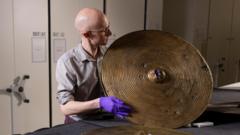
The return of the Beith Shield, a 2,800-year-old Bronze Age artifact, to North Ayrshire after 233 years of institutional displacement represents more than a repatriation; it is a case study in the preservation of archaeological context and the material science of the Yetholm-type shield. Discovered in a peat bog in 1791, this object is one of only 30 known examples globally. Its survival is not an accident of history but a function of the specific anaerobic chemistry of Scottish wetlands and the sophisticated sheet-metal engineering of the late second millennium BCE.
The Mechanics of Anaerobic Preservation
To understand the shield’s condition, one must analyze the deposition environment. Peat bogs operate as natural carbon sequestration and preservation engines due to three primary variables:
- Oxygen Deprivation: The waterlogged nature of the bog prevents aerobic bacteria from decomposing organic matter or oxidizing metals.
- High Acidity: The presence of sphagnum moss creates an acidic environment that inhibits microbial growth, though it typically challenges the structural integrity of calcium-based materials like bone.
- Tannic Concentration: Natural tannins act as a pickling agent, stabilizing organic components that might otherwise degrade.
The Beith Shield is composed of a high-tin copper alloy, beaten to an extreme thinness that defies primitive characterization. While the British Museum held the artifact since the late 18th century, its physical state reflects the environmental stability of the Beith peatlands. The transition from a stable, anaerobic bog to a climate-controlled museum environment involves a "conservation debt" where the artifact must be shielded from atmospheric pollutants and humidity fluctuations to prevent the onset of "bronze disease"—a destructive, self-sustaining chloridic corrosion.
The Engineering Logic of Yetholm-Type Shields
The Beith Shield is not a piece of functional combat equipment in the modern sense; it is a masterclass in prehistoric metal smithing and status signaling. Weighing very little and measuring approximately 0.6 millimeters in thickness, the shield's architecture suggests a specific utilitarian divergence from practical defense.
The Structural Components
- The Boss: A central, raised dome designed to house the handgrip on the reverse side.
- Concentric Rings: The shield features approximately 20 to 30 rows of raised bosses interspersed with concentric ribs.
- Sheet Metal Thinness: The ability to beat a bronze ingot into a consistent, paper-thin sheet of this diameter indicates a highly developed understanding of work hardening and annealing.
The smiths had to repeatedly heat the metal and then cool it to maintain malleability. If the metal were worked too long without annealing, it would become brittle and crack. If heated too much, it would lose the structural tension required to maintain its shape. This delicate balance suggests a specialized class of artisans whose "cost of production" in terms of labor and material was astronomical for the period.
Ritual Deposition vs. Accidental Loss
The "Broken Logic" of many archaeological reports assumes these items were lost or discarded. Data-driven analysis of find-spots for Yetholm shields suggests a deliberate Ritual Deposition Framework.
The majority of these shields are found in watery contexts—bogs, rivers, or marshes. Because these items were functional status symbols and high-value capital, their placement in a bog represents a "sunk cost" in the most literal sense. This behavior points to a socio-economic mechanism where value was generated not through the accumulation of goods, but through their strategic destruction or removal from circulation. By depositing a shield in a bog, a leader or community signaled a surplus of wealth and a direct transaction with the metaphysical or the territorial landscape.
The Logistics of Repatriation and Localized Value
The relocation of the shield from the British Museum to the Kilwinning Heritage Centre involves a complex transfer of "Cultural Equity." For 233 years, the artifact was centralized in a global hub, which maximized its visibility but stripped it of its geographic and narrative context.
The current strategy of localized display focuses on Contextual Re-integration. By placing the artifact near its original find-spot, the "provenance value" increases for the local population and researchers. This move highlights a shift in museum science from "collection-centric" models to "site-specific" narratives.
The Constraints of Localized Display
- Micro-climate Control: Maintaining the precise 40-50% relative humidity required for ancient bronze.
- Security Infrastructure: Protecting a high-valuation asset in a smaller, less fortified facility.
- Knowledge Transfer: Ensuring that the technical history of the shield is not lost in favor of purely sentimental local narratives.
Material Analysis and Future Research Vectors
Future study of the Beith Shield should prioritize Lead Isotope Analysis and X-ray Fluorescence (XRF). These technologies allow researchers to trace the copper ore to its specific mine of origin—likely the Great Orme in Wales or sites in continental Europe. This would quantify the "Trade Radius" of the Bronze Age Scottish economy.
The manufacturing process itself—specifically the indentation of the bosses from the reverse side—indicates a standardized "Template Logic." The precision of the concentric circles suggests the use of a compass-like tool, which predates many assumed technological milestones in the region.
The return of the shield is a catalyst for investigating the Aegean-Atlantic trade routes. There are striking similarities between these shields and those found in the Mediterranean, suggesting that despite the "primitive" label often applied to the Bronze Age, the technological and aesthetic "Standard Model" for elite weaponry was remarkably globalized.
The strategic imperative for the Kilwinning Heritage Centre is to leverage this asset not as a static trophy, but as a dynamic research platform. The focus must remain on the shield’s role as a bridge between the anaerobic preservation of the past and the analytical precision of modern metallurgy.
The shield represents a "frozen" moment of technological peak. As a business or cultural entity, the retention of this object locally serves as a hedge against the homogenization of history, ensuring that the specific environmental and engineering achievements of the North Ayrshire Bronze Age remain accessible at the point of origin. The next phase of analysis should involve high-resolution 3D scanning to create a digital twin, ensuring that even if the physical artifact eventually succumbs to the entropy of oxygen, the structural data—the true value of the asset—is preserved indefinitely.