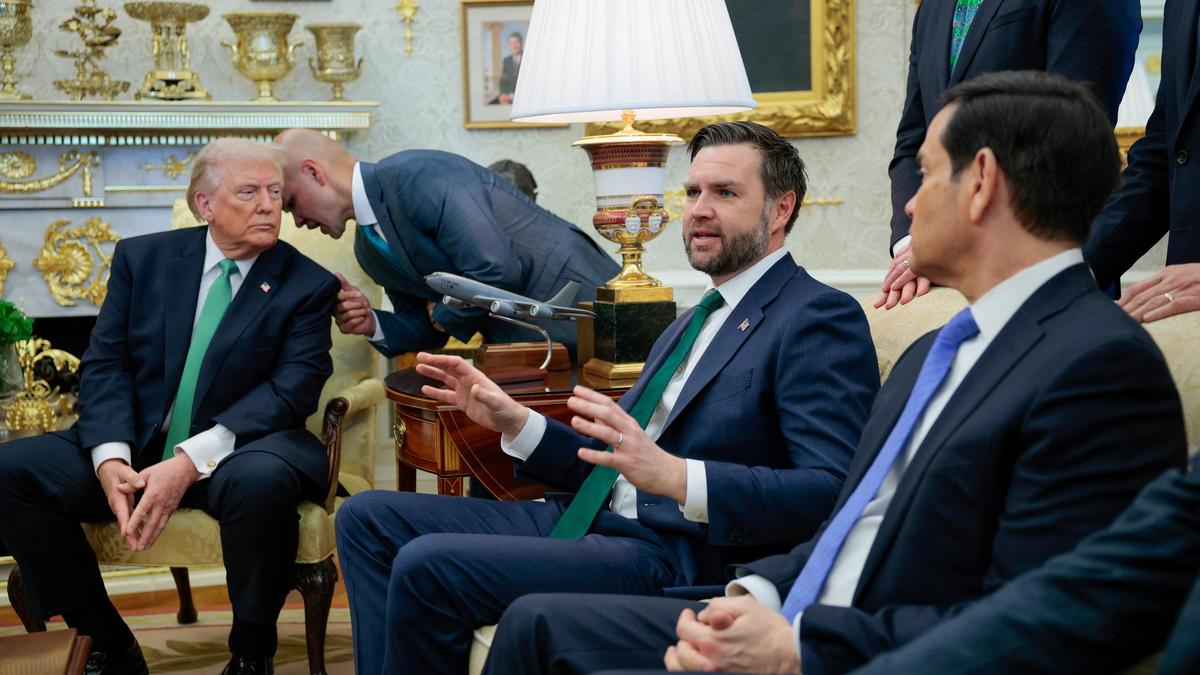
The American intelligence community is currently facing its most severe internal rupture since the 2003 invasion of Iraq. On Wednesday, the nation’s top spy chiefs, including Director of National Intelligence Tulsi Gabbard and CIA Director John Ratcliffe, arrived on Capitol Hill for a high-stakes public hearing that was intended to be a routine "Worldwide Threats" assessment. Instead, it has transformed into a forensic examination of the "imminent threat" justification used to launch Operation Epic Fury on February 28.
At the heart of the firestorm is the sudden resignation of Joe Kent, the former head of the National Counterterrorism Center. Kent, a staunch ally of the administration until 48 hours ago, went public with a scorching resignation letter alleging that the White House ignored intelligence indicating Iran was not, in fact, preparing a strike against U.S. interests. His departure has provided a roadmap for Senate investigators to challenge the administration's narrative that the war was a necessary act of self-defense.
The Intelligence Gap and the 165 Deaths
The most damning evidence likely to surface during this week's testimony involves a strike on an Iranian elementary school that killed over 165 people. While the administration initially blamed an Iranian "misfire," emerging reports suggest the U.S. relied on outdated targeting data provided by the Defense Intelligence Agency (DIA). Lt. Gen. James H. Adams, the DIA director, is expected to face brutal questioning regarding why ten-year-old coordinates were used to authorize a kinetic strike in a civilian-dense area.
This is not merely a technical error. It represents a systemic failure in the vetting process. For years, the intelligence community has warned that the "hyperwar" environment—where decisions are made in seconds based on AI-filtered data—could lead to catastrophic collateral damage. The school strike appears to be the first major realization of those fears.
The Resignation That Changed Everything
Joe Kent’s exit has stripped away the administration’s unified front. By stating that Iran "posed no imminent threat," Kent has effectively called his former colleagues liars. This creates a massive legal and political hurdle for the White House. Under the War Powers Resolution, the justification of an "imminent threat" is the primary mechanism for bypassing formal Congressional declarations of war. If that threat was fabricated or exaggerated, the entire legal basis for the ongoing bombing campaign evaporates.
Tulsi Gabbard has attempted to pivot, stating on social media that the President alone has the authority to determine what constitutes a threat. However, in the halls of the Senate, that defense carries little weight. Senators are demanding to see the "raw" intelligence—the unvarnished cables and satellite imagery—rather than the curated summaries presented to the public.
Technology and the New Fog of War
The 2026 conflict is the first to see the widespread use of autonomous systems and large-scale cyber warfare as primary, rather than secondary, tools of engagement.
- Russian Intelligence Sharing: Recent reports indicate that Russia is providing Iran with modified Shahed drones and real-time satellite imagery to target U.S. bases in the Middle East.
- Cyber Retaliation: The Canadian Centre for Cyber Security has already documented a surge in Iranian-linked "wiper" malware targeting Western energy and maritime infrastructure.
- AI in the Loop: There are growing concerns that the "imminent threat" assessment may have been influenced by predictive AI models that misinterpreted Iranian defensive posturing as offensive preparation.
The danger of relying on these automated systems is that they lack human nuance. If an algorithm sees a missile battery move into a firing position, it flags it as a threat. It cannot understand the political context of that movement or the possibility that it is a bluff.
The FBI Under Scrutiny
While the war rages abroad, FBI Director Kash Patel is facing a separate but related crisis at home. The FBI is currently grappling with a wave of domestic "lone wolf" attacks, including a recent shooting at a Texas bar by an individual draped in Iranian imagery. Critics argue that Patel’s aggressive restructuring of the Bureau—which included firing dozens of veteran agents—has left the U.S. vulnerable to domestic blowback from the war.
Patel’s leadership has been a lightning rod for controversy. His recent public appearance at a celebration for the U.S. Olympic hockey team, while the Middle East burned, has provided his detractors with ammunition to claim he is more interested in the optics of his position than the gritty work of counterintelligence.
The Missing Endgame
The most haunting question looming over the Senate Intelligence Committee is the lack of a clear exit strategy. Recent intelligence assessments, which Gabbard and Ratcliffe will be asked to defend, suggest that the current bombing campaign is unlikely to result in regime change. Instead, it has seemingly unified the Iranian public behind a wounded but still functional leadership, now overseen by Mojtaba Khamenei.
The administration has rejected mediation efforts by Oman and Egypt, insisting that the "degradation" of Iranian capabilities must continue. But as the war enters its third week, the "short-term deal" promised by some Republicans is nowhere in sight. Shipping through the Strait of Hormuz has slowed to a crawl, and global energy prices are beginning to reflect the reality of a prolonged conflict.
The testimony this week will do more than just update the public on global threats; it will determine if the United States is fighting a war based on a verifiable reality or a convenient fiction. If the intelligence chiefs cannot provide a concrete, unclassified explanation for the "imminence" of the Iranian threat, the administration may find itself facing a revolt not just from the opposition, but from its own ranks.
Demand for a ceasefire is no longer a fringe position; it is the logical conclusion of an intelligence community that can no longer agree on why it started the fire in the first place.