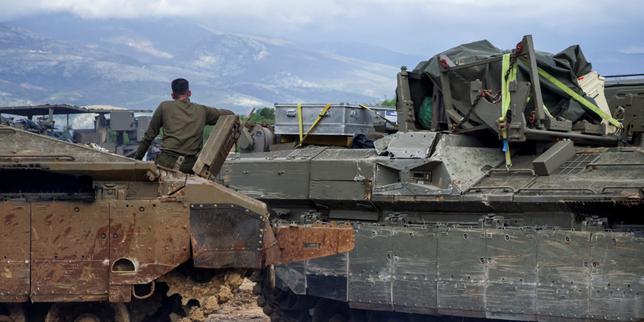
Benjamin Netanyahu has issued a directive to the Israeli Defense Forces to broaden the buffer zone in southern Lebanon. This is a gamble. By pushing the "grey zone" further into Lebanese territory, the Israeli government intends to neutralize Hezbollah’s short-range rocket capabilities and prevent another cross-border raid. However, history suggests that holding ground in Lebanon is rarely a static achievement; it is a magnetic pull into a war of attrition. The Prime Minister’s order transforms a temporary tactical maneuver into a permanent geopolitical fixture that may backfire on the very security it seeks to provide.
For the residents of northern Israel, the promise of a buffer zone is a prerequisite for returning home. They have lived in hotels and temporary housing for months, displaced by a constant rain of anti-tank missiles. The logic from the Kirya in Tel Aviv is simple: if you push the enemy back, the bullets can't reach the target. But "expanding" a zone in the rugged, tunnel-riddled terrain of the Lebanese south is not as clean as drawing a new line on a map. It requires boots, blood, and a multi-year commitment that the Israeli public may not be prepared to fund or fight.
The Ghost of 1982 and the High Cost of Space
Military planners often suffer from a specific type of amnesia regarding southern Lebanon. In 1982, the initial "Peace for Galilee" operation was sold as a limited, 40-kilometer push to clear out the PLO. That limited push turned into an eighteen-year occupation. The current expansion of the buffer zone mirrors that mission creep.
Israel is currently operating in a landscape where Hezbollah has spent two decades building subterranean fortresses. Expanding the zone means more than just patrolling a few extra kilometers of scrubland. It means clearing villages that have been turned into literal launchpads. When Netanyahu orders the army to "expand," he is essentially asking them to take over and hold high-ground positions that are easily targeted by Hezbollah’s mobile units. This is the Security Paradox. To make the border safe, you must move the border. But moving the border closer to the enemy's core only increases the frequency and intensity of contact.
This isn't just about geography. It is about the physical reality of modern warfare. A wider buffer zone reduces the effectiveness of Kornet missiles against Israeli kibbutzim, but it places IDF soldiers in a "static target" environment. Every outpost established to maintain this zone becomes a bullseye for drones and indirect fire.
The Logistics of Displacement
A buffer zone is only effective if it is empty. This is the brutal truth that diplomats avoid. For Israel to "expand" its zone in southern Lebanon, it must ensure that the area remains devoid of Hezbollah operatives. In practice, this means the displacement of Lebanese civilians is no longer a byproduct of war—it becomes a strategic necessity.
When an army creates a "no-go" area, they are responsible for everything that moves within it. If the IDF expands the zone to the Litani River or beyond, they are effectively managing a wasteland.
- Surveillance requirements increase exponentially with every square kilometer added.
- Supply lines become longer and more vulnerable to ambush.
- Political pressure from the international community mounts as the "temporary" nature of the zone begins to look like a de facto annexation.
The expanded zone is an admission that diplomacy has failed. UN Resolution 1701, which was supposed to keep Hezbollah north of the Litani, has been a dead letter for years. By taking matters into its own hands, Israel is moving from a policy of international reliance to one of raw military enforcement. It is a shift from "trust but verify" to "occupy and deny."
The Hezbollah Trap
Hezbollah’s leadership is likely watching this expansion with a grim sense of opportunity. They are not a conventional army that fears losing territory; they are a guerrilla force that thrives on the presence of an occupying power. An expanded buffer zone provides Hezbollah with exactly what it needs to sustain its domestic legitimacy: a visible "Zionist aggressor" on Lebanese soil.
The deeper the IDF moves into the south, the more the tactical advantage shifts to the defender. Hezbollah uses a "spiderweb" defense strategy. They allow the enemy to penetrate deep into their territory, stretching their lines thin, before striking at the flanks. By expanding the zone, Netanyahu might be walking his troops directly into a pre-constructed killing field.
We must also consider the technological shift. In the 1990s, a buffer zone worked because it physically distanced the enemy from the border. In 2026, distance is less of a shield. Long-range precision missiles and suicide drones can overfly a 10-kilometer or 20-kilometer buffer zone with ease. The "extension" of the zone may solve yesterday's problem of cross-border sniping, but it does nothing to stop the swarm of tech-heavy munitions launched from the Beqaa Valley or further north.
The Economic Drain of a Permanent Front
Wars are won by treasuries as much as by tanks. Israel's economy is already feeling the strain of a multi-front conflict. Reservists are being pulled from the tech sector and the construction industry for months at a time. Expanding and holding a wider swathe of Lebanon requires a massive, permanent deployment of manpower.
Maintenance of a buffer zone is a high-overhead operation. You need sensors, fences, paved patrol roads, and fortified bunkers. You need constant aerial surveillance. This isn't a one-time expense; it is a recurring bill that must be paid in both shekels and lives. If the goal is to allow 60,000 displaced Israelis to return to the north, the cost of that security must be weighed against the long-term stability of the national budget. At what point does the cost of holding the buffer zone exceed the economic value of the towns it protects?
The Fallacy of the Limited Expansion
There is no such thing as a "limited" expansion in a theater like Lebanon. Every hill taken reveals another hill that the enemy can use for observation. To secure Hill A, you must take Hill B. To protect Hill B, you need a presence on Hill C. This is the logic of the mountain, and it leads to a total commitment that rarely has an exit strategy.
Netanyahu’s order is a political signal to his right-wing coalition and a frustrated public that he is "doing something." But "doing something" is not the same as having a terminal objective. If the objective is the total destruction of Hezbollah, an expanded buffer zone is insufficient. If the objective is a negotiated peace, the expansion might be seen as a bargaining chip, but only if the other side is willing to bargain.
Currently, there is no indication that Naim Qassem or the remaining Hezbollah leadership is looking for a way out. They are playing a longer game than the Israeli electoral cycle. They are betting that the IDF will tire, the Israeli economy will stumble, and the international community will eventually force a retreat.
The Strategic Failure of the "Grey Zone"
By creating an expanded buffer zone, Israel is essentially formalizing a "Grey Zone" conflict. This is a state of permanent, low-intensity war. It is not quite peace, and it is not quite a total regional conflagration. It is a slow bleed.
The problem with the Grey Zone is that it favors the side with the higher pain threshold. Hezbollah, backed by Iranian logistics, has shown a remarkable ability to endure high levels of attrition while maintaining a baseline of harassment. Israel, a democratic society with a high sensitivity to casualties, struggles in protracted, indecisive conflicts. The "expansion" plays into the very type of war Israel is least equipped to win in the long run.
Beyond the Litani
If the IDF moves to "extend" the zone, we should expect a sharp increase in the use of heavy standoff weapons. To clear the path for this expansion, the military will likely use a scorched-earth approach to northern Lebanese infrastructure to prevent the area from being used as cover. This will inevitably lead to a higher civilian toll, which in turn fuels the recruitment cycles for the next generation of militants.
The reality of the Middle East is that vacuum-filling is a constant. If Israel clears a zone, it must fill it with soldiers, or the enemy will return the moment the tanks pull back. There is no middle ground. You either own the territory or you don't. Netanyahu's order to "expand" the zone is an attempt to find a middle ground that simply does not exist in the geography of the Levant.
The real test will come in the winter months. Southern Lebanon's mud and cold have broken the spirit of many armies before. If the IDF is still "expanding" and "holding" these new lines when the rains come, the logistical nightmare will truly begin. The move to expand the zone is a tactical response to a strategic crisis, a band-aid applied to a gaping wound. It buys time, but it doesn't buy peace.
Determine if your local municipal or national leaders have a defined exit strategy for this expansion, or if we are witnessing the birth of "The Security Zone 2.0."