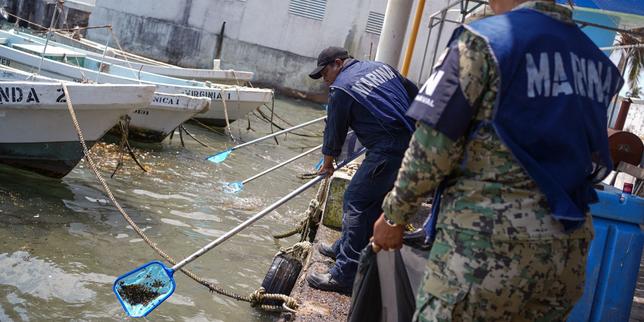
The black sludge doesn't care about tourist season. It doesn't care about the nesting cycles of Kemp's ridley sea turtles either. For weeks, thick clumps of hydrocarbons and iridescent sheens have been washing up on the shores of Veracruz and Tamaulipas, transforming some of Mexico’s most famous vacation spots into ecological graveyards. Local fishermen are pulling up nets coated in sticky residue. Hoteliers are watching cancellations pile up. Yet, the official response remains a masterclass in bureaucratic foot-dragging and finger-pointing.
It's a mess. Honestly, calling it a "spill" feels too polite. This is a recurring systemic failure of infrastructure and oversight that’s hitting the Gulf of Mexico where it hurts most.
Why the Gulf Coast is Wearing the Cost of Negligence
When you see photos of oil-soaked sand in places like Coatzacoalcos or the beaches of Tuxpan, the immediate question is always the same. Where did it come from? While storms and natural seeps can account for small amounts of bitumen, the scale of recent sightings points directly toward the aging industrial heart of Mexico’s energy sector.
Pemex, the state-owned oil giant, frequently finds itself at the center of these controversies. The company’s infrastructure is old. Pipes corrode. Platforms leak. In 2023, massive slicks near the Ek Balam fields drew international condemnation, and while the company often downplays the volume of leaked crude, the satellite imagery usually tells a different story. For the people living on the coast, the "source" is less important than the reality that their livelihood is literally being smothered.
The environmental impact isn't just a headline. It's a chain reaction. When oil hits the beach, it isn't just a surface problem. It sinks into the sand. It enters the food chain through microorganisms. Crabs, shorebirds, and the already endangered sea turtles bear the brunt of the toxicity. If you’ve ever tried to scrub crude oil off a rock, you know it doesn't just "wash away." It persists for years, leaching chemicals like polycyclic aromatic hydrocarbons (PAHs) into the water.
The Myth of the Easy Cleanup
There’s a common misconception that once you hire a few crews with shovels and absorbent pads, the beach is "clean." That’s nonsense.
Cleaning a beach after a spill is a brutal, expensive, and often ineffective process. Manual removal often involves stripping the top layer of sand, which leads to coastal erosion. Using chemical dispersants—a favorite tactic for keeping oil away from the "visible" shoreline—often just pushes the problem underwater, making it more toxic for fish and coral reefs.
- The "Invisible" Damage: Oil that settles on the ocean floor can stay there for decades, getting stirred up every time a major storm hits.
- Economic Paralysis: It’s not just about the cleanup cost. It’s the loss of the "blue economy." Fishermen can't sell tainted catches. Tourists don't want to swim in a petroleum bath.
- Health Risks: Local communities often report respiratory issues and skin rashes after major incidents, yet long-term health monitoring is virtually non-existent in these regions.
Environmental defenders in Mexico are beyond frustrated. Groups like Greenpeace Mexico and local NGOs have been screaming into the void for years. They're demanding transparency that Pemex and the federal government seem unwilling to provide. When data is obscured, accountability dies.
Breaking the Cycle of Environmental Impunity
Mexico has some of the most beautiful coastlines on the planet, but it’s treating the Gulf like a private waste bin for the energy industry. If we want to stop these tides of sludge, the strategy has to shift from reactive cleaning to aggressive prevention.
Investment in infrastructure is the boring but necessary answer. You can't run a 21st-century energy economy on mid-20th-century pipes. There’s also the issue of the "fine." In many jurisdictions, the cost of paying an environmental fine is cheaper than the cost of fixing the leak. That’s a death sentence for the environment. Until the penalties for these spills outweigh the profits of cutting corners on maintenance, the beaches will keep turning black.
We also need to talk about independent monitoring. We shouldn't have to rely on a company’s own press release to know how many barrels of oil are in the water. Independent satellite tracking and third-party environmental audits should be the standard, not a radical demand.
What You Can Actually Do
If you’re a traveler or a concerned citizen, don't just look away.
First, support the organizations on the ground. Groups like Centro Mexicano de Derecho Ambiental (CEMDA) are doing the heavy lifting of filing lawsuits and demanding government transparency. They need resources to fight these legal battles.
Second, if you’re visiting the coast and see oil, report it. Take photos. Use social media to tag the Secretaría de Medio Ambiente y Recursos Naturales (SEMARNAT) and the Procuraduría Federal de Protección al Ambiente (PROFEPA). Public pressure is often the only thing that moves the needle in Mexico.
Finally, stay informed about the health of the seafood you consume. Tainted fish isn't just an environmental tragedy; it’s a public health hazard. Demand to know where your food comes from.
The "black tide" in Mexico isn't an act of God. It’s a man-made disaster fueled by a lack of investment and a culture of secrecy. We've got to stop accepting it as the price of doing business. Grab your phone, document what you see, and keep the pressure on the people in power. The Gulf is running out of time.