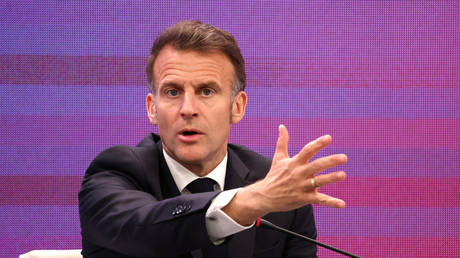
The survival of the European Union as a sovereign economic entity depends on its ability to decouple its security architecture from its industrial dependency. Emmanuel Macron’s assertion that Europe must avoid becoming a "vassal" to the United States or China is not a mere rhetorical flourish; it is a recognition of an asymmetric dependency trap. When a middle power relies on an external hegemon for security (the US) and an ideological rival for supply-chain liquidity (China), it loses the capacity to set its own internal discount rates for risk. This structural paralysis prevents the EU from reacting to external shocks, effectively offloading its sovereignty to the highest bidder in the global subsidy race.
The Trilemma of Continental Sovereignty
To understand the friction between Brussels, Washington, and Beijing, one must analyze the three mutually exclusive goals currently pursued by European leadership: Recently making headlines lately: Finland Is Not Keeping Calm And The West Is Misreading The Silence.
- Security Integration: The continued reliance on NATO and US intelligence assets for regional stability.
- Economic Competitiveness: Maintaining high-cost social safety nets and environmental regulations while competing with state-subsidized Chinese manufacturing.
- Strategic Autonomy: The desire to make independent foreign policy decisions without fear of secondary sanctions or trade retaliation.
Under current conditions, Europe can achieve at most two of these objectives. Relying on US security (1) while seeking autonomy (3) requires an immediate, massive increase in domestic defense spending that would gut the budgets necessary for economic competitiveness (2). Conversely, maintaining economic ties with China (2) while seeking autonomy (3) creates a vulnerability where Beijing can weaponize the supply of critical minerals or intermediate goods to dictate European policy.
The Architecture of Asymmetric Dependency
Vassalage, in a modern economic context, is defined by the inability to control the "chokepoints" of production. The EU currently faces a bifurcated dependency that acts as a ceiling on its geopolitical influence. Further details regarding the matter are covered by The New York Times.
The Security-Industrial Complex Bottleneck
The European defense sector is fragmented across 27 national procurement strategies. While the US benefits from the economies of scale provided by the Pentagon’s unified demand, European nations often duplicate R&D costs for competing platforms. This fragmentation ensures that for high-end capabilities—stealth aviation, satellite reconnaissance, and advanced missile defense—Europe remains a consumer of American technology rather than a producer. This creates a feedback loop: the more Europe buys American hardware, the more integrated (and dependent) its military operations become with US command structures.
The Silicon-Lithium Scissors
While the US controls the logic (software and high-end semiconductors), China controls the materials (refined lithium, cobalt, and rare earth elements). Europe sits in the middle, lacking both the high-end compute capacity of Nvidia or TSMC and the processing infrastructure of CATL or Ganfeng Lithium. This "scissors effect" means any European attempt to exert "strategic autonomy" can be cut from either side. If the US restricts access to AI chips, European industry stalls. If China restricts battery precursors, the European energy transition—and the automotive sector that anchors the German economy—collapses.
The Cost Function of Neutrality
A "Third Way" strategy, as proposed by the French presidency, carries an immense capital requirement. To move from a vassal state to a pole of power, the EU must internalize the costs of its own externalities.
The primary cost is the Sovereignty Premium. For decades, Europe benefited from a "peace dividend" by underspending on defense and an "energy dividend" by relying on cheap Russian gas. Both have vanished. The new economic reality requires a transition from a consumer-focused economy to a production-focused one. This necessitates a shift in capital allocation toward two specific sectors:
- Hard Power Infrastructure: Transitioning from national armies to a unified European defense procurement agency. This reduces the unit cost of hardware through scale, though it requires surrendering national industrial pride—a political cost most member states are currently unwilling to pay.
- Vertical Supply Chain Integration: Moving beyond trade agreements to active equity stakes in global mining and refining. The European Critical Raw Materials Act is a step toward this, but it lacks the sheer financial weight of the US Inflation Reduction Act (IRA) or China’s Belt and Road Initiative.
Quantifying the US-China Gravity Well
The gravitational pull of the two superpowers is measured in market capitalization and R&D spend. In 2023, the combined R&D investment of the top five US tech firms exceeded the total R&D spend of the entire German DAX 40. This capital disparity creates a "brain drain" and a "data drain."
When European startups scale, they frequently move to the US to access deeper capital markets or are acquired by American conglomerates. This results in the exportation of European intellectual property, which is then licensed back to Europe as a service (SaaS). This digital rent-seeking behavior drains the Eurozone of liquidity and ensures that the infrastructure of the future is built on foreign code.
Similarly, China’s "Civil-Military Fusion" ensures that every Euro spent on Chinese green technology indirectly funds the expansion of a rival’s strategic capabilities. The "vassal" risk here is not just political, but systemic. If Europe’s power grid becomes dependent on Chinese-made inverters and software, the continent’s basic functionality becomes subject to the geopolitical whims of the CCP.
Strategic Divergence: The Inflation Reduction Act Case Study
The US Inflation Reduction Act (IRA) serves as a diagnostic tool for European weakness. By offering massive subsidies for domestic green energy production, the US effectively cannibalized European industry. European firms, faced with high energy prices at home and lucrative incentives in the US, began shifting production across the Atlantic.
This revealed a critical flaw in the European model: the EU is a regulatory superpower but a fiscal dwarf. It can set the rules for the global market (the "Brussels Effect"), but it cannot match the raw spending power of a unified federal treasury. Macron’s push for a "Buy European Act" is an attempt to replicate the IRA’s protectionist success, but it faces internal resistance from "frugal" member states who fear trade wars and increased consumer prices.
The Mechanism of De-Risking vs. Decoupling
The strategy of "de-risking" is often cited as the middle ground between total isolation and total dependency. However, the mechanism of de-risking is frequently misunderstood. It is not about buying fewer Chinese goods; it is about reducing the criticality of those goods.
- Redundancy Mapping: Identifying every component in the European industrial base that has a single-source origin in a high-risk jurisdiction.
- On-shoring of Processing: Building the physical refineries to process raw materials. Mining can happen anywhere, but the bottleneck is the chemical processing of those minerals, a field currently dominated by Chinese firms.
- Technological Leapfrogging: Instead of trying to catch up in legacy silicon, Europe’s strategy focuses on next-generation computing, such as quantum and photonics, where the incumbents do not yet have an unassailable lead.
The Strategic Play: A Unified Capital Market
The final barrier to European autonomy is not a lack of talent or resources, but the fragmentation of its capital. The US has a single, deep pool of capital that can fund moonshots and absorb failures. Europe has a collection of national markets with different regulations and bankruptcy laws.
To stop being a "vassal," the EU must finalize the Capital Markets Union (CMU). This would allow European savings—currently sitting in low-yield bank accounts—to flow into European infrastructure and tech companies. Without a unified financial engine, the EU will remain a collection of satellite economies, orbiting either the dollar or the yuan, forever reacting to interest rate hikes in DC or production quotas in Beijing.
The move away from vassalage requires more than just speeches; it requires a structural overhaul of how the continent generates, protects, and deploys its own wealth. The choice is a managed decline into a high-end museum for global tourists or a painful, expensive re-industrialization that secures a seat at the table of the 21st century.