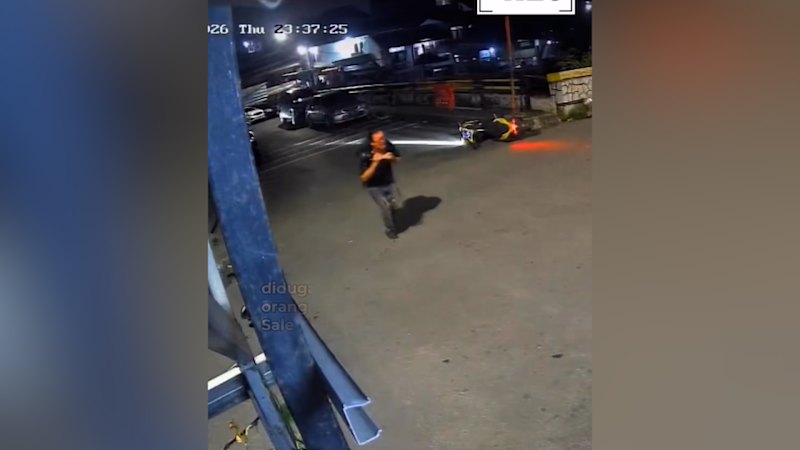
The humidity in Jakarta doesn't just sit on your skin; it breathes with you. On a typical Tuesday evening, the city is a cacophony of idling motorbike engines, the sweet, smoky scent of chicken satay wafting from street carts, and the neon hum of a metropolis that never truly sleeps. Andrie Yunus was part of that rhythm. He was a man moving through the familiar currents of his home, likely thinking of nothing more consequential than the traffic or his next meal.
Then the air broke.
It wasn't a sound or a flash of light that signaled the shift. It was a sensation—a sudden, violent erasure of the world as he knew it. In an instant, the mundane surroundings of a Jakarta street were replaced by a searing, liquid agony. When chemicals meet human tissue, there is no negotiation. There is only the chemistry of destruction.
The Invisible Border of Safety
We walk through our lives assuming a certain structural integrity to the world. We believe the sidewalk is solid, the air is breathable, and the strangers passing us are bound by the same unspoken social contract of non-aggression. When someone like Andrie Yunus is targeted in a chemical attack, that contract isn't just broken; it is incinerated.
This wasn't a random accident of industry. This was an intentional act of erasure.
In the immediate aftermath, the reports were clinical. They spoke of "serious injuries" and "chemical substances." But "serious injuries" is a sterile phrase that fails to capture the terrifying reality of what happens when the body becomes a site of a chemical reaction. Imagine the sensation of heat, but without the flicker of a flame. Imagine a substance that continues to work, deeper and deeper, long after the initial splash. It is a slow-motion trauma that turns seconds into hours.
The bystanders who rushed to help faced a dilemma that defines the modern urban nightmare. How do you touch someone whose very skin has become a hazard? To pull him to safety is to risk the same fate. To stay back is to watch a human being dissolve.
A City Under the Surface
Jakarta is a city of layers. There is the glittering facade of the Sudirman Central Business District, and then there are the winding alleys where the real life of the city pulses. These attacks—vicious, personal, and devastatingly quiet—happen in the gaps between these layers.
Why Andrie? The question hangs over the city like the smog that refuses to lift. In the wake of such violence, the public searches for a motive to distance themselves from the victim. We want to believe there is a reason, a logic, a "why" that protects us. If he did something, we can avoid doing it. If he knew someone, we can avoid knowing them.
But the horror of the chemical attack lies in its accessibility. Unlike a firearm, which leaves a trail of ballistics and serial numbers, the components of a liquid assault are often sitting under a kitchen sink or in a garage. It is the weaponization of the everyday. It turns the household into an armory and the street corner into a battlefield.
The Architecture of Recovery
When the skin is compromised at this scale, the body loses its ability to regulate anything. Temperature fluctuates wildly. The risk of infection becomes a constant, looming shadow. For Andrie, the hospital bed isn't just a place of healing; it is a fortress against a world that has suddenly become toxic.
Recovery from a chemical injury isn't a linear path. It is a grueling, repetitive cycle of debridement and grafting. It is a psychological reckoning with a mirror that no longer reflects the person you were five minutes before the attack. We often talk about "survivors," but that word implies a finished state. Andrie isn't just a survivor; he is an inhabitant of a new, painful reality.
Consider the sensory memory of the event. For many who endure such trauma, the smell of a certain cleaning product or the sight of a plastic bottle can trigger a physical reclamation of the terror. The city remains, but the victim's map of it has changed. Certain streets are now haunted. Certain smells are now warnings.
The Silence of the Witness
In the days following the attack, the digital space filled with the usual noise. Outrage, prayers, demands for justice. But beneath the digital roar is a chilling silence. The witnesses who saw the perpetrator, the people who know the "who" and the "where," often retreat into the shadows. In a city as dense as Jakarta, anonymity is a survival strategy.
Justice in these cases is notoriously elusive. The evidence washes away. The trail goes cold as soon as the liquid evaporates or is rinsed into the gutter. It leaves the victim in a vacuum, suffering for a crime that the legal system struggles to even categorize properly. Is it assault? Is it attempted murder? Or is it something more sinister—a form of psychological warfare intended to mark the victim forever?
The stakes are higher than one man’s health. Every time an attack like this occurs without a clear consequence, the threshold for violence in the community drops. It sends a message that the most intimate form of violation—the literal melting of a person's features—is a tool available to anyone with a grievance and a bottle.
The Weight of the After
There is a specific kind of bravery required to face a world that has shown you its sharpest, most corrosive edge. As Andrie Yunus fights through the fog of pain and the long, antiseptic corridors of the Indonesian healthcare system, the rest of the city moves on. The satay continues to smoke. The bikes continue to roar.
We read the headline and we feel a pang of sympathy, a momentary shiver of "there but for the grace of God go I." Then we scroll. We look for the next story, the next distraction.
But for Andrie, there is no scrolling. There is only the slow, meticulous work of putting a life back together when the very fabric of that life has been chemically altered. The true story isn't the attack itself; it's the quiet, agonizing persistence of the days that follow. It's the moment he decides to step back out into the Jakarta air, knowing exactly what it is capable of carrying.
The scars are never just on the surface. They are woven into the way a person breathes, the way they flinch at a sudden movement, and the way they look at a stranger carrying a simple plastic cup. The air in Jakarta remains heavy, but for some, it will never be clear again.
The city watches, the lights flicker, and somewhere in a quiet room, a man tries to remember the face he had before the world turned to acid.