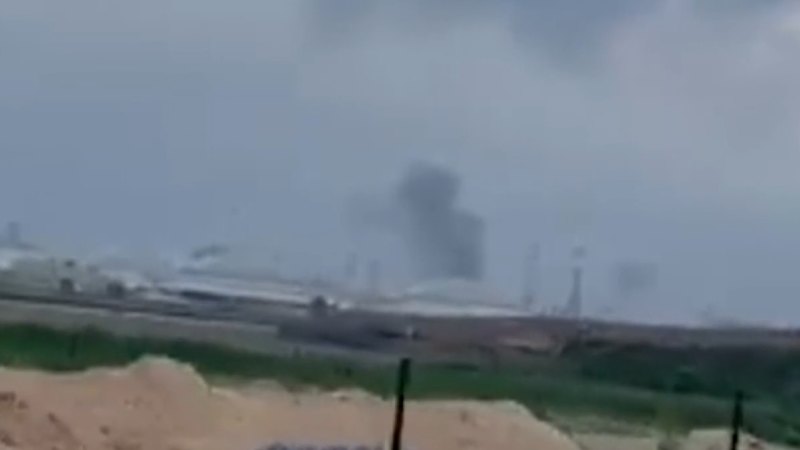
The headlines are predictable. A drone strikes a refinery in the Middle East, oil futures jump three percent, and every desk-bound analyst from London to New York starts screaming about the "fragility" of the global energy grid. They tell you we are one explosion away from a dark age. They claim these "critical sites" are the soft underbelly of modern civilization.
They are wrong.
The obsession with physical energy infrastructure as a strategic "center of gravity" is a relic of 1940s military doctrine applied to a 2026 reality. We are witnessing the death of the bottleneck, yet the media remains obsessed with the cork. If you think a missile hitting a processing plant in Abqaiq or a terminal in the Gulf of Oman changes the long-term trajectory of global power, you aren't paying attention to the math. You’re watching theater.
The Resilience Myth and the Cult of the Bottleneck
The "lazy consensus" argues that the energy sector is a house of cards. The reality? It is a hydra. Whenever a "critical" site is hit, the market doesn't collapse; it reroutes.
I’ve spent fifteen years watching commodity traders and logistics engineers respond to "catastrophic" disruptions. They don't panic. They arbitrage. In 2019, when the world's most sophisticated processing facility was swarmed by drones, the "expert" prediction was a months-long shutdown and triple-digit oil. Instead, the market absorbed the shock in weeks. Why? Because the global energy system is built on redundancy, not efficiency.
Modern energy giants have spent decades building "dark capacity"—extra storage, bypass pipelines, and modular refining units—specifically because they know they are operating in a shooting gallery. To think that a few million dollars in ordinance can permanently cripple a trillion-dollar network is a fundamental misunderstanding of industrial scale.
Why Your "Energy Security" Map is Obsolete
Standard analysis focuses on two things:
- Physical location (The Map)
- Production volume (The Flow)
This is a failure of imagination. In a world of surging renewable integration and high-voltage DC (HVDC) transmission, the "site" is becoming irrelevant. When a gas plant goes offline, the grid doesn't just go dark; it shifts to liquefied natural gas (LNG) regasification, triggers demand-response protocols, or draws from decentralized battery arrays.
Targeting a refinery today is like trying to stop the internet by cutting one fiber-optic cable. It's an inconvenience, not an existential threat. The real vulnerability isn't the steel and the pipes; it’s the digital logic controlling the pressure valves. But the headlines prefer the fireballs because fireballs sell ads.
The Economics of Futility
Let’s talk about the ROI of kinetic strikes on energy assets. If you are an insurgent group or a rogue state, you spend $50,000 on a suicide drone to cause $500 million in damage. On paper, that’s a win.
In reality, you’ve just subsidized your competitor's modernization.
Every time a site in the Middle East is targeted, it triggers an immediate wave of capital expenditure. Old, manual valves are replaced with automated, hardened systems. Analog vulnerabilities are purged. I have seen companies use insurance payouts from "disastrous" strikes to leapfrog ten years of technological debt. You aren't weakening the target; you are forcing them to evolve.
The Hidden Cost of "Stable" Prices
The public asks: "How do we stop these attacks to keep prices low?"
This is the wrong question.
Artificially low prices, maintained by a facade of "security," actually increase our vulnerability. High volatility—the kind caused by these strikes—is the only thing that drives the shift toward energy independence and localized microgrids. If you want a truly secure energy system, you should stop wishing for "undisturbed" Middle Eastern flows and start embracing the chaos that forces us to build systems that don't rely on a single geographical point.
Dismantling the "Oil is Power" Delusion
The competitor piece likely leans heavily on the idea that controlling or threatening these sites gives a nation "leverage."
Leverage over whom?
We are currently in a period of massive oversupply and diversifying sources. The United States is a net exporter. Guyana is coming online. The North Sea is reinventing itself. The idea that a regional actor can hold the world hostage by hitting a terminal is a 1973 fever dream that won't die.
In the current market, if you take 2 million barrels a day offline in the Middle East, you don't break the West. You just give a massive gift to producers in the Permian Basin and Brazil. The "victim" of an energy strike isn't the consumer at the pump; it’s the producer who loses market share that they may never get back.
The Real Target: The Insurance Industry
If you want to find the true point of failure, stop looking at the refineries and start looking at the underwriters in London and Zurich.
The physical damage of a strike is usually a rounding error for a national oil company. The risk premium—the cost to insure the tanker, the cargo, and the facility—is where the real damage happens.
- Scenario: A drone hits a storage tank.
- Result: $10 million in repairs.
- Actual Impact: $200 million in increased annual premiums across the regional fleet.
The "insider" truth is that the kinetic warfare we see in the news is actually a war on financial margins. The bombs are just a way to trigger a spreadsheet error. If we want to secure energy, we don't need more Patriot missiles; we need a new way to price geopolitical risk that doesn't reward the theater of violence.
The Hardened Truth About Renewable Vulnerability
There is a smugness among the "green energy" crowd that moving away from oil will solve this security dilemma.
It won't. It just changes the shape of the target.
While a refinery is hard to hide, a wind farm or a massive solar array is impossible to defend. They are sprawling, thin-skinned, and highly sensitive to kinetic interference. If a group wants to "target critical energy," a concentrated solar plant is a much softer target than a buried pipeline.
The transition to "clean" energy is actually a transition to a much larger physical attack surface. We are trading a few high-value targets for thousands of medium-value ones. This isn't a "fix" for energy security; it’s a decentralization of the headache.
What Actually Works (And Why We Don't Do It)
If the goal were truly to neutralize the threat to energy sites, the solution is boring, expensive, and invisible:
- Over-provisioning: Building 30% more capacity than we need.
- Strategic Decoupling: Ending the "just-in-time" delivery model for fuels.
- Hardware Air-Gapping: Removing the "smart" from the grid's most sensitive physical switches.
But no one wants to pay for 30% more than they use. No one wants to hold months of inventory. And no one wants to admit that "digital transformation" has made our infrastructure more fragile, not less.
Stop Being a Geopolitical Tourist
When you read about the next "unprecedented" attack on a Middle Eastern energy hub, ignore the maps showing the blast radius. Ignore the analysts talking about "global supply shocks."
Look at the tanker tracking data. Look at the spread between Brent and WTI. Look at the "Force Majeure" clauses in the contracts.
The world isn't running out of energy. It’s running out of ways to make the threat of energy shortages look scary. The strikes are real, the fire is hot, but the "crisis" is a manufactured product sold by people who need you to believe that the old world still matters.
The "critical" nature of these sites is a myth maintained by those who own them and those who want to blow them up. Both sides need you to believe the stakes are high to keep their relevance alive. In reality, the grid is moving on, the technology is moving on, and the only thing truly being "targeted" is your ability to see the system for what it actually is: a self-healing, redundant machine that views a missile strike as nothing more than a temporary surge in the cost of doing business.
The next time a "critical" site goes up in flames, don't look at the fire. Look at the neighboring plant that just increased its output by 5% to steal the victim's customers.
That is the true face of energy security. It isn't peace. It's the ruthless, redundant efficiency of a market that has learned to eat its own disasters.
Stop asking how to protect the sites. Start asking why we still care if they burn.