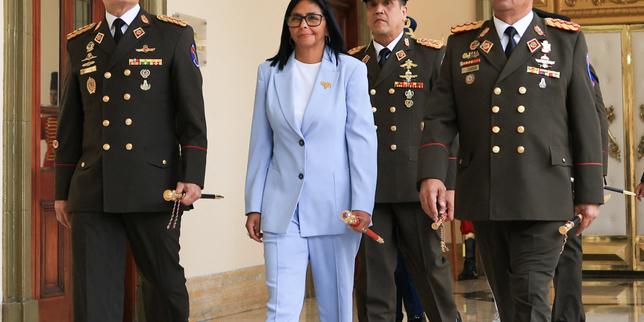
The air in the Miraflores Palace doesn't circulate like it does in the colorful, chaotic streets of Caracas. Up there, behind the ornate white walls and the heavy security cordons, the atmosphere is thick with the scent of floor wax and the static of unspoken anxieties. Power in Venezuela has always been a rhythmic thing—a series of pulses, some weak, some violent—but what happened recently wasn't a pulse. It was a surgical extraction.
While the world was looking at spreadsheets of oil exports or debating the semantics of election tallies, the foundation of the Venezuelan state shifted. Nicolás Maduro didn’t just sign a decree. He rewired the nervous system of the country’s muscle. By elevating Delcy Rodríguez to the role of acting president and simultaneously purging the entire military high command, the regime signaled that the old pact between the barracks and the palace is dead. A new, more desperate era has begun.
Imagine a chess player who, mid-match, decides that his knights and rooks are no longer trustworthy. Instead of trying to win the game with them, he sweeps them off the board and replaces them with pieces that have no memory of the previous rounds. That is what just occurred in Caracas.
The Architect in the High Heels
Delcy Rodríguez is often described by foreign analysts in sterile terms: Vice President, former Foreign Minister, loyalist. These words are ghosts. They don't capture the reality of a woman who has become the most formidable shadow in the Western Hemisphere. She is the "Architect of Survival." When the economy collapsed into the dirt, she was the one who found the back channels to keep the lights on—or at least the palace lights.
Her ascent to the acting presidency while Maduro traveled to the BRICS summit in Russia was more than a temporary promotion. It was a coronation of the civilian-bureaucratic wing over the traditional military caste. For decades, the Venezuelan military—the Fuerza Armada Nacional Bolivariana—was the ultimate arbiter of truth. If the generals were happy, the President stayed. If the generals were restless, the President packed his bags.
By handing the keys to Delcy, Maduro sent a freezing message to every officer wearing gold braid: The revolution no longer needs your permission. It only needs your silence.
The Vanishing Command
The "Haut Commandement" sounds like a monolithic block of iron. In reality, it was a collection of men who had grown rich, heavy, and perhaps a bit too comfortable in their influence. These were men who remembered the era of Hugo Chávez. They held a certain kind of institutional memory that can be dangerous to a leader who feels the ground shaking beneath his feet.
The replacement of the entire high command—the heads of the army, navy, air force, and national guard—wasn’t a scheduled rotation. It was an eviction.
Consider the psychological weight of such a move for a mid-level colonel. You wake up and realize that the men you spent thirty years saluting, the men who guaranteed your own safety and your family’s business interests, are gone. In their place are fresh faces, chosen not for their strategic brilliance or their standing among the troops, but for a singular, terrifying quality: total, unblinking dependence on the executive branch.
This is how a state becomes a fortress. You don't build the walls higher; you make sure the people guarding the door have nowhere else to go.
The Invisible Stakes of the Barracks
We often talk about "the military" as if it were a single machine. It isn't. It is a collection of thousands of young men and women who are hungry. The tragedy of the Venezuelan soldier is that he carries a rifle but often cannot afford the bread to give him the energy to lift it.
The high command lived in a different universe. They oversaw the distribution of food, the mining of gold, and the management of ports. They weren't just soldiers; they were CEOs in camouflage. When Maduro wiped the slate clean, he disrupted the patronage networks that held the lower ranks in check.
This is the gamble.
By removing the old guard, Maduro eliminates potential rivals who might have been tempted to negotiate with the opposition or foreign powers. But he also severs the traditional lines of loyalty. The new commanders owe everything to the President and Delcy Rodríguez, but do they have the respect of the rank-and-file? Can they stop a hungry sergeant from walking away from his post?
The tension in Venezuela isn't found in the public squares right now. It is found in the mess halls and the motor pools. It is the sound of whispered conversations between men who realize the rules of the game just changed, and they weren't invited to the meeting.
The BRICS Mirage and the Reality of Steel
The timing of this purge was masterfully cynical. As Maduro touched down in Kazan to seek the blessing of the BRICS nations, he wanted to present an image of absolute domestic control. He wanted to show Vladimir Putin and Xi Jinping that he was not a man besieged, but a man in total command of his house.
But you don't fire your entire military leadership if you are confident. You do it because you are terrified of a shadow.
The world sees a diplomatic move. The Venezuelan people see a tightening of the noose. The elevation of Delcy Rodríguez represents the "technocratization" of the autocracy. She doesn't speak the language of the old-school caudillo; she speaks the language of sanctions-evasion, international finance, and strategic repression. She is the modern face of an ancient power struggle.
The Weight of the Silence
There is a specific kind of silence that falls over a country when the military is reshuffled in the dark. It is the silence of a breath being held.
The international community looks for "game-changers" or "pivotal moments," but history usually moves in a crawl. This wasn't a explosion; it was the sound of a bolt sliding into a lock. By the time the world realizes the door is closed, the room will already be empty.
The generals who were dismissed didn't go out with a fight. They went out with a signature. They were ushered into the "active reserve," a polite euphemism for political irrelevance. They will keep their cars and their houses, but they have lost their swords. And in Caracas, a man without a sword is just a man waiting for the phone to stop ringing.
We are watching the birth of a new kind of Venezuelan state. One that is less of a popular movement and more of a corporate entity, managed by a small circle of loyalists who have decided that the only way to survive is to never, ever let go.
The sun sets over the Ávila mountain, casting long, jagged shadows over the city. Below, the people continue their daily struggle for water, for electricity, for a future that feels real. They don't care about the names of the new generals. They know that regardless of who wears the stars on their shoulders, the weight of the boots on the ground remains the same.
Power hasn't changed hands. It has simply narrowed its grip.
Somewhere in the halls of Miraflores, a pen is laid down. A list of names has been crossed out. A new list has been typed. The furniture is the same, the carpets are the same, but the people standing in the corners are different. They are younger. They are quieter. And they are watching the door.