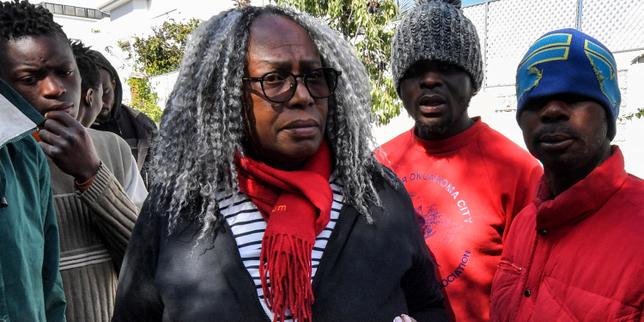
The international press is lazy. They see a black activist in a North African jail and they reflexively reach for the "antiracism" template. They frame the eight-year sentence handed to Saadia Mosbah—the face of the Mnemty association—as a simple story of racial persecution. They are missing the forest for a single, albeit significant, tree.
Mosbah was not just silenced because she advocated for the rights of black Tunisians or sub-Saharan migrants. She was dismantled because she occupied the last remaining inch of independent civic space in a country that is systematically cauterizing its own lungs. If you think this is only about skin color, you are falling for the regime’s distraction. This is about the criminalization of the very concept of an "association."
The Financial Laundering Trap: A Feature Not A Bug
The court in Tunis didn't convict Mosbah on charges of "being a nuisance." They used the 2015 anti-terrorism and money laundering laws. This is the new playbook for autocracy in the Mediterranean. By accusing Mnemty of "financial irregularities" and receiving "foreign funding," the state shifts the conversation from human rights to national security.
I have seen this happen from Cairo to Istanbul. When a government wants to liquidate an opponent without making them a martyr for a specific cause, they attack their spreadsheet. They make the activist look like a shady accountant or a foreign asset.
The "lazy consensus" suggests that Mosbah is a victim of a sudden surge in Tunisian xenophobia. Nonsense. Xenophobia has been the baseline. The change is the legal machinery being used to equate civil society work with treason. When the state controls the banks and the narrative, every Euro or Dollar sent by an international NGO to fund a workshop becomes a "suspicious transaction" in the eyes of a judge who knows exactly which way the wind is blowing.
The Myth of the Tunisian Exception is Dead
For a decade, Western pundits touted Tunisia as the "sole success story" of the Arab Spring. It was a comfortable lie. We watched the slow-motion car crash of the 1959-style strongman politics returning under the guise of "rectifying the path."
The sentencing of Mosbah—and the simultaneous arrests of lawyers like Sonia Dahmani and other activists—proves that the "exception" was just a pause. The state is currently obsessed with "purity." It wants a pure national identity, a pure political landscape, and a pure economy untainted by "external influence." In this environment, an activist who points out the cracks in that purity isn't just a critic; they are a contaminant.
The Migrant Crisis as a Political Shield
Let’s be brutally honest about the sub-Saharan migrant situation in Tunisia. The regime isn't just reacting to public anger; it is curating it. By turning the spotlight on "illegal settlement" and "conspiracies to change the demographic makeup of Tunisia," the leadership creates a perfect enemy.
- The Distraction: If the bakeries have no bread and the taps have no water, blame the "invisible hands" and the "foreign-funded" activists who support the migrants.
- The Leverage: This rhetoric serves as a terrifyingly effective bargaining chip with the European Union. Italy’s Giorgia Meloni isn't going to lose sleep over Saadia Mosbah's eight-year sentence as long as the Tunisian National Guard keeps the boats from hitting the shores of Lampedusa.
The nuance the competitor pieces miss is the Transactional Autocracy. The Tunisian state is trading the human rights of its own citizens and residents for European silence and "border management" funds. Mosbah is the collateral damage of a high-stakes geopolitical shakedown.
Why the "Foreign Funding" Argument is a Logic Trap
The prosecution’s heavy focus on Mnemty’s funding is designed to trigger a nationalist reflex. "Why do they need foreign money?" the trolls ask on Facebook.
Here is the reality of the NGO sector in a developing economy: There is no local billionaire class interested in funding antiracism. There is no domestic philanthropic infrastructure for civil rights. If you don't take international grants, you don't exist. The state knows this. By banning or criminalizing foreign funding, they aren't "protecting sovereignty"; they are ensuring a monopoly on organized social action.
If you are an activist in Tunis today, you have two choices:
- Become a state cheerleader.
- Become a "financial criminal."
The Erasure of History
Saadia Mosbah’s work was essential because Tunisia likes to pretend its history with slavery and racial hierarchy ended with a decree in 1846. It didn't. By sentencing her to nearly a decade in prison, the state is attempting to re-bury that history. They want a sterilized version of Tunisia where everyone is "equally Tunisian" under the Great Leader, ignoring the systemic reality that Mosbah spent her life documenting.
This isn't just about a trial. This is a lobotomy of the national conscience.
Stop Asking for "Reform"
People keep asking how the Tunisian justice system can be "reformed." That is the wrong question. The system isn't broken; it is working exactly as intended. It is a precision tool for the consolidation of power.
You don't "reform" a guillotine. You stop feeding it.
The international community’s "deep concern" is a joke. Unless there is a fundamental shift in how the EU and US condition their security assistance, these sentences will only get longer and the charges more absurd. We are witnessing the birth of a New Dark Age for North African civil society, and we are paying for the electricity to keep the lights on in the interrogation rooms.
Mosbah’s eight years are a message to every lawyer, every journalist, and every student in Tunis: Your bank account is a weapon we can use against you. Your associations are liabilities. Your silence is the only thing we will accept as currency.
Tunisia isn't just arresting activists; it is deleting its own future.
Check your own registers. If you think your "advocacy" is safe because you have a clean balance sheet, you haven't been paying attention to how the desert wind is shifting.
Don't look for a silver lining. There isn't one.