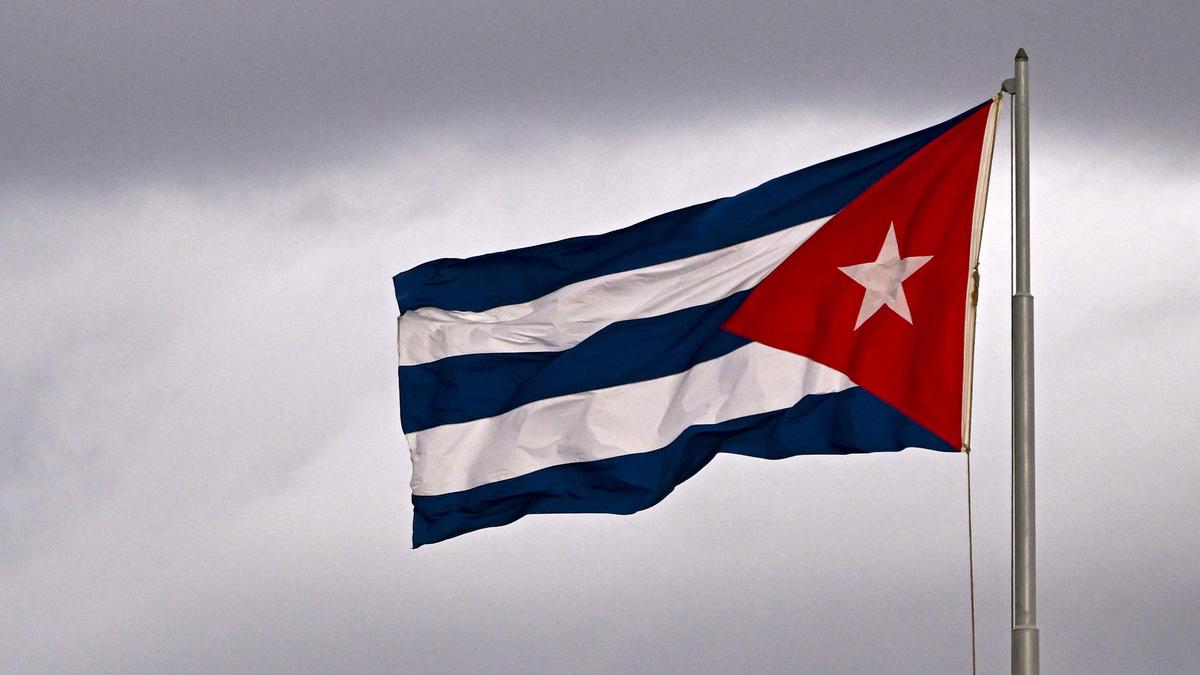
The humidity in Key West doesn't just sit on your skin; it anchors itself to your bones. On a Tuesday afternoon at the edge of Roosevelt Boulevard, the Atlantic looks like a sheet of hammered turquoise, deceptively still. For decades, this specific stretch of water—the ninety miles separating the southernmost tip of the United States from the craggy shores of Havana—has been more than a geographic gap. It is a psychological fault line.
Whenever the political barometer shifts in Washington or the streets of Cuba swell with the desperate energy of protesters, a familiar ghost begins to haunt the saltwater air. It is the ghost of 1961. The ghost of 1994. The persistent, low-frequency hum of a question that has defined generations of families on both sides of the Florida Straits: Are the ships coming?
Recently, that hum turned into a roar of digital rumors. Social media feeds began to churn with whispered "intel" about troop movements and tactical preparations. In the digital age, a single grainy video of a transport truck on a Florida highway can be spun into a herald of war. But the reality, delivered recently by the senior military leadership at the Pentagon, is far quieter.
There is no invasion. There is no fleet gathering in the shadows of the mangroves. The U.S. military is not preparing to cross that turquoise sheet.
The Architecture of a Rumor
Consider a man we will call Elias. He sits at a domino table in Little Havana, Miami, his fingers stained with the tobacco of a life spent remembering a home he hasn't seen in forty years. For Elias, news of "military preparation" isn't a headline; it’s a heartbeat. It’s the hope of a return or the terror of a bloodbath. When a senior U.S. General stands before a microphone to say the military is not looking for a fight, he isn't just delivering a policy update. He is attempting to de-escalate the heartbeat of a million people like Elias.
The General’s words were precise, stripped of the bravado that usually colors cinematic depictions of the Joint Chiefs. The message was clear: there are no plans, no orders, and no appetite for an amphibious assault on Cuban soil.
Why do we find this so hard to believe?
We live in an era where we expect the worst to be true because the "worst" is what gets shared. The vacuum of information is quickly filled by the oxygen of anxiety. When the Pentagon clarifies that they are monitoring the situation—referring to the internal instability and economic collapse currently gripping the island—they are performing a delicate surgical procedure. They are trying to keep the peace without appearing indifferent to the suffering.
The Logistics of Restraint
War is loud. Preparation for war is even louder.
If the United States were truly preparing to move on Cuba, the signs wouldn't be hidden in "secret" folders. They would be visible from space. They would be felt in the supply chains of every town from Jacksonville to Florida City. An invasion requires a massive redirection of calories, fuel, and human souls. You would see the "Prepo" ships—the massive floating warehouses of the Military Sealift Command—moving into position. You would see the surge in hospital readiness. You would hear the relentless thud of rotors at Homestead Air Reserve Base.
None of that is happening.
Instead, the military’s stance is one of "strategic posture." This is a sterile term for a very human reality: they are watching. They are waiting. They are prepared to handle a humanitarian crisis—a mass migration event where thousands of people take to the sea in rafts made of inner tubes and desperation—but they are not prepared to fire the first shot.
This distinction matters because of the "invisible stakes." Every time a false rumor of invasion gains traction, it provides a propaganda gift to the regime in Havana. It allows the leadership there to point across the water and say, "See? The Goliath is at the door. Cling to us, or be crushed." By explicitly denying invasion plans, the U.S. military isn't just being honest about its schedule; it is stripping away a shield used by those they are supposedly opposing.
The Weight of the Ninety Miles
To understand why the General’s denial is so significant, you have to understand the trauma of the Straits. This isn't a map in a war room; it’s a graveyard.
I once spoke with a woman who crossed in the mid-nineties. She described the water at night as "living ink." She told me that the most terrifying sound wasn't the waves or the wind, but the silence of the horizon. When you are in the middle of that stretch, you realize how small the world’s most powerful militaries actually are compared to the indifference of the ocean.
The U.S. General’s statement is a commitment to that silence.
It is an admission that the solution to the "Cuba problem" is not found in the belly of a C-130 or the deck of an Arleigh Burke-class destroyer. The military knows what many armchair pundits forget: you can’t bayonet an ideology, and you can’t stabilize a collapsing economy with a blockade.
The Mirror of Modern Warfare
Our fascination with a potential conflict in Cuba is often a distraction from the reality of how modern power is actually exercised. We want the drama of the 1962 Missile Crisis because it had a clear beginning, middle, and end. It had heroes in suits and villains in fatigues.
Today’s reality is much more grueling. It is a war of attrition played out in rolling blackouts in Havana and inflation rates that make a loaf of bread cost a week’s wages. The U.S. military’s refusal to engage isn't a sign of weakness; it’s a recognition of the limits of kinetic force.
When the General says "we are not preparing," he is also saying "we are not the main characters in this story." The main characters are the people standing in line for milk in Matanzas. The main characters are the protesters who took to the streets on July 11, 2021, risking everything for the "invisible stakes" of dignity and bread.
The military's job, in this context, is to be the guardrail, not the driver. They are there to ensure that if the island does reach a breaking point, the resulting chaos doesn't spill over into a regional conflagration. They are preparing for "contingencies"—a polite word for the worst-case scenarios of human flight—but they are staying on their side of the line.
The Ghost in the Machine
We must also confront our own hunger for the narrative. Why do we keep clicking on the articles that suggest a secret war is brewing?
Perhaps it’s because a physical invasion is easier to wrap our heads around than the slow, agonizing decay of a neighbor. A war has an objective. Decay just has victims. By focusing on the "will they or won't they" of military intervention, we avoid looking at the much harder truth: that there is no easy way out for the eleven million people living ninety miles away.
The General’s briefing was a splash of cold water. It was an invitation to look at the facts as they are, not as our anxieties imagine them to be.
- Fact: There is no surge in "Notice to Mariners" that would indicate a naval blockade.
- Fact: Tactical aviation units in the Southeast remain on their standard training cycles.
- Fact: The rhetoric coming from Southcom (U.S. Southern Command) remains focused on counter-narcotics and disaster relief, not regime change.
The Last Light on the Horizon
If you drive all the way down to the end of the Florida Keys, past the kitsch and the tourists, you eventually reach a concrete buoy that marks the "90 Miles to Cuba." People line up to take selfies there. They smile and throw peace signs, standing on the edge of a geopolitical abyss they rarely think about.
But if you turn away from the buoy and look out at the water, you see the truth that the military already knows.
The water is empty.
There are no landing craft. There are no destroyers on the prowl. There is only the rhythmic, eternal pulse of the tide. The U.S. military is holding its breath, hoping—like the rest of us—that the future of Cuba is written by the hands of its own people, rather than the steel of an outside force.
The silence from the Pentagon isn't a cover-up. It is a heavy, deliberate choice. It is the sound of a superpower deciding that, for once, the most powerful thing it can do is nothing at all.
The sun sets behind the Seven Mile Bridge, casting long, skeletal shadows over the water. The rumors will likely start again tomorrow, fueled by a tweet or a misinterpreted flight path. But for tonight, the only thing crossing the Straits is the wind, carrying the salt and the heat and the quiet, desperate prayers of a million people waiting for a change that won't come from a gun.