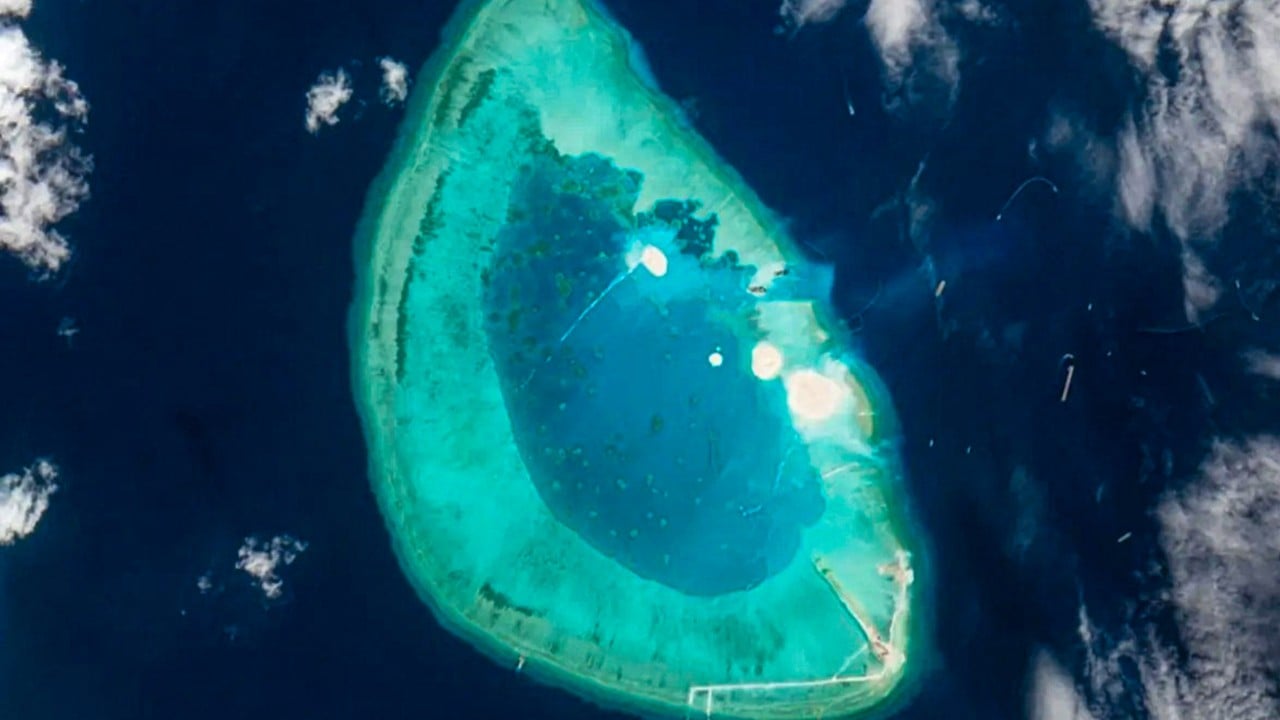
The expansion of Chinese infrastructure at Antelope Reef in the Paracel Islands represents a shift from symbolic presence to a permanent, functional logistics node in the South China Sea. While traditional analysis focuses on the diplomatic fallout and the predictable protests from Hanoi, the strategic reality is dictated by the creation of a persistent operational envelope. China’s "island-building" is not merely a territorial claim; it is the deployment of a distributed sensor and logistics network designed to compress the reaction time of rival claimants and external actors.
The Triad of Permanent Presence
The development at Antelope Reef functions through three distinct mechanisms that alter the regional security equilibrium.
Hydrological Dominance and Land Reclamation
By converting semi-submerged features into permanent outposts, the People’s Liberation Army (PLA) effectively extends its baseline for territorial waters and Exclusive Economic Zones (EEZ). This is not about the acreage of the sand itself but the legal and physical denial of access to the surrounding seabed. The engineering process involves massive dredging that destroys local ecosystems to create stable foundations for runways, hangars, and radar arrays.Sensor Density and Data Fusion
Antelope Reef serves as a "plug" in a larger maritime surveillance grid. Every new installation increases the resolution of China’s "Blue Ocean Information Network." This network integrates satellite imagery, subsea acoustic sensors, and land-based high-frequency (HF) radar. The goal is total domain awareness, ensuring that no vessel—commercial or military—moves through the Paracels without being tracked in real-time.Logistical Persistence
The Achilles' heel of maritime power is the "tyranny of distance." By establishing fuel depots, repair facilities, and desalination plants on features like Antelope Reef, China eliminates the need for its Coast Guard (CCG) and Maritime Militia to return to Hainan Island for resupply. This allows for a "rolling presence" where hulls are constantly on-station, exhausting the smaller, less-resourced Vietnamese and Philippine fleets through sheer attrition.
The Cost Function of Vietnamese Resistance
Vietnam's response is governed by a complex cost-benefit analysis. Hanoi must balance its economic dependence on China with the necessity of defending its sovereign claims and "blue economy" (fishing and offshore oil/gas).
Diplomatic Depreciation
Hanoi’s formal protests are increasingly viewed as a depreciating asset. In international relations, a protest that is not backed by a credible threat of escalation or a shift in trade policy loses its signal strength. China has calculated that the diplomatic cost of occupying Antelope Reef is lower than the strategic benefit of completing the "Great Wall of Sand."
The Asymmetric Resource Gap
Vietnam’s maritime strategy relies on "active defense," using a mix of Kilo-class submarines and Gepard-class frigates. However, the maintenance cycles and operational costs of these platforms are significantly higher than the low-tech, high-durability vessels China uses for reef occupation.
- Fuel Consumption: Chinese vessels stationed at nearby Woody Island or the newly developed Antelope Reef have a 70% shorter transit time to contested zones.
- Personnel Fatigue: China rotates crews through hardened island structures, whereas Vietnamese crews must remain at sea or return to distant mainland ports, leading to faster operational degradation.
Technical Specifications of the Escalation
The hardware being deployed at Antelope Reef is not incidental; it is specifically chosen to counter Western and regional intervention capabilities.
Electronic Warfare (EW) and Signal Intelligence (SIGINT)
The installation of large-scale radomes suggests a focus on SIGINT. These arrays are capable of intercepting encrypted communications from passing carrier strike groups and neutralizing the GPS guidance systems of precision-guided munitions. This creates an "A2/AD" (Anti-Access/Area Denial) bubble that extends hundreds of miles from the reef.
The Maritime Militia as a Kinetic Buffer
The use of "fishing vessels" that are actually state-funded paramilitary units provides China with a layer of plausible deniability. These ships are built with reinforced hulls for ramming and high-pressure water cannons. By flooding the area around Antelope Reef with these "civilian" assets, China forces Vietnam into a dilemma: ignore the encroachment or fire the first shot against "fishermen," which would trigger a massive, "justified" PLA response.
Structural Bottlenecks in International Law
The 2016 Permanent Court of Arbitration (PCA) ruling at The Hague theoretically invalidated many of China’s claims, yet the lack of an enforcement mechanism has rendered the ruling a static legal document rather than a dynamic tool for deterrence.
The "Feature" Definition Loophole
International law distinguishes between "islands" (which generate an EEZ) and "rocks" or "low-tide elevations" (which do not). By physically transforming a low-tide elevation into a permanent island, China attempts to force a fait accompli where the geography now matches the desired legal status, regardless of the historical baseline.The Bilateralism Trap
China consistently refuses to negotiate through multilateral bodies like ASEAN, preferring bilateral talks where its economic weight can be used to isolate individual members. By building at Antelope Reef, China demonstrates to other ASEAN members that the "Code of Conduct" (CoC) negotiations are effectively secondary to physical reality.
Supply Chain Implications and Global Trade
While often framed as a local territorial dispute, the Paracel escalation threatens the stability of a trade artery that carries over $3 trillion in annual commerce.
- Insurance Premiums: As the region becomes more militarized, the "war risk" premiums for commercial shipping are likely to rise. This creates a hidden tax on global trade moving through the Malacca Strait toward Northeast Asia.
- Resource Extraction Stalling: The presence of Chinese military hardware at Antelope Reef makes it nearly impossible for Vietnam to attract foreign investment for its "Red Orchid" gas fields. International energy firms are hesitant to deploy multi-billion dollar platforms in zones where Chinese warships are permanently stationed within visual range.
The Strategic Pivot: Integrated Deterrence
To counter the expansion at Antelope Reef, a shift from reactive protests to "Integrated Deterrence" is required. This does not mean a direct kinetic confrontation, but rather the systematic raising of the costs associated with China's expansion.
Transparency Operations
Utilizing commercial SAR (Synthetic Aperture Radar) satellite constellations to provide unclassified, real-time tracking of construction activity. By making the escalation "public and permanent," the international community can apply targeted sanctions against the state-owned enterprises (SOEs) responsible for the dredging and construction.Distributed Lethality
Regional actors must shift away from large, expensive surface combatants that are easily tracked and targeted by the Antelope Reef sensors. The focus should be on small, unmanned surface vessels (USVs) and mobile, land-based anti-ship missile batteries located on the Vietnamese coast.Economic Decoupling in Critical Sectors
The leverage China holds over Hanoi is primarily economic. Reducing this dependency through "friend-shoring" trade with the Quad (US, Japan, India, Australia) is the only long-term method to give Vietnam the "strategic space" to ignore Chinese coercion.
The construction at Antelope Reef is the latest iteration of a "salami-slicing" strategy designed to win without fighting. By the time a formal legal or military response is coordinated, the concrete is dry, the radars are active, and the map has been permanently rewritten. The only remaining variable is whether rival claimants will continue to rely on the rhetoric of "protest" or begin the far more difficult task of structural and economic realignment to negate the utility of these artificial outposts.
The final strategic play for Vietnam and its partners is the deployment of a persistent "Grey Zone" monitoring fleet. This fleet, consisting of high-endurance autonomous drones, must provide a 24/7 live-streamed verification of Chinese activities. This removes the shroud of "construction for civilian safety" and forces the global supply chain to acknowledge the militarization of its primary transit routes, eventually triggering the maritime insurance hikes and redirected shipping lanes that China’s economy—still dependent on export stability—cannot afford.