History is not a collection of dates in a textbook. It is a living, breathing weight that sits in the room during every high-stakes negotiation and every polite dinner between world leaders. Sometimes, that weight is so heavy it threatens to crack the floorboards. Other times, it is a phantom that someone accidentally summons with a single, careless sentence.
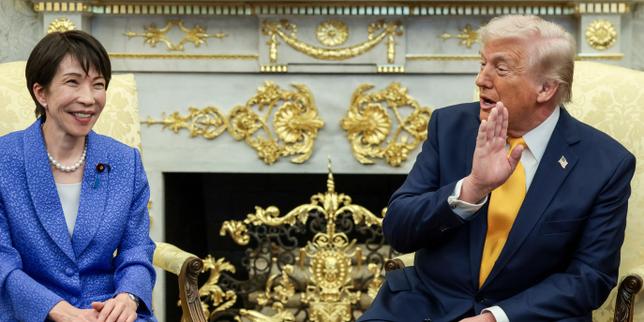
When Donald Trump looked across at Shinzo Abe, the then-Prime Minister of Japan, he wasn't just looking at a political ally. He was looking at the representative of a nation that had once been the ultimate antagonist in the American story. For Trump, a man whose worldview was forged in the neon-lit, zero-sum competition of 1980s New York real estate, history was a scoreboard. And on that scoreboard, one name stood out in jagged, permanent ink: Pearl Harbor.
Imagine the setting. The air is thick with the practiced grace of international diplomacy. There are linens, expensive water, and the quiet hum of translators working in hushed tones. This is the world of the "Gilded Cage," where every word is weighed by a dozen advisors before it is uttered. But Trump never liked cages. He preferred the raw, the unscripted, and the blunt.
During a briefing, or perhaps over a meal—the accounts vary, but the sting remains the same—Trump reportedly turned to Abe and dropped a rhetorical anchor into the middle of the conversation. He mentioned that he remembered Pearl Harbor. He didn't say it as a historian. He said it as a reminder.
Silence.
In the world of Japanese diplomacy, silence is an art form. It is a protective layer. But this silence was different. It was the sound of a bridge being strained. For the Japanese delegation, the remark wasn't just an observation. It was a breach of the unspoken contract that had defined the post-war era: the agreement that we move forward together, eyes on the future, while keeping the ghosts of the 1940s locked in their shrines.
The Weight of the Ancestors
To understand why a simple mention of a 1941 attack could freeze a 21st-century room, you have to look past the policy papers. You have to look at the concept of "face." In Japan, history is an inheritance of honor and shame. Shinzo Abe was the grandson of Nobusuke Kishi, a man who had been imprisoned as a suspected war criminal before rising to become Prime Minister himself. For Abe, the relationship with America wasn't just about trade deficits or military bases. It was about the long, painful process of redemption.
Abe had spent years cultivating Trump. He was the first foreign leader to rush to Trump Tower after the 2016 election, carrying a gold-plated driver as a peace offering. He understood that with this American president, the personal was the political. He played the "golf diplomacy" game with a stoic dedication, enduring long hours on the green to ensure that Japan remained America’s most vital partner in the Pacific.
Then came the remark.
It was a reminder that no matter how many golf games were played, or how many billions of dollars in trade were negotiated, the "Greatest Generation" narrative of the mid-century still dictated the emotional pulse of the American presidency. To Trump, Pearl Harbor was the ultimate "bad deal" Japan had forced upon America. To Abe, it was the tragedy they had spent seventy years trying to transcend.
The friction here wasn't about the facts of December 7th. It was about the utility of trauma. Trump used history as a lever. He wanted to remind his counterpart that Japan was, in his eyes, forever indebted to the American security umbrella. He was using the ghost of the past to squeeze a better deal in the present.
The Invisible Stakes of Memory
We often think of diplomacy as a chess match played with cold, wooden pieces. It isn't. It’s a psychodrama. Every leader brings their nation’s collective trauma to the table. When an American president invokes the "day of infamy," they aren't just citing a historical event; they are re-opening a wound to see if it still bleeds.
Consider the perspective of a hypothetical career diplomat in the Japanese Ministry of Foreign Affairs. Let’s call him Sato. Sato has spent thirty years perfecting the nuance of the U.S.-Japan alliance. He knows the exact percentage of soy imported from Iowa and the precise range of every missile stationed in Okinawa. He believes in the stability of the system.
When he hears that the President of the United States has brought up Pearl Harbor in a casual, almost accusatory tone, Sato’s world tilts. It signals that the rules have changed. The alliance is no longer based on shared democratic values or mutual economic interests. It has reverted to a more primal state: a relationship between the victor and the vanquished.
This is the hidden cost of "unfiltered" diplomacy. It erodes the trust that takes decades to build. When you remind a friend of their grandfather’s sins to get a better price on steel, you might win the afternoon, but you lose the decade.
The Ghost in the Room
The irony is that both men were trapped by their own versions of the past. Trump was obsessed with the idea that America was being "laughed at" or "taken advantage of," a sentiment rooted in the economic rise of Japan in the late 20th century. Abe was obsessed with making Japan a "normal country" again, one that could stand tall without the constant shadow of the war darkening its doorstep.
They were two men trying to escape history by leaning into it.
The embarrassment felt by the Japanese side wasn't just about the awkwardness of the moment. It was a profound realization that the "special relationship" was more fragile than they had hoped. It was the realization that in the highest levels of power, logic is often a passenger, and ego is the driver.
We like to believe that our leaders are guided by complex algorithms and strategic brilliance. The reality is far more human. They are guided by the stories they tell themselves about who they are and where they came from. If a president sees himself as the hero of a comeback story, he needs a villain. If he can’t find one in the present, he will dig one up from the soil of the past.
The Pearl Harbor remark was a tectonic shift felt in whispers. It didn't start a war. It didn't break an alliance. But it changed the temperature. It reminded everyone that the peace we enjoy is not a natural state of being. It is a carefully maintained garden, and it only takes one person walking through it with a heavy pair of boots to crush the most delicate flowers.
History doesn't repeat, but it does echo. And sometimes, those echoes are loud enough to drown out the most sophisticated negotiations.
In that room, as the words hung in the air, the two leaders weren't just representatives of modern nations. They were the ghosts of 1941, 1985, and 2016 all colliding at once. The steak on the plate was cold. The air in the room was thin. And the distance between Washington and Tokyo had never felt quite so vast.
Would you like me to analyze how other historical flashpoints have been used as leverage in modern diplomatic negotiations?