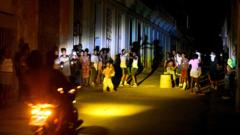
Cuba’s lights went out again on Saturday night. If you’re keeping count, that’s the second total grid collapse in a week and the third this month. Ten million people are sitting in the dark, and frankly, the "unexpected failure" tag the Ministry of Energy and Mines is using feels like a bad joke at this point. When a system is this broken, every failure is expected.
This isn't just a technical glitch or a blown fuse. It’s a systemic rot hitting a dead end. I’ve watched this play out for years, but 2026 has brought a specific kind of misery to Havana and the provinces. The Antonio Guiteras plant—the island’s biggest power-generating workhorse—is basically held together by spit and prayer. When it tripped on Saturday, it took the whole country down with it.
The anatomy of a total disconnection
When the Ministry says "total disconnection," they mean the National Electric System (SEN) simply gave up. Think of the grid like a massive, rusted bicycle chain. If one link snaps under pressure, you aren't just slowing down; the whole thing flies off the gears.
The immediate trigger was a failure at the Nuevitas plant in Camagüey, which caused a "cascading effect." But that’s the "how," not the "why." The "why" is that Cuba hasn't seen a drop of imported oil from its usual suppliers in months. Since January 2026, imports have basically flatlined. When you have zero fuel in the tanks, your aging Soviet-era plants have to run on heavy, sulfur-rich domestic crude.
That domestic oil is basically "grid poison." It’s so thick and corrosive that it eats the boiler walls from the inside out. Experts like Jorge Piñón from the University of Texas have been warning about this for years. You can’t run a 40-year-old plant on "dirty" oil and expect it to survive. Corrosion leads to leaks, leaks lead to emergency shutdowns, and shutdowns lead to ten million people wondering if their food is rotting in the fridge.
Why the lights aren't coming back on soon
You might hear the government talking about "micro-islands" or "distributed generation." Sounds fancy, right? In reality, it means they're firing up small, diesel-powered groups to keep hospitals and water pumps running while the rest of the country stays black.
The math just doesn't work anymore.
- Capacity: Cuba needs about 3,000 MW to function.
- Reality: On a good day lately, they’re lucky to hit 2,000 MW.
- Crisis mode: When Guiteras or Nuevitas goes down, that gap becomes a canyon.
It's not just the plants. The "oil blockade" is the elephant in the room. Since the U.S. intervention in Venezuela earlier this year, the subsidized oil that kept Cuba breathing has vanished. No oil from Venezuela, no shipments from Mexico—who stopped after being threatened with U.S. tariffs—and only a couple of small tankers from Russia that may or may not actually show up.
The human cost of a 40-hour blackout
If you live in Havana, you might get 12 to 15 hours of power a day if you're lucky. If you're in the interior, in places like Holguín or Santiago de Cuba, you’re looking at 40-hour stretches without a single watt.
People are tired. I'm seeing reports of "cacerolazos"—protests where people bang pots and pans in the dark. Last weekend, a Communist Party office was vandalized. It’s not just about the lights; it’s about the fact that 84% of Cuba’s water pumps need electricity. No power means no water. No power means no refrigeration for the meager food supplies people have. It’s a humanitarian disaster masquerading as an infrastructure problem.
What's actually happening behind the scenes
There’s a lot of political theater happening right now. President Miguel Díaz-Canel is talking about "impregnable resistance," while President Trump is making noise about "taking" the island. But look past the headlines and you'll see a government that's desperate.
They’ve started releasing political prisoners—51 so far this month—as a "goodwill gesture" to get the U.S. to talk. They’re even allowing more investment from the Cuban diaspora in Miami, something that would have been unthinkable five years ago. They know the grid is the regime's biggest threat. If they can't keep the lights on, they can't keep the people quiet.
Is solar the answer
The government is betting big on solar. They’ve got a plan for 92 solar parks by 2028. China is shipping over panels by the boatload, and some estimates say solar already provides about 10% of the island's power. It’s a good long-term move, but panels don’t help at 9 PM when the grid collapses and you need to cook dinner.
Until the fuel problem is solved, these nationwide blackouts are the new normal. The grid is too brittle to handle the "dirty" fuel it’s being forced to swallow, and there’s no money in the treasury to buy the "clean" stuff.
Practical steps for those following the crisis
If you're watching this from the outside or have family on the island, here is the ground reality you need to know:
- Don't rely on official timelines. When the Ministry says power will be restored in 24 hours, double it. The "cascading failures" often happen during the restoration process itself because the grid is too unstable to handle the sudden load.
- Focus on water. The lack of electricity is a water crisis first. Aid efforts are shifting toward solar-powered pumps and water purification tabs because the central system is no longer reliable.
- Watch the tankers. Keep an eye on maritime trackers for the Vilma or other Russian-flagged vessels. If those ships don't dock in Matanzas or Havana soon, the "zero hour" where the grid stays down indefinitely is a real possibility.
The situation is volatile. We’re seeing a nation's infrastructure dissolve in real-time while two governments play a high-stakes game of chicken. Honestly, the resilience of the Cuban people is the only thing keeping the country from a total societal breakdown right now. Stay tuned to independent trackers—the official state media is only giving you half the story.