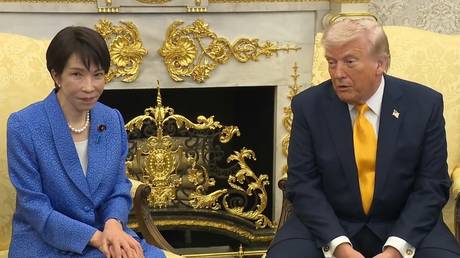
The gold-leafed ceilings of Mar-a-Lago have seen their share of deals, but they have rarely felt a chill quite like the one that settled over a private dinner between Donald Trump and Shinzo Abe. Imagine the clink of fine crystal against a backdrop of Florida humidity. The air is thick with the scent of expensive steak and the even heavier weight of global security.
Across the table sat the Prime Minister of Japan, a man whose entire political career was a masterclass in the delicate art of the "Trump Whisperer." Abe had been the first world leader to rush to Trump Tower after the 2016 election, carrying a gold-plated golf driver as a peace offering. He understood the theater of power. He knew that with Donald Trump, the personal was always political, and the political was always a transaction. For a deeper dive into similar topics, we recommend: this related article.
Then came the remark.
It wasn't a policy shift delivered via a white paper. It wasn't a briefed diplomatic maneuver. It was a blunt-force reminder of a wound that had supposedly healed decades ago. Trump leaned in and brought up Pearl Harbor. For broader information on this topic, comprehensive reporting is available at Reuters.
To the American president, it was a rhetorical gambit, a way to level the playing field in a discussion about trade deficits and military spending. To the Japanese Prime Minister, it was as if the ghost of 1941 had suddenly walked through the gilded doors to take a seat at the table.
The Currency of Memory
History is rarely dead in diplomacy; it is merely equity. When Trump reminded Abe of the "surprise" at Pearl Harbor, he wasn't just talking about a date which will live in infamy. He was using a historical trauma as a bargaining chip.
Consider the leverage. For seventy years, the relationship between Washington and Tokyo had been defined by a very specific set of rules. The U.S. provided the nuclear umbrella and the boots on the ground; Japan provided the strategic ports and a massive checkbook to help maintain them. It was a symbiotic, if lopsided, peace.
By invoking the 1941 attack, Trump was effectively ripping up the script of the "Greatest Alliance in History." He was signaling that the old debts weren't paid. He was suggesting that the security Japan enjoyed wasn't a mutual necessity, but a favor—one that could be revoked if the trade numbers didn't start looking better for the red, white, and blue.
The shock on the Japanese side wasn't just about the bluntness. It was the realization that the postwar order was no longer a sacred text. It was a ledger. And the ledger was being audited by a man who saw "alliances" as overhead costs.
The Invisible Stakes of a Tense Dinner
To understand why this mattered, we have to look past the headlines of "Trump says something wild." We have to look at the silent calculations happening in the minds of the bureaucrats in the Gaimusho—Japan’s Foreign Ministry.
If the President of the United States can weaponize Pearl Harbor during a friendly dinner, what else is on the table?
For a Japanese leader, the nightmare scenario isn't just a trade war. It’s the "Japan Passing" phenomenon—the fear that Washington might strike a deal with Beijing or Pyongyang over Tokyo’s head. When the rhetoric turns to 1941, it suggests that the trust required for a nuclear shield is built on shifting sand.
Abe’s response in these moments was always a practiced, stoic calm. He was a man who had staked his legacy on proving that Japan was a "normal country" again, one that could lead in the Indo-Pacific. But in that moment in Florida, he was reminded that in the eyes of his most important ally, Japan was still defined by the smoke over Oahu.
The Art of the Uncomfortable Truth
There is a gritty reality to why these remarks land so hard. We like to think of international relations as a series of logical moves on a chessboard. They aren't. They are human interactions driven by ego, grievance, and the need to "win" the room.
Trump’s approach was a radical departure from the "Strategic Patience" of the Obama years or the "Freedom Agenda" of the Bush era. It was a return to a raw, Jacksonian view of the world. In this worldview, there are no permanent friends, only permanent interests.
If Japan had a $60 billion trade surplus with the U.S., then the U.S. was "losing." If the U.S. was losing, then every historical grievance—from Pearl Harbor to the rise of the Japanese auto industry in the 80s—was fair game to bring the "winner" back down to size.
The discomfort in that room wasn't just about a breach of etiquette. It was the sound of the floorboards of the global order creaking under the weight of a new reality.
The Human Cost of Diplomacy by Surprise
Think about the hypothetical young diplomat in the Japanese embassy in D.C., waking up to the news of this remark. This isn't just a "gaffe" to them. It’s a week of lost sleep. It’s dozens of cables sent back to Tokyo trying to parse whether this means a change in the Status of Forces Agreement or just a bad mood after a long day of golf.
This is the hidden cost of "unpredictability." While it can keep enemies guessing, it can also leave friends exhausted.
Abe, to his credit, never blinked. He continued to play the long game, focusing on the "Free and Open Indo-Pacific" and keeping the U.S. engaged in the region. But the scar remained. The Pearl Harbor comment served as a reminder that the past is never actually past; it’s just waiting for someone to find a use for it.
The dinner ended. The steaks were cleared. The leaders smiled for the cameras, shaking hands in that awkward, long-lasting grip that became a Trump trademark.
But as the motorcade pulled away from the Mar-a-Lago gates, the silence in the back of the Prime Minister’s car must have been deafening. The world had changed. The old rules about what could and couldn't be said between allies had evaporated in the Florida heat.
History wasn't a foundation anymore. It was a weapon. And in the high-stakes game of global power, even the most gold-plated driver couldn't guarantee a smooth round when the ghosts of the past were being called out by name.
The lesson for every nation watching that night was clear. You can build a bridge for seventy years, stone by stone, treaty by treaty. But it only takes one sentence, delivered over a plate of well-done steak, to remind you just how deep the water still runs beneath it.
The light in the Mar-a-Lago windows eventually dimmed, but the echo of 1941 stayed in the room, a cold reminder that in the new era of diplomacy, nothing is sacred, and everything is for sale.