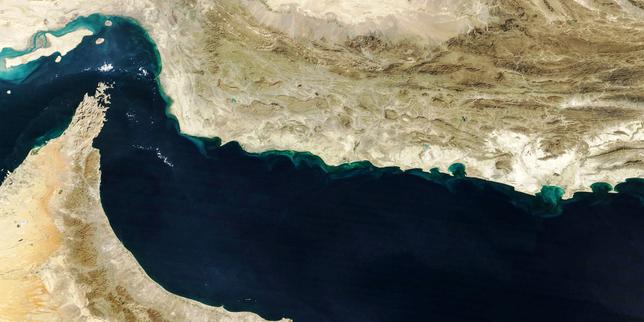
The global economy is currently tethered to a twenty-one-mile-wide strip of water that most consumers will never see, yet every one of them pays for at the pump and the grocery store. The Strait of Hormuz is not merely a geographic coordinate; it is the jugular vein of the fossil fuel world. When tensions rise between regional powers or a tanker is seized, the reaction in London and New York is instantaneous. We see the price of Brent crude spike before the first official press release even hits the wires. This isn't just about "disruption" in a vague sense. It is about the physical impossibility of rerouting 21 million barrels of oil per day—roughly one-fifth of global liquid petroleum consumption—through any viable alternative.
If the Strait closes, the world does not just get more expensive. It stops.
The Physical Reality of the Chokepoint
Geopolitics often feels abstract until you look at a nautical chart. The actual shipping lanes within the Strait of Hormuz are surprisingly narrow. While the strait itself is about 21 miles wide at its narrowest point, the Traffic Separation Scheme (TSS) used by massive tankers consists of two-mile-wide channels for inbound and outbound traffic, separated by a two-mile wide buffer zone.
These ships are the size of skyscrapers laid on their sides. They cannot maneuver quickly. They cannot "take a detour" if a minefield is reported or if a local navy decides to conduct "exercises" in the middle of the lane. This physical constraint gives the bordering nations, specifically Iran and Oman, an asymmetrical level of power over the global GDP.
Most industry analysis focuses on the total volume of oil, but that is a surface-level metric. The real story lies in the composition of the cargo. We are talking about massive quantities of Liquefied Natural Gas (LNG) primarily from Qatar, which provides the heating and industrial power for much of Europe and Asia. Unlike oil, which can be stored in strategic reserves for months, the global LNG supply chain is a "just-in-time" operation. A week-long blockage doesn't just raise prices; it leads to actual blackouts in sensitive markets.
The Myth of the Pipeline Bypass
For years, energy optimists have pointed to various pipelines across Saudi Arabia and the United Arab Emirates as the "safety valve" for a Hormuz crisis. This is a comforting thought that happens to be mathematically insufficient.
The Abu Dhabi Crude Oil Pipeline (ADCOP) and Saudi Arabia’s East-West Pipeline (Petroline) have a combined capacity that might handle roughly 6 to 7 million barrels per day if pushed to their absolute mechanical limits. That leaves a deficit of approximately 14 million barrels per day that simply cannot go anywhere else. You cannot put that volume on trucks. You cannot fly it out.
The infrastructure simply does not exist to bypass the water. Furthermore, these pipelines terminate at terminals like Fujairah or Yanbu. While these locations are outside the immediate mouth of the Persian Gulf, they remain well within the operational reach of modern drone and missile technology. Moving the exit point 200 miles down the coast provides a tactical advantage, but it does not provide strategic immunity. We have seen this play out in recent years with strikes on pumping stations and storage tanks. The bottleneck has been moved, not removed.
Insurance and the Invisible Wall
Market analysts often wait for physical blockages to signal a crisis. They are looking at the wrong indicator. The "invisible wall" is built by the Lloyd’s Market Association Joint War Committee.
Shipping is a business of margins. When the Strait of Hormuz is designated a high-risk area, insurance premiums for "War Risk" coverage do not just tick upward; they explode. In some historical instances of regional friction, these premiums have jumped tenfold in a single week.
A tanker owner faced with a $200,000 insurance surcharge for a single transit will pass that cost directly to the refiner, who passes it to the consumer. Even if not a single shot is fired, the mere threat of instability acts as a functional tax on the global economy. If insurance companies refuse to underwrite the hulls, the ships stop moving regardless of whether the water is physically clear. No captain is going to sail a $100 million vessel with $100 million of cargo into a zone where they aren't covered for a total loss.
The Shift Toward Asian Vulnerability
The traditional American obsession with the Strait of Hormuz is a relic of the 1970s and 80s. While the U.S. still maintains a massive naval presence in the region—the Fifth Fleet is headquartered in Bahrain for this exact reason—the actual flow of oil has shifted dramatically East.
Today, the vast majority of crude passing through the Strait is destined for China, India, Japan, and South Korea.
This creates a bizarre geopolitical tension. The United States provides the security and "policing" of a waterway that primarily feeds the economies of its chief economic rivals. This is a burden-sharing nightmare that has persisted for decades. If the Strait were to be blocked today, the immediate shock to the Chinese manufacturing sector would be far more devastating than the impact on the U.S., which has become a net exporter of energy thanks to shale production.
However, the global nature of oil pricing means that even if the U.S. doesn't "need" that specific Iranian or Kuwaiti barrel, the American consumer still pays the global price. We are protected from the supply shortage, but we are not protected from the price contagion.
The Tactical Nature of Modern Harassment
We need to move past the 20th-century vision of a "blockage" involving a sunken ship or a massive naval blockade. Modern disruption is much more subtle and difficult to counter.
It involves "grey zone" tactics:
- Limpet mines attached to hulls under the cover of darkness.
- GPS spoofing that leads merchant vessels into territorial waters where they can be legally seized.
- Drone swarms launched from unmarked coastal sites.
These methods allow a regional actor to exert pressure while maintaining a degree of plausible deniability. It puts the defending naval forces in a bind. Do you fire on a small fast-attack craft that might just be "patrolling"? If you do, you escalate the conflict. If you don't, you risk the safety of the merchant fleet. This constant state of low-level friction is the new normal. It is an intentional strategy designed to keep the "War Risk" premiums high and the global markets on edge without ever crossing the threshold into an all-out war that would be suicidal for the perpetrator.
The Liquidity Trap
Financial markets often treat oil like a digital asset, but the Strait of Hormuz reminds us that it is a physical commodity. When the physical flow is restricted, "paper oil" (futures and derivatives) becomes incredibly volatile.
In a true Hormuz shutdown, we would likely see a total breakdown in the relationship between the price of oil on the screen and the price of oil at the dock. This is known as a decoupling. Those who hold physical supplies in tanks outside the Gulf would suddenly possess the most valuable currency on earth.
We must also consider the role of the "shadow fleet." A significant amount of oil already moves through the region on aging, under-insured tankers that operate outside traditional regulatory frameworks. These vessels are more prone to mechanical failure and environmental disasters. A single major oil spill in the narrow shipping lanes—whether accidental or intentional—would create a biological blockade that would be just as effective as a naval one. Cleaning up a massive spill in a high-tension zone is a diplomatic and logistical impossibility.
The End of Cheap Security
The era of taking the Strait of Hormuz for granted is over. The "Hormuz Dilemma" cannot be solved by building more pipelines or adding more carrier strike groups. It is a fundamental flaw in the design of our global energy architecture.
As long as the world’s industrial base relies on a concentrated source of energy that must pass through a singular, narrow geographic point, stability is an illusion. We are one tactical miscalculation away from a global recession that no central bank has the tools to fight. The cost of maintaining this fragile status quo is rising, not just in military spending, but in the permanent "risk premium" baked into the cost of modern life.
The next time you look at a map of the Persian Gulf, stop looking at the land. Look at that tiny gap of blue water between the mountains of Iran and the cliffs of Oman. Everything you buy, everything you eat, and the very stability of your retirement fund is currently floating through that gap on the deck of a vulnerable, slow-moving ship.
Contact your energy risk desk and ask for their Tier 3 contingency plan for a thirty-day Hormuz outage. If they don't have one, they aren't paying attention.